

You cannot edit an ACRA filing after it has been lodged. What you can do is file a Notice of Error, which asks the Registrar to correct the record and tags the correction to the original transaction. It costs $60 for most errors and $200 for revised financial statements.
Raffles Corporate Services works with a panel of experienced Singapore law firms who offer cost-effective and efficient legal service and advice. This article is general information only and is not legal advice.
The register is a public record, and people rely on it. That is why correction is an application rather than an edit. It is also why the fee is charged whether or not ACRA agrees with you, and whether or not you later withdraw.
None of that should put you off. An NOE is a routine piece of housekeeping. It just rewards being deliberate about which route you use and what you attach.
Which route fixes which error
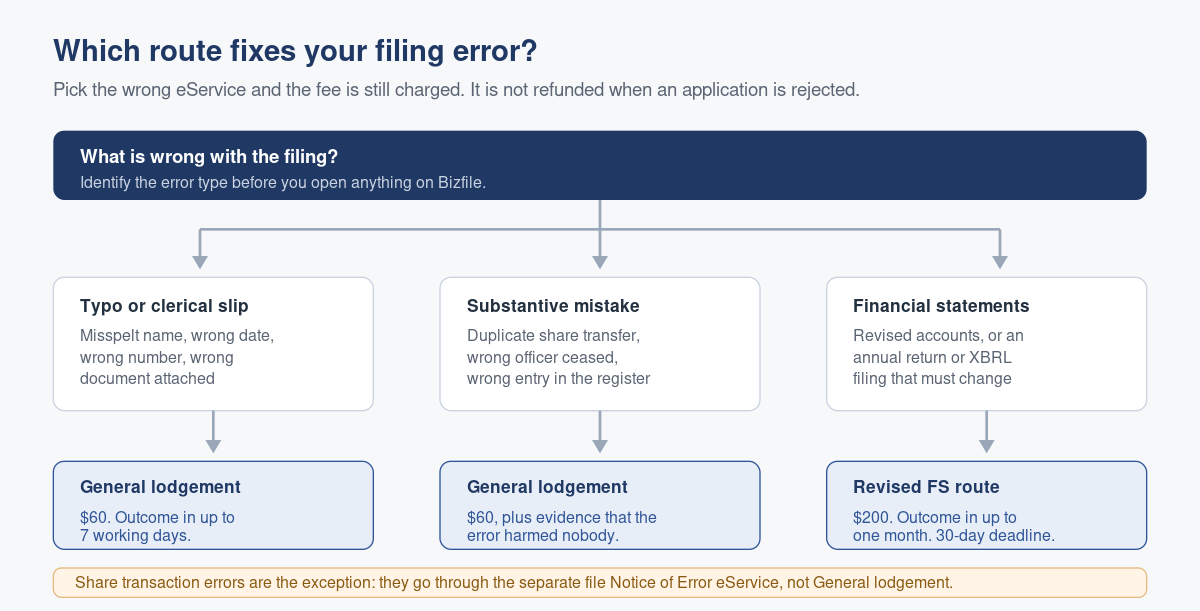
There are three destinations, and picking the wrong one costs you a non-refundable fee plus the waiting time.
| Type of error | Route | Fee | Outcome within |
|---|---|---|---|
| Clerical or typographical error, such as a misspelt name, a wrong date or number, or the wrong document attached | General lodgement, File Notice of Error | $60 | 7 working days |
| More than a typing mistake, such as a duplicate share transfer filing or a director or secretary ceased in error | General lodgement, File Notice of Error | $60 | 7 working days |
| Errors in an annual return transaction or XBRL financial statements, or financial statements revised to comply with the Companies Act 1967 or accounting standards | Notification of revised financial statements | $200 | 1 month |
| Share transaction errors | The separate file Notice of Error eService | See ACRA’s fee schedule | See ACRA’s fee schedule |
The useful development here is the last row of the first table. Correcting financial statements no longer requires a court application to remove an annual return filing, which used to be the expensive part of getting this wrong.
When you have to file
Two different answers, depending on the error.
For financial statement errors or revisions: within 30 days of the date of revision, which in practice means the date the directors approved the revised document. Miss that and a late lodgement penalty applies on top of the filing fee.
There is a second obligation running inside that same 30 days, and it is the one people forget. The revised documents must also go to everyone who received the original financial statements, and to anyone entitled to notice of a general meeting as at the date of revision. Filing with ACRA is not the whole job.
For everything else: as soon as you discover it. There is no fixed deadline, which sounds relaxed until you consider that a wrong entry on the register is doing damage the entire time it sits there. A director recorded as having ceased when they have not is a director who cannot sign a bank mandate.
What to prepare before you start
For any NOE
- The entity’s Unique Entity Number.
- The transaction number of the filing that contains the error. Find this first. Hunting for it mid-application is how people select the wrong transaction and get rejected.
- A clear statement of exactly what is wrong and what it should say.
For errors that are more than a typo
You are asking the Registrar to change a substantive entry, so you have to show two things:
- That the error was genuinely unintended.
- That nobody will be disadvantaged by the correction.
Board minutes, the signed underlying instrument, correspondence showing the intended position, a confirmation from the affected party. Attach the evidence rather than asserting the conclusion. An assertion without documents is the single most common reason an NOE comes back.
For revised financial statements
The revised set has to meet the requirements of section 202A of the Companies Act 1967, which includes a new directors’ statement replacing the original, a description of the non-compliance being corrected, a list of the key changes made, and an amended auditor’s report where there is one.
This is a job for your auditor and your corporate secretary working together, not a form-filling exercise. If your accounts were compiled rather than audited, the same structure still applies to the revision.
Filing it
- Find the original transaction number for the filing that contains the error.
- Open the General lodgement eService on Bizfile and log in.
- Select File Notice of Error under Manage. If the matter is an urgent NOE relating to annual returns, financial statements or other data types, select Others instead.
- Identify the transaction being corrected and set out the correction.
- Attach your supporting documents.
- Pay the fee and submit.
A position holder of the entity can file directly. You can also engage a corporate service provider to file on your behalf, which is usually the sensible route for anything beyond a typo, because the evidence package matters more than the form.
If Bizfile access is the obstacle, our guides to logging in as a business user through Corppass and setting up Corppass for a new company will get you through the door, and what Bizfile actually is and what you can do in it covers the wider platform.
After you file
ACRA emails the outcome within one month for revised financial statements, and within seven working days for everything else.
If it is approved, ACRA corrects the information in its register, tags the NOE to the original transaction, and the corrected position shows up in ACRA’s information products and free entity search results where applicable. Note the tagging: the original filing does not vanish. The record shows that a correction was made, which is exactly as it should be on a public register.
If it is rejected, the email explains why. In practice the reasons cluster: the wrong transaction was selected, the supporting documents were thin or missing, or the application was incomplete. You can file a fresh NOE with better material. You will pay the fee again, because the first one is not refunded.
What goes wrong in practice
Fixing the symptom instead of the transaction. A director’s name is misspelt, so somebody files a fresh change of particulars rather than an NOE. The register now shows a name change that never happened, layered on top of a typo. Two wrong entries where there was one.
Waiting for a convenient moment. There is no deadline for correcting a clerical error, so it drifts. Then a bank, a buyer or an auditor pulls a business profile and the conversation is no longer about a typo. It is about why the company’s public record is wrong.
Underestimating the evidence threshold. For anything beyond a typo, ACRA is being asked to accept that an error was unintended and harmless. That is a finding, and findings need material. Sending a one-line explanation and hoping is a $60 lesson.
Forgetting the recipients. On a financial statement revision, the 30 days covers both the ACRA filing and the distribution of the revised documents to the people entitled to them. Only doing half of it leaves the company in breach.
Where the error sits deeper than the register, for example where the underlying registers and the ACRA position have diverged over years, an NOE alone will not close the gap. Our note on restoring statutory registers and records covers that harder problem.
Frequently asked questions
Can I just edit or delete a filing I made by mistake?
No. Once a transaction is lodged it forms part of ACRA’s public record. The only way to change it is to file a Notice of Error asking the Registrar to correct the information. If approved, the correction is tagged to the original transaction rather than replacing it.
How much does a Notice of Error cost?
$60 for clerical, typographical and other non-share errors filed through General lodgement, and $200 where you are filing revised financial statements. Both fees are non-refundable, including where the application is withdrawn, rejected or appealed, so it is worth getting the route and the documents right first time.
How long does ACRA take to decide?
Up to seven working days for most errors, and up to one month for revised financial statements. ACRA sends the outcome by email. If it is rejected, the email sets out the reason and you may file a fresh NOE with better supporting information.
Do I have a deadline for correcting a mistake?
For financial statement errors or revisions, yes: within 30 days of the date of revision, otherwise a late lodgement penalty applies. For all other errors there is no fixed deadline, but you are expected to file as soon as the error is discovered, and the register is wrong in the meantime.
Who can file a Notice of Error?
A position holder of the entity can file directly through Bizfile. You can also engage a corporate service provider to file on your behalf. For anything more substantive than a typing mistake, using a provider is usually the better call, because the application stands or falls on the supporting evidence.
My error involves a share transfer. Same process?
No. Share transaction errors go through a separate Notice of Error eService rather than General lodgement. Duplicate share transfer filings are the exception that can be handled through General lodgement, so check which category your situation falls into before you pay anything.
Better still, do not file it wrong
Every NOE starts as a filing somebody rushed. The fee is small, the delay is manageable, but the corrected record is permanent and a buyer’s lawyer will read it.
Raffles Corporate Services files ACRA transactions for several hundred Singapore entities and checks them before submission rather than after. Where something has already gone wrong, we will tell you which route fixes it and what evidence ACRA will actually want to see.
Reach us through Raffles Corporate Services, or read more on Singapore corporate secretarial practice at Singapore Secretary Services.
— The Editorial Team, Raffles Corporate Services
Need help with corporate secretarial or compliance matters?
If you would like help with your company's corporate secretarial, governance or compliance requirements, email [email protected] or WhatsApp +65 8501 7133.
Our team can assist with corporate secretarial, accounting and tax matters. Where legal advice is needed, advisers from our associated law firms can assist.