
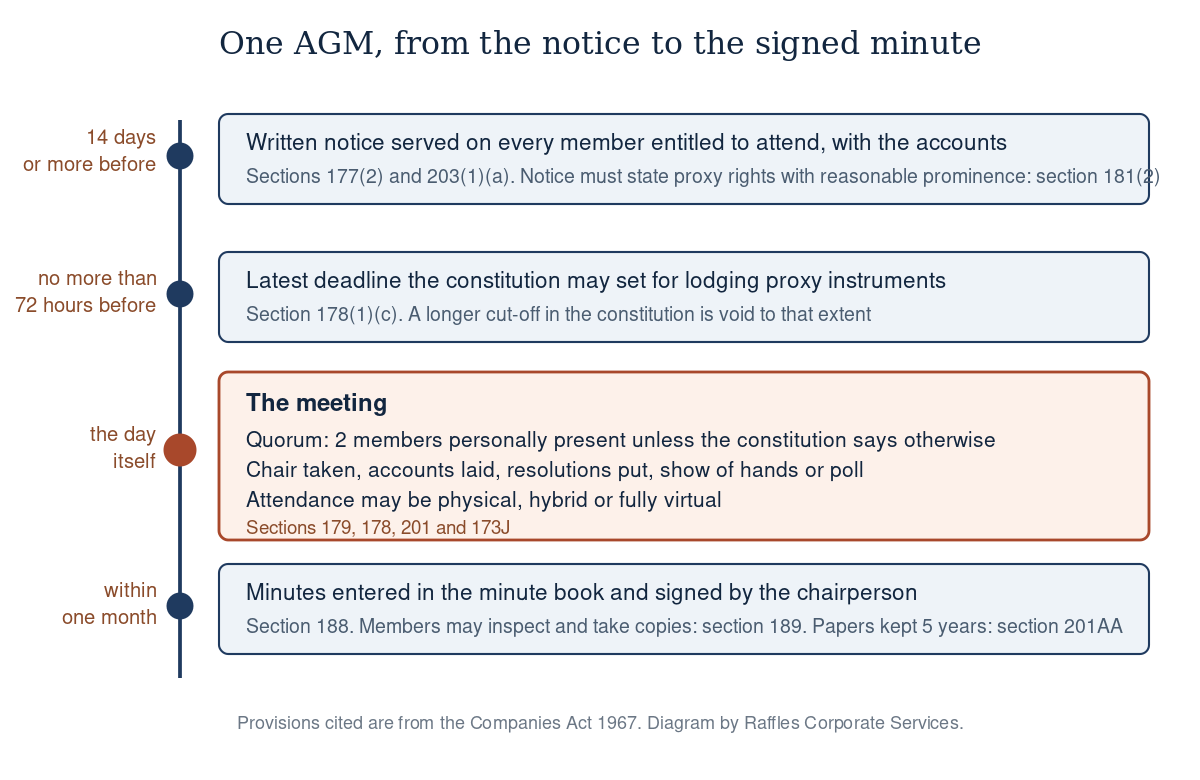
Give at least 14 days’ written notice to every member entitled to attend, send the accounts with it, check you have a quorum on the day, put each resolution to the meeting, and enter signed minutes in the minute book within one month. Those five steps are the meeting.
The detail matters because a general meeting is a legal event, not a diary entry. If the notice was short, if the quorum was not there, if a properly demanded poll was refused, what happened in the room may not be worth the paper the minutes are written on. The directors who relied on it are the ones exposed.
This is the practical half of the subject. The purpose of the AGM and the statutory basis for it is covered separately, as is dispensing with the meeting altogether.
Step one: get the notice right
Under section 177(2) of the Companies Act 1967, a meeting must be called by written notice of not less than 14 days, or such longer period as the constitution provides. Read the constitution first: a longer period in it binds you, a shorter one does not help you.
Notice goes to every member having a right to attend. Where the constitution does not say how, section 177(4) points to the manner of service in the model constitution prescribed for that type of company.
Notice periods at a glance
| What you are calling | Minimum written notice | Provision |
|---|---|---|
| General meeting, ordinary business | 14 days, or longer if the constitution says so | Section 177(2) |
| Special resolution, private company | 14 days, specifying the intention to propose it as a special resolution | Section 184(1)(a) |
| Special resolution, public company | 21 days, specifying the same intention | Section 184(1)(b) |
| Accounts and auditor’s report sent to members | At least 14 days before the meeting | Section 203(1)(a) |
Short notice, and who has to agree
Section 177(3) lets a meeting called on short notice count as duly called, but the consent threshold differs:
- For a meeting called as the AGM: all the members entitled to attend and vote must agree.
- For any other meeting: a majority in number of the members having a right to attend and vote, together holding not less than 95% of the total voting rights.
Section 184(2) applies the 95% test to a special resolution on short notice. Note the asymmetry: an AGM on short notice needs unanimity, so one unreachable shareholder is enough to stop it.
What the notice must actually say
Two items are routinely left out of homemade notices.
First, the business. A notice has to tell members what will be decided, and where a special resolution is proposed, section 184(1) requires the notice to specify the intention to propose it as a special resolution.
Second, proxies. Section 181(2) requires every notice calling a meeting to state, with reasonable prominence, that a member may appoint a proxy to attend and vote instead of them and that a proxy need not be a member. Default is an offence by every officer in default. If proxy instruments may be deposited electronically under section 181(1B), section 181(1BA) requires the notice to specify the electronic means.
Step two: quorum, chair and who counts as present
Unless the constitution provides otherwise, section 179(1) supplies the defaults. Two members personally present form a quorum. Any member elected by the members present may be chairperson.
“Personally present” is wider than it looks. Where a corporate shareholder has authorised a representative by resolution of its directors under section 179(3) and that person attends, section 179(4) deems the corporation personally present. A corporate representative is not a proxy, and the authorisation is a different document.
Meetings may be held at a physical place, at a physical place with virtual meeting technology, or by virtual meeting technology only, under section 173J, and references in the Act to attending, being present, speaking and voting are read to include doing those things remotely. That applies despite the constitution, unless the company has amended its constitution to exclude or modify it. Check the constitution before promising a fully virtual AGM.
Step three: put the resolutions, and count the votes properly
An ordinary resolution carries on a simple majority of those voting. A special resolution, under section 184(1), needs a majority of not less than three-fourths of such members as, being entitled to do so, vote in person or by proxy at a meeting called on the notice described above.
Show of hands, then poll
On a show of hands each member personally present and entitled to vote has one vote, under section 179(1)(c)(i). On a poll, each member has one vote per share. That is why polls exist: a show of hands counts people, a poll counts capital.
Section 178(1) protects the right to demand a poll. A constitution is void insofar as it would exclude that right on any question other than election of the chairperson or adjournment, or would make ineffective a demand by not less than 5 members having the right to vote, by members representing not less than 5% of total voting rights, or by members holding shares on which not less than 5% of the total paid-up sum has been paid. A proxy instrument is deemed to confer authority to demand or join in demanding a poll.
Where a special resolution is submitted, section 184(3) makes the chairperson’s declaration that it is carried conclusive evidence unless a poll is demanded. That is a real power, and a reason to take a poll whenever the outcome is contentious.
Proxies
Unless the constitution provides otherwise, section 181(1A) says a proxy may not vote except on a poll, a member may not appoint more than two proxies for the same meeting, and where two are appointed the member must specify the proportions of their holding represented by each. A proxy has the same right as the member to speak.
The deadline catches people out. Section 178(1)(c) makes void any provision requiring the proxy instrument to be received more than 72 hours before the meeting. If the constitution says four days, that part of it does not work.
Step four: the record that has to survive the meeting
The meeting ends. The obligations do not.
- Enter the minutes within one month. Section 188(1) requires minutes of all proceedings of general meetings to be entered in books kept for that purpose within one month of the meeting.
- Get them signed. By the chairperson of that meeting, or of the next succeeding meeting.
- Keep the minute books at the registered office or principal place of business in Singapore. Section 189(1). General meeting minutes are open to inspection by any member without charge; directors’ minutes are not, under section 189(2A).
- Furnish copies within 14 days of a written request. At up to $1 per page, under section 189(2).
- Keep the AGM papers for five years. Section 201AA, running from the date of the meeting. The Registrar can require them to be produced.
- Lodge the annual return. Under section 197(1), after the AGM and within 7 months of financial year end for a non-listed company, 5 months for a listed one.
Signed minutes are worth more than tidiness. Under section 188(2) and (3), minutes entered and purportedly signed are evidence of the proceedings, and until the contrary is proved the meeting is deemed duly held and convened, the proceedings duly had, and appointments made at it valid. That presumption is what a bank, a buyer’s solicitor or a court will lean on years later. Failure to comply with section 188 is an offence, carrying a fine not exceeding $2,000 and a default penalty, for the company and every officer in default.
What goes wrong in practice
Minutes written a year later, from memory. By far the most common. The one-month rule in section 188(1) exists because reconstructed minutes are unreliable. When a dispute arrives, minutes clearly typed in a batch at annual return time do not carry the weight the company wants.
Short notice taken for granted. Family companies hold the AGM whenever everyone is free and treat the consent as understood. Where one member is overseas, unwell or simply not speaking to the others, the unanimity required by section 177(3)(a) has not been obtained and the meeting is vulnerable.
Proxy cut-offs copied from an old constitution. A clause requiring proxies more than 72 hours before the meeting is void to that extent under section 178(1)(c). Rejecting a proxy on the strength of it is how a valid vote gets excluded.
No quorum, and nobody noticed. Two members personally present is the statutory default, but a sole-shareholder company has only one. Check whether the constitution provides for a quorum of one, and where it does not, consider whether written means under section 184A or, for a single-member company, section 184G is cleaner.
Resolutions that needed lodging, not lodged. Certain resolutions must be filed with the Registrar. Passing them correctly and leaving them in the minute book creates a mismatch between your records and ACRA’s. Our note on restoring statutory registers and records covers unwinding that, and the Companies Act 1967 common mistakes guide covers the filings that get rejected.
Frequently asked questions
How much notice do I need to give for a Singapore AGM?
Not less than 14 days’ written notice under section 177(2) of the Companies Act 1967, or longer if the constitution requires it. Where a special resolution is proposed, a private company still needs 14 days but the notice must specify the intention to propose it as a special resolution, and a public company needs 21 days.
Can we hold the AGM on shorter notice?
Yes, if all the members entitled to attend and vote agree, under section 177(3)(a). For meetings other than an AGM, the test is a majority in number holding at least 95% of total voting rights. Get the consent in writing before the meeting, not afterwards.
What is the quorum for an AGM?
Two members personally present, unless the constitution provides otherwise, under section 179(1)(a). An authorised representative of a corporate member attending under section 179(3) causes that corporation to be treated as personally present. Check the constitution, because many companies vary the default.
Does a proxy have to be a shareholder?
No. Under section 181(1) a member may appoint any person, member or not, as proxy to attend and vote instead of them, and the proxy has the same right to speak. Unless the constitution says otherwise, a proxy may only vote on a poll, and a member may not appoint more than two proxies for the same meeting.
When must AGM minutes be written up?
Within one month of the meeting, entered in the minute book, and signed by the chairperson of that meeting or of the next succeeding one, under section 188(1). Late or unsigned minutes lose the evidential presumption in section 188(2) and (3), and non-compliance carries a fine of up to $2,000 and a default penalty.
Getting the paperwork to match the meeting
A properly run AGM produces four things: a notice you can show, a signed attendance and voting record, minutes entered within the month, and an annual return lodged inside the window. Most companies produce one or two.
Raffles Corporate Services prepares the notice, the resolutions and the minutes, keeps the diary, and files the return on time. If your minute book has gaps, we would rather find them now than have a buyer’s solicitor find them during due diligence.
You can reach us through Raffles Corporate Services, or read more on Singapore corporate secretarial practice at Singapore Secretary Services. The statutory text is on Singapore Statutes Online and ACRA’s compliance pages are at acra.gov.sg.
— The Editorial Team, Raffles Corporate Services