

An annual general meeting is the one occasion each year when the directors have to put the company’s financial statements in front of the people who own it and answer questions about them. That is the entire point. Everything else is procedure built around it.
Raffles Corporate Services works with a panel of experienced Singapore law firms who offer cost-effective and efficient legal service and advice. This article is general information only and is not legal advice.
Section 175 of the Companies Act 1967 requires a company to hold a general meeting called the annual general meeting after the end of each financial year, within four months for a listed public company and within six months for every other company. Section 201 requires the directors to lay the financial statements for that year before the company at that meeting.
Put those two together and you have the bargain. Shareholders put money into a company and hand day to day control to a board. Once a year the board reports back, in writing, on a fixed timetable, to a room full of people entitled to disagree.
Most owner-managed Singapore companies treat the AGM as a form to be signed, which is understandable when the directors and the shareholders are the same three people. It is still worth understanding what the meeting does, because the moment the shareholder list stops matching the board, the AGM is what protects whoever is not in the room every day.
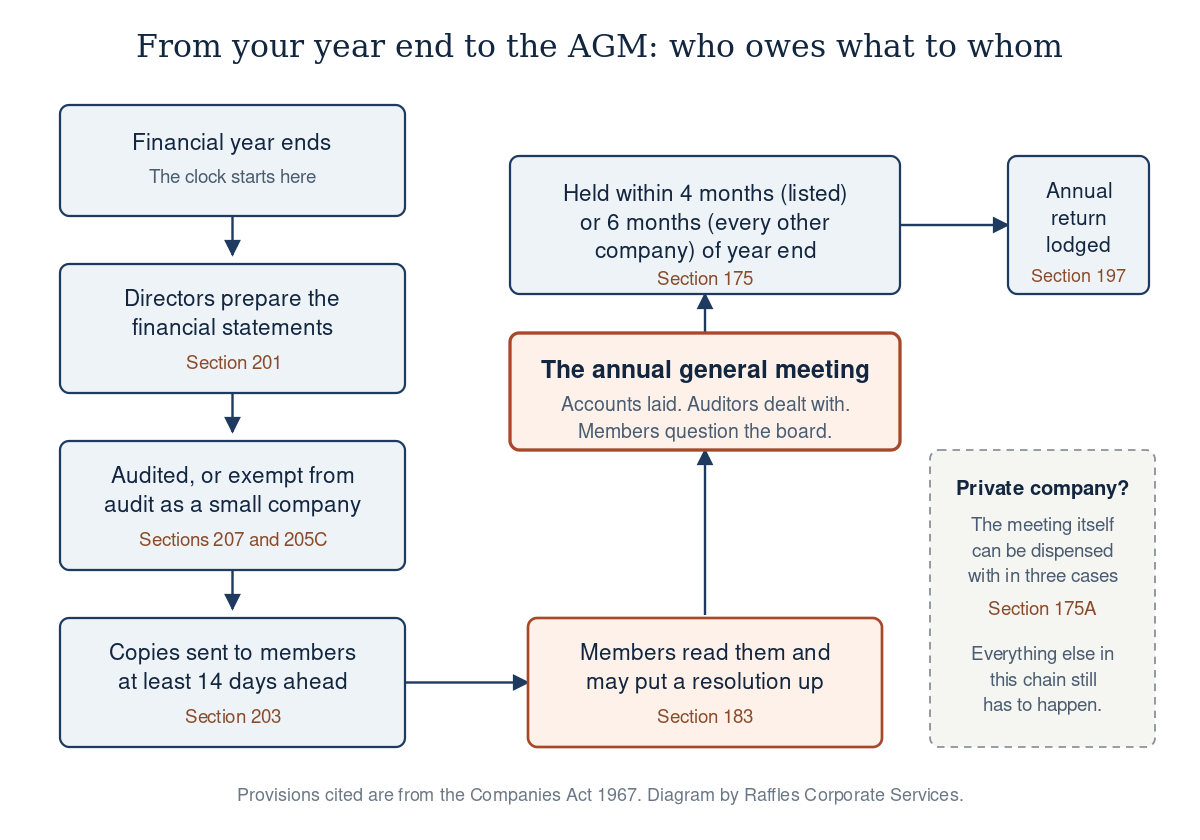
The statutory basis, in one place
The AGM is not a matter of good governance practice in Singapore. It is a statutory obligation with a criminal penalty attached, and the obligation sits on the company and on every officer in default.
| Requirement | Provision | What it says in practice |
|---|---|---|
| Hold an AGM after each financial year end | Section 175(1) | Within 4 months (listed public company) or 6 months (any other company) of financial year end |
| Lay the financial statements before the members at that meeting | Section 201(1) | Consolidated financial statements and a parent company balance sheet where the company is a parent, under section 201(5) |
| Have the accounts audited before they are laid | Section 201(8) | Unless the company is exempt from audit, for example as a small company under section 205C or a dormant company under section 205B |
| Send the accounts to everyone entitled to notice of general meetings | Section 203(1)(a) | Not less than 14 days before the meeting |
| Lodge the annual return with the Registrar after the AGM | Section 197(1) | Within 5 months of year end for a listed company, 7 months for any other company |
| Keep the documents laid at the AGM | Section 201AA | At least 5 years from the date of the meeting |
Two things fall out of that table that people regularly miss.
First, the AGM deadline and the annual return deadline are different deadlines measured from the same starting point. A private company has six months to hold the meeting and seven to lodge the return, and the return comes after the meeting. If the meeting slips past month six, the return usually slips too, and you have two breaches rather than one.
Second, the obligation to prepare and circulate accounts is not conditional on holding a meeting. It is the meeting that is optional in certain cases, not the accounts. That is the whole subject of when a private company can dispense with the AGM.
What the members are actually deciding
An AGM is not a general management review. The business transacted at it is narrower than most first-time directors assume, and it comes from three places: the Act, the company’s constitution, and whatever a member has properly put on the agenda.
Receiving the accounts
The directors lay the financial statements before the meeting. Members read them, ask about them, and can vote on a resolution to receive or adopt them if the constitution or the agenda provides for one.
Note what members are not doing: they are not taking responsibility for the accounts. That stays with the directors, who must satisfy themselves that the statements comply with the Accounting Standards and give a true and fair view, and who make a formal directors’ statement to that effect. A shareholder vote does not launder a bad set of accounts.
Dealing with the auditors
Appointment and remuneration of auditors is governed by section 205. Where a company is audited, the AGM is the natural point at which the auditor’s position for the coming year is settled, with the auditor’s report under section 207 in front of the members.
If the company is exempt from audit as a small company under section 205C, there is no auditor’s report and that item falls away. Audit exemption is not accounts exemption, and it is certainly not AGM exemption.
Directors, dividends and anything the constitution adds
Retirement and re-election of directors by rotation, and the declaration of a final dividend, are usually constitutional rather than statutory items. Read your own constitution before assuming either applies. Plenty of Singapore private companies have no rotation provision at all, and plenty of AGM minute templates still recite one.
Whatever a member properly puts up
Under section 183, members holding at least 5% of the total voting rights, or at least 100 members holding shares on which an average of at least $500 per member is paid up, can require the company to circulate notice of a resolution to be moved at the next AGM, together with a supporting statement of up to 1,000 words. Where the requisition requires notice of a resolution, it must be deposited at the registered office not less than six weeks before the meeting.
That is what turns the AGM from a formality into something with teeth. An unhappy minority shareholder does not have to wait to be invited to speak. They can put their own resolution in front of every other member, on the company’s notice.
Why the law bothers
The AGM exists because information inside a company is not evenly distributed. Directors know what happened. Members, especially members who are not employed in the business, know only what they are told.
Three consequences follow:
- It fixes a date. Without a statutory deadline, accounts get finished when the business feels like finishing them. The six-month rule means a member of a Singapore private company knows their information is at most half a year old.
- It creates a forum. Written accounts answer the questions the directors chose to answer. A meeting lets members ask the ones they did not.
- It creates a record. Minutes of a general meeting must be entered in the minute book within one month and signed, under section 188, and members can inspect them and take copies under section 189.
This matters most in the situations nobody plans for: a founder dies and the shares pass to a spouse who has never seen the numbers, or an investor asks why there has been no dividend. The annual cycle of accounts, notice and meeting is the first thing anyone looks at.
What goes wrong, and what it costs
The usual failure is not refusal. It is drift. The accounts are late because the bookkeeping is behind, the meeting waits for the accounts, and the deadline goes past without anyone making a decision to miss it.
Where a company fails to hold its AGM in time, section 175(4) makes the company and every officer in default guilty of an offence, punishable on conviction by a fine not exceeding $5,000, and also a default penalty. The Court can additionally order a meeting to be called on the application of any member.
ACRA may offer a composition sum instead of prosecution, with a minimum of $500 for each breach. Where composition is not accepted, or breaches are repeated, ACRA can prosecute the company and its directors. Directors who do not meet AGM requirements also face disqualification and debarment, and a debarred person cannot take on new appointments as a director or secretary while the debarment stands.
The problem also compounds. A late AGM usually produces a late annual return, and each late annual return carries its own penalty and enforcement exposure.
If you know before the deadline that you will not make it, there is a proper route: section 175(2) lets the Registrar extend the period on application by the company, and ACRA’s published route is an application for a 60-day extension of time. Apply before the due date passes. If the year end itself is the problem, our guide on changing your company’s financial year end sets out that alternative.
Frequently asked questions
Does a small private company with one shareholder really need an AGM?
The obligation in section 175 applies to companies generally, not just to large ones. A private company may be able to dispense with the meeting under section 175A, and a company with a single member can pass resolutions by recording and signing them under section 184G, but the default position is that an AGM is required.
Is the AGM the same thing as filing the annual return?
No. The AGM is a meeting of members required by section 175. The annual return is a filing lodged with the Registrar under section 197, made after the AGM, and due within seven months of financial year end for a non-listed company. You can hold the meeting on time and still be late on the return.
Do the shareholders approve the accounts at the AGM?
They receive them. Directors are the ones responsible for preparing financial statements that comply with the Accounting Standards and give a true and fair view. A resolution of members receiving or adopting the accounts does not transfer that responsibility, and it does not cure a defect in the statements.
What happens if the company simply never holds one?
The company and every officer in default commits an offence under section 175(4), with a fine of up to $5,000 and a default penalty. ACRA may offer composition, from a minimum of $500 per breach, or prosecute. Directors can also be disqualified or debarred, and any member can apply to Court for a meeting to be ordered.
Can the AGM be held online?
Yes. Section 173J allows a general meeting to be held at a physical place, at a physical place together with virtual meeting technology, or using virtual meeting technology only, unless the company’s constitution has been amended to exclude that. Check your constitution before you send out a notice for a fully virtual meeting.
Keeping the annual cycle boring
The companies that never have an AGM problem are not the disciplined ones. They are the ones where somebody owns the calendar: accounts drafted by month three, circulated by month five, meeting or written resolution by month six, annual return by month seven.
That is the service. Raffles Corporate Services runs that cycle for Singapore private companies, prepares the notice and resolutions, keeps the minute book current and lodges the return inside the statutory window. If you are reading this because a deadline is already close, that is a short conversation and usually still fixable.
The companion pieces cover how to run an AGM properly and dispensing with the meeting. For the wider picture, see our Companies Act 1967 deep-dive FAQ and the common mistakes and rejection reasons guide. The statutory text is on Singapore Statutes Online and ACRA’s compliance pages are at acra.gov.sg.
You can reach us through Raffles Corporate Services, or read more on Singapore corporate secretarial practice at Singapore Secretary Services.
— The Editorial Team, Raffles Corporate Services
Need help with corporate secretarial or compliance matters?
If you would like help with your company's corporate secretarial, governance or compliance requirements, email [email protected] or WhatsApp +65 8501 7133.
Our team can assist with corporate secretarial, accounting and tax matters. Where legal advice is needed, advisers from our associated law firms can assist.