

A private company need not hold an annual general meeting in three situations: a resolution to dispense with AGMs is in force, the financial statements were sent to everyone entitled to notice within five months of financial year end, or the company is a dormant relevant company whose directors are exempt from preparing financial statements. Those are the only three, and they are set out in section 175A of the Companies Act 1967.
Raffles Corporate Services works with a panel of experienced Singapore law firms who offer cost-effective and efficient legal service and advice. This article is general information only and is not legal advice.
What follows is what most people get wrong about them. Skipping the meeting does not mean skipping the year. The accounts still have to be prepared and circulated in two of the three cases, the business of the AGM still has to be transacted by written resolution, the annual return is still due, and a single member can pull the meeting back into existence with a fourteen-day notice. Treat the exemption as a change of format, not a reduction in workload.
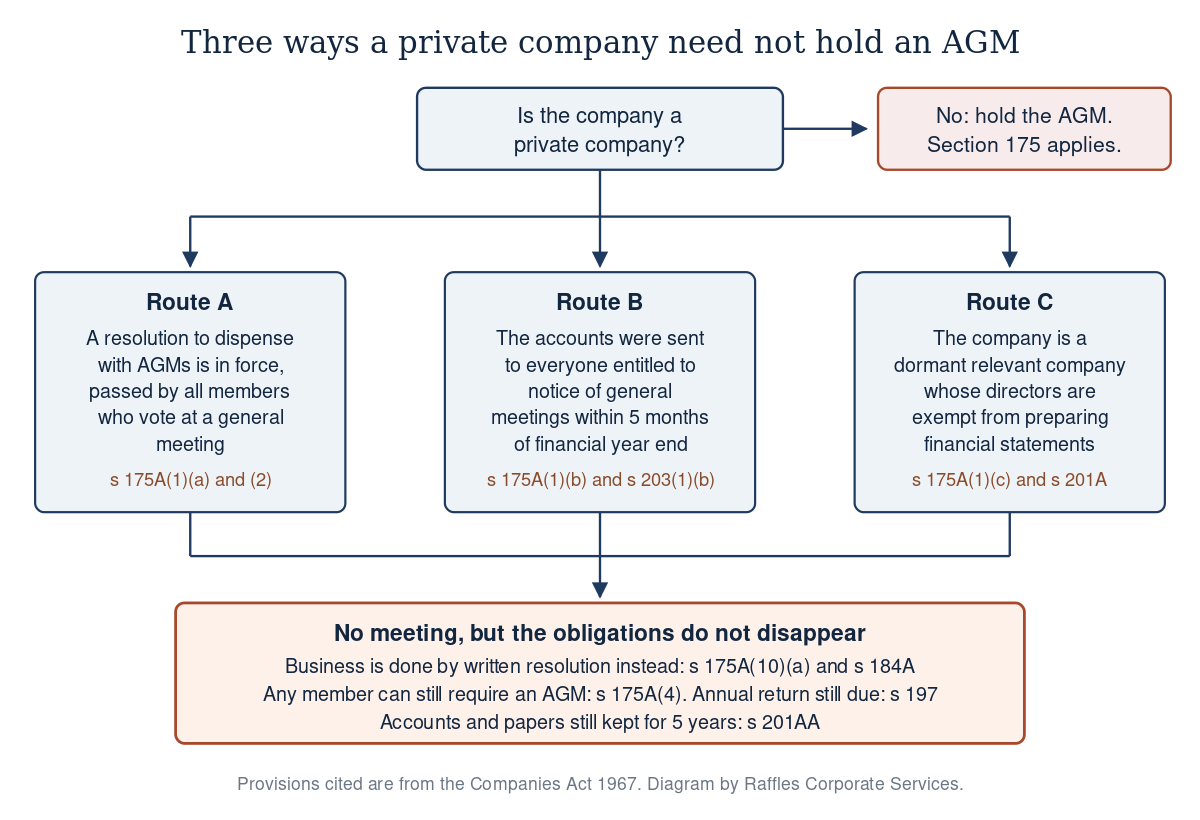
The three routes, side by side
| Route A: dispensing resolution | Route B: accounts sent within 5 months | Route C: dormant relevant company | |
|---|---|---|---|
| Provision | Section 175A(1)(a) | Section 175A(1)(b) | Section 175A(1)(c) |
| Who qualifies | A private company | A private company at the end of that financial year | A private company that is also a dormant relevant company |
| What has to happen | A resolution to dispense with AGMs, passed by all members who, being entitled to do so, vote in person or by proxy at a general meeting | The section 203(1) documents sent to all persons entitled to notice of general meetings, within the period in section 203(1)(b) | The directors are exempt under section 201A from the section 201 requirements for that year |
| How long it lasts | That year and subsequent years, until it ceases | That financial year only | That financial year only |
| Ends when | The company converts to a public company, or members revoke it | Each year is assessed separately | The dormancy exemption no longer applies |
Route A is set up deliberately, usually at incorporation or when a corporate secretary tidies up an older company. Route B is the one most active small companies use without realising it has a name: circulate the signed accounts inside five months and you are there.
Route C is narrow. It depends on the directors being exempt under section 201A from the duty to prepare financial statements, which is not the same as audit exemption under section 205B or section 205C. Companies conflate the two constantly.
The conditions attached, and the traps in them
The dispensing resolution cannot be passed by written means
Section 175A(2) says the resolution to dispense with AGMs is only treated as passed at a general meeting if it has been passed by all such members as, being entitled to do so, vote in person or, where proxies are allowed, by proxy present at the meeting. Section 184A(2) expressly takes that resolution outside the written resolution machinery.
So the one resolution whose purpose is to avoid meetings has to be passed at a meeting. If your file contains a written resolution dispensing with AGMs, signed round by the shareholders, the dispensation is not in force and every year since has been an unexcused failure to hold an AGM.
Route B is five months, not six
The AGM deadline for a non-listed company is six months after financial year end, under section 175(1)(b). The Route B exemption is keyed to the period in section 203(1)(b), which is not later than five months after year end. Circulating the accounts in month six meets neither test: too late for the exemption, and no meeting to satisfy section 175. One month is the whole difference between compliant and not, so diarise month five.
A resolution in force can be undone by one member
Section 175A(4) lets any member, in a year in which an AGM would otherwise have been required and none has been held, require one by notice to the company not later than 14 days before the date by which the AGM would have been required under section 175, and section 175A(5) allows that to be sent by electronic communication to an address the company has specified. Once the notice arrives, section 175A(6) applies section 175(1) and (4), so the deadline and the offence come back with it.
There is a parallel right over the accounts. Under section 203(4) and (4A), any member or the auditor may, by notice within 14 days after the documents were sent out, require a general meeting to lay those documents before the company. The directors must convene it within 14 days, under section 203(6). If they do not, each director in default commits an offence carrying a fine of up to $5,000, and the Court may order a meeting.
Dispensation works while everyone is content. It is not a shield against an unhappy shareholder.
Conversion to a public company kills it
Under section 175A(7) a dispensing resolution ceases to be in force if the company converts to a public company. Section 175A(8) gives a small mercy: if it ceases and fewer than three months remain to the date by which the AGM must be held, that AGM need not be held. That does not override an obligation created by a member’s notice under section 175A(4).
What you must still do instead
No AGM does not mean nothing happens. Here is the substitute cycle, in order.
- Prepare the financial statements. Section 201 still applies, unless you are in Route C with a section 201A exemption. Section 201C only removes the obligation to lay them before the company at an AGM.
- Send them out. Under section 203(1)(b), where the company is not required to hold an AGM because of section 175A(1)(a), the accounts go to all persons entitled to notice of general meetings not later than five months after year end. For Route B, sending them inside that period is what creates the exemption.
- Check the constitution before using written resolutions. Section 184B(1) makes a written resolution valid only if the constitution does not prohibit resolutions by written means and every condition it imposes is met. A resolution passed in breach is invalid under section 184B(2).
- Pass the year’s business by written resolution. Section 175A(10)(a) reads a reference to doing something at an AGM as doing it by written resolution under section 184A. Ordinary resolutions need a majority of total voting rights, special resolutions at least 75%, under section 184A(3) and (4). Directors must send the text to each member entitled to vote (section 184C); members with at least 5% of voting rights may within 7 days require a meeting instead (section 184D); an unpassed resolution lapses after 28 days unless the constitution says otherwise (section 184DA); and the company must notify every member within 15 days that it passed (section 184E).
- Write it into the minute book. Section 184F requires a record of the resolution and each member’s agreement to be entered in a book in the same way as minutes, and section 188(3A) requires entry within one month, signed by a director within a reasonable time under section 188(3B).
- Keep the papers five years. Section 201AA(1)(b) applies the retention rule to the accounts and auditor’s report sent to members, running from the date they were sent.
- Lodge the annual return. Section 197 is untouched. Section 175A(10)(c) moves the reference point: the return is lodged after the accounts were sent (Routes A and B), or after the end of the financial year (Route C). The deadline remains seven months after year end for a non-listed company.
- If a member forces a late AGM, tell the Registrar. Under section 197(4), where a private company must hold an AGM under section 175A(4) after it has already lodged that year’s annual return, it lodges notice of the AGM date within 14 days of the meeting.
A single-member company has a shortcut for step 4: section 184G lets it pass a resolution by the member recording it and signing the record.
What goes wrong
“We are a small company, so we do not need an AGM.” There is no small company AGM exemption. Small company status under section 205C is an audit exemption. The AGM exemptions are the three in section 175A and nothing else.
The dispensing resolution that was never validly passed. The single most common defect we see in acquired minute books. It is silent, it compounds annually, and it surfaces during due diligence.
Accounts circulated late, exemption assumed anyway. Route B works only if despatch happened inside five months. If it did not, the company needed a meeting inside six, and there is now an offence under section 175(4) with a fine of up to $5,000 and a default penalty, plus ACRA’s composition route from a minimum of $500 per breach.
A constitution that prohibits written resolutions. Older and bespoke constitutions do exactly that. Every written resolution passed in the face of the prohibition is invalid under section 184B(2), which can mean a share issue or a director appointment rests on nothing.
Nothing written down at all. Then the bank asks for the resolution approving the facility, and there is no document. The minute book obligations in sections 184F and 188(3A) exist precisely because written resolutions are easy to lose.
If your records have already drifted, the fix is reconstruction, not backdating. Our guide to restoring statutory registers and records sets out how that is properly done, and the Companies Act 1967 deep-dive FAQ covers the surrounding provisions.
Frequently asked questions
Can any Singapore company dispense with its AGM?
No. Only a private company, and only through one of the three routes in section 175A: a dispensing resolution in force, accounts sent to everyone entitled to notice within five months of year end, or being a dormant relevant company whose directors are exempt under section 201A. A public company must hold its AGM.
How is the dispensing resolution passed?
At a general meeting, by all such members as, being entitled to do so, vote in person or by proxy at that meeting, under section 175A(2). It cannot be passed as a written resolution, because section 184A(2) excludes it. Once passed it has effect for that year and subsequent years.
If we skip the AGM, do we still file an annual return?
Yes. Section 197 is unaffected. A non-listed company lodges within seven months of financial year end, measured after the accounts were sent to members, or after year end for a dormant relevant company under section 175A(1)(c). Missing that is a separate offence from missing an AGM.
Can one shareholder force us to hold an AGM anyway?
Yes. Under section 175A(4) any member may require an AGM to be held by giving notice not later than 14 days before the date by which the AGM would otherwise have been due. Separately, under section 203(4) and (4A), a member or the auditor may require a meeting to lay the accounts within 14 days of their despatch.
Does audit exemption mean AGM exemption?
No, and the confusion is expensive. Small company audit exemption under section 205C and dormant company audit exemption under section 205B remove the audit, not the meeting. The AGM exemptions sit in section 175A, and the only dormancy-based one turns on the section 201A accounts exemption rather than on audit.
Choosing the route that suits the company
For a two-shareholder operating company with clean books, Route B is usually the right answer: circulate the signed accounts in month five, pass the year’s resolutions in writing, lodge the return in month seven. For a dormant holding vehicle, Route C may already apply. A standing dispensing resolution under Route A suits a stable and aligned shareholder base, and little else.
Whichever route you use, the deciding factor is whether somebody is keeping the calendar and the minute book. That is the part Raffles Corporate Services does: accounts out inside five months, written resolutions drafted and recorded properly, annual return lodged in the window, constitution checked before anyone relies on a written resolution.
You can reach us through Raffles Corporate Services, or read more on Singapore corporate secretarial practice at Singapore Secretary Services. The statutory text is on Singapore Statutes Online, and ACRA’s compliance pages are at acra.gov.sg.
For the rest of this series, see what an AGM is actually for and how to run one properly.
— The Editorial Team, Raffles Corporate Services
Need help with corporate secretarial or compliance matters?
If you would like help with your company's corporate secretarial, governance or compliance requirements, email [email protected] or WhatsApp +65 8501 7133.
Our team can assist with corporate secretarial, accounting and tax matters. Where legal advice is needed, advisers from our associated law firms can assist.