
Most Singapore private companies must file their annual return within seven months of the financial year end. File late and a penalty of $300 or $600 is added automatically at the payment screen, depending on how late you are. Beyond that sits a composition sum, then prosecution, then disqualification.
The penalty figures are small enough that some directors treat them as a filing fee with a surcharge. That is the wrong way to read them. The $300 is not the risk. The risk is what a pattern of late filings does to the directors personally, and what it does to a company that stops filing altogether.
Here are the actual dates, the actual amounts, and the escalation ladder they sit on.
The deadlines
Two things determine your deadline: your financial year end, and your company type. Nothing else. The deadline is a period measured forward from the FYE.
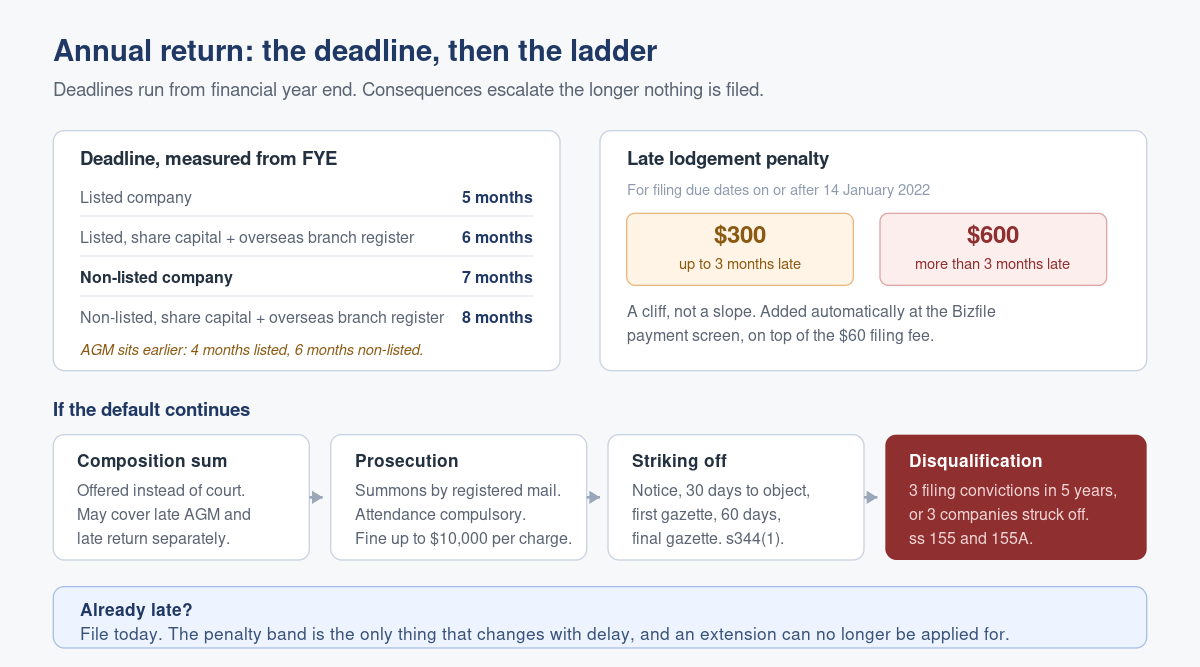
| Company type | Annual return filing deadline |
|---|---|
| Listed companies | Within five months after FYE |
| Listed companies with a share capital and an overseas branch register | Within six months after FYE |
| Non-listed companies | Within seven months after FYE |
| Non-listed companies with a share capital and an overseas branch register | Within eight months after FYE |
For the overwhelming majority of Singapore private limited companies, the answer is seven months after FYE. A company with a 31 December year end files by 31 July. A company with a 30 June year end files by 31 January.
The AGM deadline sits earlier, and is a separate obligation with separate consequences: four months after FYE for listed companies, six months after FYE for non-listed companies, for financial years ending on or after 31 August 2018. The sequencing between the two is covered in our article on the annual return timeline.
Who this applies to
Every company registered in Singapore whose status on ACRA’s register is “live”. There is no small company exemption from filing, no dormancy exemption from filing, and no exemption because IRAS has waived your tax return. Those reliefs, where they exist, go to what the return must contain, not to whether it must be filed. Part one of this series sets out what actually goes into the return.
The late lodgement penalty
If the return is filed after its due date, a penalty applies. For filing due dates on or after 14 January 2022:
| How late | Penalty |
|---|---|
| Up to three months after the deadline | $300 |
| More than three months after the deadline | $600 |
It is a cliff, not a slope. One day late and three months less a day late both cost $300. The day after the three-month mark, it doubles. There is no daily accrual and no proportionality, which means the practical advice is blunt: if you are already late, file today rather than next month, because the only thing that changes with delay is the penalty band.
The penalty is applied automatically when you submit the late return through Bizfile. You do not receive a bill later; you pay it at the point of filing, on top of the $60 filing fee.
A worked example
A private company has a financial year ending 31 December 2025. Its filing deadline is seven months later, 31 July 2026. It files on 20 August 2026, twenty days late. That is within three months of the deadline, so the penalty is $300, added to the $60 filing fee. Had it filed on 20 November 2026 instead, the penalty would be $600.
Above the penalty: composition, prosecution, striking off
The late lodgement penalty is the floor, not the ceiling. ACRA has published that more serious action may follow depending on the circumstances.
Composition sum
Rather than prosecuting, ACRA may offer a composition sum, which settles the matter without a court appearance. Because a late AGM so often produces a late annual return, a composition offer may cover both breaches together, and each breach carries its own sum.
ACRA’s published illustration is worth understanding. A company with a 31 December 2025 year end holds its AGM about a month late and files its return about a month late. The composition sum is at least $500 for the late AGM and at least $500 for the late annual return. Two breaches, two sums, and “at least” is doing real work.
Court prosecution
ACRA may prosecute the company and its directors where the composition is not accepted, where there are multiple or repeated late filings, or where ACRA decides not to offer a composition at all.
The mechanics are not gentle. A summons is sent by registered mail to the company’s registered office or to the director’s home address. A director, or a representative holding a letter of authority, must attend court, and that obligation is not suspended by a pending appeal. If the company sends nobody, the court may proceed in its absence. If a director fails to attend, a warrant may be issued for their arrest.
On conviction, the fine can be up to $10,000 per charge, with a possible default penalty on top. Per charge, not per company.
ACRA-initiated striking off
Under section 344(1) of the Companies Act 1967, ACRA may strike a company off its register where there is reasonable cause to believe the company is not carrying on business or is not in operation. Persistent failure to file annual returns over several consecutive years is a common trigger. This is different from a voluntary striking off the company applies for.
The sequence is published and predictable:
- ACRA issues a Striking Off Notice to the company, its directors, secretaries and shareholders.
- You have 30 days from the notice to object. The company’s status is still “live” at this point.
- If nobody objects within those 30 days, or an objection is disallowed within that period, ACRA publishes the company in the First Gazette Notification and the status becomes “Gazetted to be Struck Off”. You can still object at this stage.
- If there is still no objection 60 days after the First Gazette, ACRA publishes the Final Gazette Notification, the status becomes “Struck off”, and the company no longer legally exists.
Reviving a company after that point is a court exercise, and a far more expensive one than the filing that was avoided.
Disqualification and debarment
This is where it stops being about money.
| Consequence | Trigger | Effect |
|---|---|---|
| Disqualification, sections 155 and 155A of the Companies Act 1967 | Convicted of three or more filing offences within five years | Five-year disqualification |
| Disqualification, sections 155 and 155A | Three or more companies struck off by ACRA within five years | Three years for a first occurrence, five years for a repeat |
| Debarment | Failure to lodge required documents for a continuous period of three months or more | Cannot take new appointments as a director or company secretary |
A disqualified person cannot act as a director of, or manage, any local or foreign company for the period. For a founder with several companies, one neglected shell can take the whole portfolio down with it.
What goes wrong in practice
The dormant shell nobody closed. By far the most common route to disqualification we see is not fraud, it is an abandoned company. A venture that did not work, left on the register because closing it felt like admitting defeat, quietly accumulating missed annual returns. Three of those inside five years and the founder is disqualified from directing anything.
Several years missed, filed all at once. If more than one financial year is outstanding, every overdue return has to be filed, in sequence, each carrying its own penalty. The bill is per return, not per rescue exercise.
The reminder went to a mailbox nobody reads. ACRA emails position holders one month before the deadline, using the addresses recorded in Bizfile. If the registered email belongs to a director who left in 2022, nobody receives it. Pop-up alerts still appear in Bizfile, but a company whose filings are already lapsing is a company nobody is logging in to.
Waiting for the extension to be approved. An extension of time takes up to 14 working days to process and cannot be applied for after the deadline has passed. Applying two days before the deadline is effectively the same as not applying.
Confusing ACRA with IRAS. A tax filing waiver is not an ACRA exemption. Companies with IRAS waivers still file annual returns.
Appealing a penalty
You can appeal to have a penalty reduced or a summons reviewed. The route is ACRA’s Late Lodgment Appeal Form, with supporting documents attached. Review takes about four weeks, longer in peak periods, and each case is decided on its own merits.
One thing to be clear about: an appeal in progress does not excuse you from attending a scheduled court date. If a summons has been issued, you attend, appeal or no appeal.
Appeals succeed on facts, not on regret. Hospitalisation, a genuine auditor failure, an event outside the company’s control, documented at the time, is an argument. “We were busy” is not.
Frequently asked questions
What is the annual return deadline for a Singapore private limited company?
Seven months after the financial year end for a non-listed company, or eight months where the company has a share capital and keeps an overseas branch register. Listed companies file within five or six months. A company with a 31 December year end therefore files by 31 July.
How much is the late filing penalty for an annual return?
For filing due dates on or after 14 January 2022, the late lodgement penalty is $300 if you file within three months of the deadline and $600 if you file more than three months late. It is charged automatically at the Bizfile payment screen, in addition to the $60 filing fee.
Can I avoid the penalty by applying for an extension after the deadline?
No. Extension of time applications cannot be submitted through Bizfile once the deadline has passed. Extensions must be applied for beforehand, ideally at least 14 working days before the deadline, and each application costs $200 regardless of outcome.
What happens if we have not filed for several years?
Every outstanding return must be filed, each in its own transaction with its own penalty. Beyond the penalties, ACRA may offer a composition sum, prosecute the company and its directors, or begin striking the company off the register under section 344(1) of the Companies Act 1967.
Can a director be disqualified for late annual returns?
Yes. Under sections 155 and 155A of the Companies Act 1967, three or more filing offence convictions within five years brings a five-year disqualification, and having three or more companies struck off by ACRA within five years brings a three-year or five-year disqualification. A disqualified person cannot direct or manage any company.
The cheapest compliance you will ever buy
Nobody misses an annual return on purpose. It gets missed because the accounts slipped, because the person who used to handle it left, or because a company stopped being interesting to the people who own it. The consequences do not care about the reason.
Raffles Corporate Services keeps the filing calendar for the companies we act for: deadlines diarised from the FYE, AGM or dispensation paperwork prepared in time, registers reconciled before the return is opened, and extensions applied for early on the rare occasions they are needed. If you have companies sitting on the register that nobody has filed for, that is a conversation worth having before the Striking Off Notice arrives rather than after.
Related reading: what goes into an annual return, the annual return timeline, changing your financial year end, and our Companies Act 1967 deep-dive FAQ. Directors dealing with a company they cannot exit should also read our note on the trapped director and ACRA’s strike-off guidance.
Primary sources: ACRA on deadlines and requirements for annual returns and on penalties and enforcement action for late filing, and the Companies Act 1967 on SSO.
— The Editorial Team, Raffles Corporate Services