

A Singapore annual return is an electronic declaration filed with ACRA confirming your company’s registered particulars, its officers, its shareholders and shares, its financial statements position and how it dealt with its annual general meeting. It costs $60 to file and takes effect immediately on submission.
Raffles Corporate Services works with a panel of experienced Singapore law firms who offer cost-effective and efficient legal service and advice. This article is general information only and is not legal advice.
The word “return” makes it sound like a form you fill in. It is closer to an affidavit. Every screen in the Bizfile transaction ends in a declaration by a company officer that the information is correct, and the annual return then becomes the public record that banks, investors, auditors and counterparties rely on for the next twelve months.
Most directors have never actually read what they were signing. This article walks through the whole thing, field by field, and flags what each section commits you to. The companion article on the annual return timeline deals with sequencing and dates.
The legal basis, in one paragraph
Section 197 of the Companies Act 1967 requires a company to lodge an annual return with the Registrar. The obligation attaches to the company and, through directors’ duties, to its officers personally. It applies for as long as the company is on the register with a “live” status. Dormancy does not switch it off. A tax filing waiver from IRAS does not switch it off either, because that is a different regulator answering a different question.
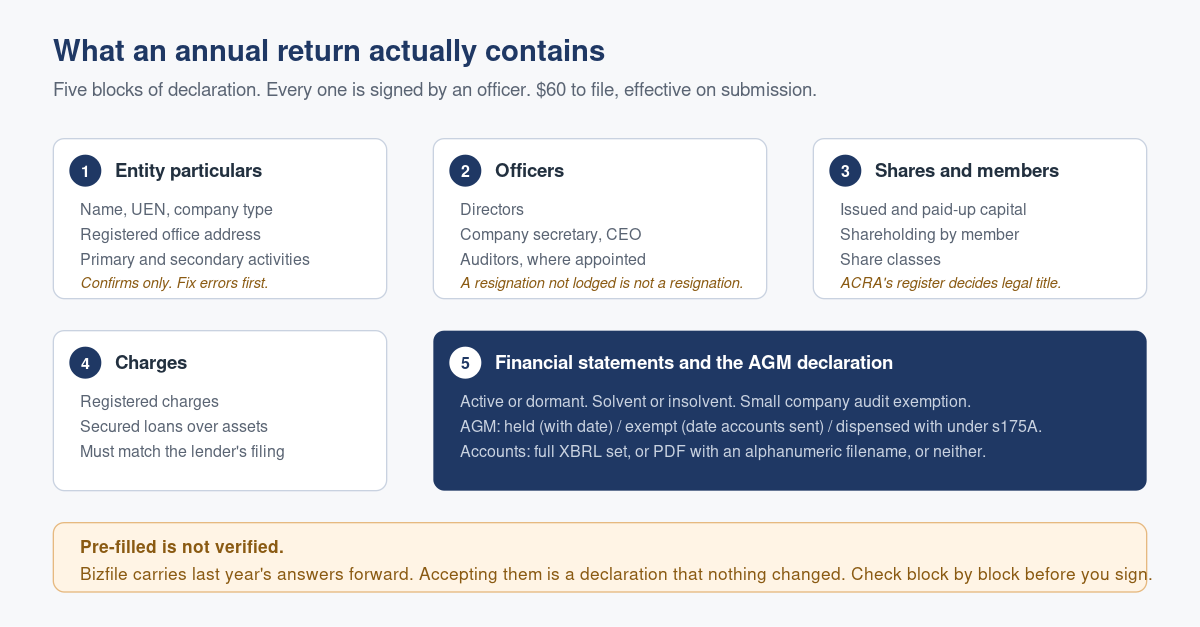
The five blocks of an annual return
Everything in the transaction falls into one of five blocks. Think of them in this order, because that is broadly the order Bizfile presents them.
| Block | What ACRA is asking | What it commits you to |
|---|---|---|
| Entity particulars | Name, UEN, company type, registered office, business activities | That your public record is accurate today, not at some point last year |
| Officers | Directors, company secretary, chief executive officer, auditors | That every appointment and resignation has been lodged |
| Shares and members | Issued share capital, paid-up capital, shareholdings, share classes | That every allotment and transfer has been lodged |
| Charges | Registered charges and loans over the company’s assets | That the charge register reflects reality |
| Financial statements and AGM | Solvency, dormancy, audit exemption, AGM treatment, the accounts themselves | That the accounts exist, are properly signed, and were dealt with correctly |
Block one: entity particulars
Company name, unique entity number, company type, registered office address and business activities, both primary and secondary.
Note the trap here. The annual return is not the place to fix errors. If your registered office moved eight months ago and nobody lodged the change, you cannot quietly correct it inside the annual return. You must file the change separately first, through the relevant update transaction, then come back. The annual return confirms; it does not amend. Which makes it, in practice, an audit of your own filing discipline over the past year.
Block two: officers
Directors, the company secretary, the chief executive officer where one is designated, and auditors where the company has them.
Two things catch companies out. First, a director who resigned informally, by email or in a board minute, is still a director as far as ACRA is concerned until the cessation is lodged. Second, a company secretary vacancy is a live breach, not a paperwork gap, and the annual return will make it visible.
Block three: shares and members
Number of shares held by each member, issued share capital and paid-up share capital, broken down by class where the company has more than one.
This is the block that matters most commercially, because ACRA’s electronic register of members is the legal register for a private company. If the annual return says one thing and your shareholders believe another, ACRA’s version is the one that decides legal title.
The usual failure is a share transfer that was agreed, priced, stamped and paid for, but never lodged. It surfaces at the annual return, often a year later, and it is much harder to unwind then than it would have been at the time.
Block four: charges
Any registered charge or loan secured over the company’s assets. Most owner-managed companies have none. Companies with bank facilities almost always do, and the charge particulars need to match what the lender registered.
Block five: financial statements and the AGM
The heaviest block, and the one with the most branching. What you are asked depends on your company type: exempt private company limited by shares, private company limited by shares, public company limited by guarantee, public company limited by shares, and the three unlimited variants each get a different set of questions.
Across all of them you are declaring some combination of:
- Whether the company is active or dormant for the financial period.
- Whether it is solvent or insolvent, for exempt private companies and unlimited companies.
- Whether it qualifies as a small company exempt from audit, and ticking a declaration to that effect if it does.
- For dormant companies, whether it is exempt from preparing financial statements at all, which is a narrower relief than the audit exemption.
- For public companies limited by shares, whether the company was listed on a Singapore securities exchange during the period or at the date of filing.
Then the AGM declaration, and then the accounts themselves.
The AGM declaration you cannot skip
Every annual return carries an AGM declaration. There is no “not applicable” route out of it. You must state which of three situations applies:
- The company held an AGM, and you give the date it was held.
- The company was exempt from holding one, and you give the date the financial statements were sent to members.
- The company dispensed with AGMs by unanimous member resolution under section 175A of the Companies Act 1967.
You may attach the written resolution when you file. Companies that have dispensed with AGMs sometimes assume the declaration goes away with the meeting. It does not. The declaration is how ACRA knows the accounts reached the members, which is the underlying purpose the AGM was serving.
The accounts: XBRL, PDF, or neither
Whether you attach financial statements, and in what format, is driven by your company type and status.
- If your company must file a full set of financial statements in XBRL, you prepare and validate them in ACRA’s preparation tool first, upload them, and then select them inside the annual return transaction. Where you have filed the full XBRL set, you do not also attach a PDF.
- If you do not submit the full XBRL set, you attach a PDF of the complete financial statements. Bizfile is fussy about the filename: letters and numbers only, no spaces, no full stops, no ampersands, no accented or non-Latin characters. A filename with a space in it is one of the most common reasons a submission stalls at the last screen.
- Solvent exempt private companies and dormant relevant companies sit outside the attachment requirement, which is why so many small Singapore companies never upload anything.
Who signs the directors’ statement
One director only in the company: that director signs. Two or more directors: at least two must sign. This is not a Bizfile preference, it is the statutory position, and a statement signed by one director in a multi-director company is defective.
What goes wrong in practice
The return is filed on stale data. Bizfile pre-fills from your previous filing, which is genuinely helpful and also genuinely dangerous. Pre-filled is not the same as verified. The officer who clicks through accepting last year’s figures has just declared that a share transfer, a director change or an address move did not happen. That declaration is made by a person, not by the software.
The company treats dormancy as an exemption from everything. Dormant companies still file annual returns. Some are relieved from preparing financial statements, some from audit, and those are two different reliefs with two different tests. Neither of them is a relief from filing.
Nobody checks the controller registers first. The annual return sits downstream of your Register of Registrable Controllers and, where relevant, the registers of nominee directors and nominee shareholders. Those obligations run on their own clock and carry their own consequences. If you have nominee arrangements, read our note on nominee shareholder arrangements and beneficial ownership disclosure before filing, not after.
The FYE is wrong and it is now too late. You cannot change your financial year end once the annual return filing deadline has passed. If your FYE needs correcting, that is a decision to take early. Our guide on changing your financial year end covers the mechanics and the IRAS basis period knock-on.
After you submit
Your public record updates immediately. There is no processing queue and no approval step, which is a double-edged benefit: a mistake is live the moment you click submit.
You also get a free electronic Business Profile, which expires if you do not download it within 60 days. Download it the same day and file it with your board papers. It is the cleanest evidence that the filing went through, and the document your bank will ask for.
Filing the annual return does not discharge your tax obligations. IRAS is a separate filing on a separate deadline, and dormant companies file tax returns too unless IRAS has waived it.
Frequently asked questions
Does a dormant Singapore company still file an annual return?
Yes. The obligation applies for as long as the company is listed as live on ACRA’s register, regardless of whether it trades. Some dormant companies are relieved from preparing or auditing financial statements, but none are relieved from filing the annual return itself.
How much does it cost to file an annual return?
The filing fee is $60. That is the fee for an on-time filing. If you file after the deadline, a late lodgement penalty is added automatically at the payment screen, on top of the $60.
Can I correct a wrong registered address inside the annual return?
No. The annual return confirms your particulars, it does not change them. Lodge the change through the separate update transaction first, then file the annual return. If you file first, you will have declared the wrong address to be correct.
Who is allowed to file the annual return?
A company officer, typically a director or the company secretary, filing through Bizfile as a business user via Corppass. You may also appoint a corporate service provider to file on the company’s behalf. The legal responsibility stays with the directors either way.
We dispensed with our AGM. Do we still complete the AGM section?
Yes. You declare that the company dispensed with AGMs under section 175A of the Companies Act 1967, and you may attach the members’ written resolution. The declaration is compulsory whether you held, were exempt from, or dispensed with the meeting.
Getting the year’s filings to line up
The annual return is easy on the day and hard over the year. Everything that makes it easy, accurate officers, a clean register of members, charges that match the facility documents, is work done in the eleven months before you open Bizfile.
That is the part Raffles Corporate Services takes on. We maintain the statutory registers, lodge changes inside their windows, and file the annual return with the underlying record already reconciled rather than discovering problems at the payment screen.
Next in this series: the annual return timeline from financial year end to filing, and the deadlines and late filing penalties that apply when the sequence slips. For the wider statutory framework, our Companies Act 1967 deep-dive FAQ is the place to start, and if Bizfile itself is new to you, begin with what Bizfile actually is.
ACRA’s own landing page for filing annual returns is the authoritative source for current fees and requirements, and section 197 of the Companies Act 1967 is available on SSO.
— The Editorial Team, Raffles Corporate Services
Need help with corporate secretarial or compliance matters?
If you would like help with your company's corporate secretarial, governance or compliance requirements, email [email protected] or WhatsApp +65 8501 7133.
Our team can assist with corporate secretarial, accounting and tax matters. Where legal advice is needed, advisers from our associated law firms can assist.