

The Singapore annual return runs on a fixed sequence: your financial year ends, the accounts are prepared, the accounts reach the members through an AGM or a lawful substitute, and only then is the annual return lodged. For a typical non-listed private company with a share capital, the whole sequence has to be complete within seven months of the financial year end.
Raffles Corporate Services works with a panel of experienced Singapore law firms who offer cost-effective and efficient legal service and advice. This article is general information only and is not legal advice.
The sequence is the part people get wrong. Not the deadline, the order. Companies discover in month six that the accounts are not ready, so the AGM cannot be held, so the annual return cannot be declared, and by then the extension of time window has closed.
This article walks the timeline in order and marks the points of no return. If you want the contents of the return itself, field by field, that is in part one on what actually goes into an annual return.
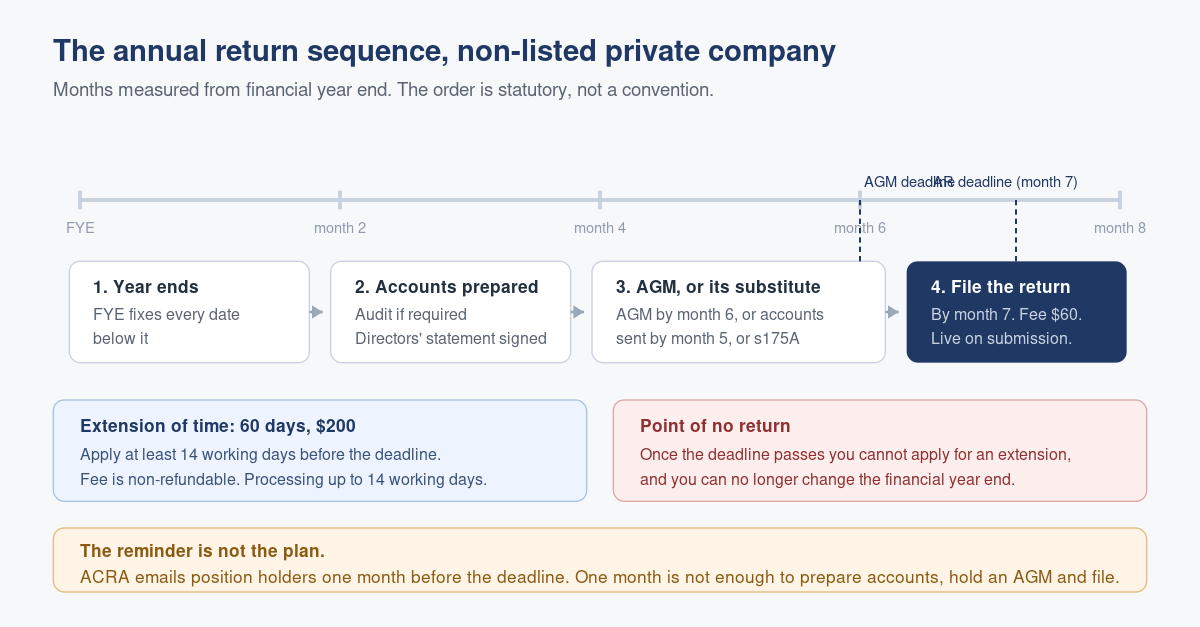
Why the order is legally fixed, not just conventional
Section 197 of the Companies Act 1967 frames the annual return as something lodged after the annual general meeting. That single word sets the whole chain, and the AGM itself has a deadline measured from the financial year end.
Where a private company does not hold an AGM, section 175A does not remove the sequence, it substitutes a step. The annual return is then lodged after the company has sent the accounts to everyone entitled to notice of general meetings, or, for a dormant relevant company exempt from preparing accounts at all, after the end of the financial year.
So there are three valid routes to the filing point, and all three run through the same idea: the members see the numbers before the public record is updated.
Step 1: the financial year end fixes everything downstream
Every deadline in this article is measured from the FYE. Choose it badly and you inherit an awkward compliance calendar for years.
Two practical points.
First, the FYE drives your IRAS basis period as well as your ACRA dates, so the two regimes should be considered together rather than sequentially. Our guide to changing your financial year end sets out the interaction.
Second, and this is a hard stop: you cannot change your FYE once the annual return filing deadline for that year has passed. A company that realises in month nine that its year end is wrong has lost the option for that year. If a change is on the table, take the decision early in the year, not at filing time.
Step 2: prepare the accounts
Nothing else can move until the financial statements exist in signable form. Where an audit is required, the audit sits inside this step, and audits are the single most common cause of a slipped AGM.
The directors’ statement is signed here too. One director in the company means that director signs. Two or more directors means at least two must sign. A statement signed by one director in a multi-director company is defective.
If your accounts have to be filed in XBRL, preparation and validation happens at this stage as well, because the validated file must exist before you can select it inside the annual return transaction.
Step 3: AGM, exemption, or dispensation
Three routes, and you must know which one you are on before you open Bizfile.
| Route | What has to happen | Deadline from FYE |
|---|---|---|
| Hold an AGM | Meeting held, accounts laid before members | Four months for listed companies, six months for non-listed companies |
| Exempt from AGM | Private company sends the accounts to all members within the statutory window, or is a dormant relevant company exempt from preparing accounts | Accounts sent within five months after FYE for the sending route |
| Dispensed with AGM | All members have passed a resolution under section 175A dispensing with AGMs; business handled by written resolution | Resolution must be in force for the financial year |
Two warnings on the non-AGM routes.
Dispensation is unanimous, and it persists. The resolution must be passed by all members entitled to vote. Once passed, it carries forward into later years until something ends it, and it lapses automatically if the company converts to a public company.
Members can still demand a meeting. Even with an exemption or a dispensation in place, a member may require an AGM to be held by giving notice not later than 14 days before the date by which an AGM would otherwise have been due. If that notice comes, you hold the meeting within six months of the FYE. Companies that have not held an AGM in five years and have let the habit atrophy find this genuinely disruptive.
Step 4: file the annual return
Only now. A company officer, or a corporate service provider engaged for the purpose, logs in to Bizfile as a business user through Corppass and works through the transaction. If Corppass access is the obstacle, start with our guide to logging in to Bizfile as a business user.
The filing fee is $60. The record updates immediately on successful submission, with no approval queue.
Filing deadlines run from the FYE and depend on company type:
| Company type | Annual return deadline |
|---|---|
| Listed companies | Within five months after FYE |
| Listed companies with a share capital and an overseas branch register | Within six months after FYE |
| Non-listed companies | Within seven months after FYE |
| Non-listed companies with a share capital and an overseas branch register | Within eight months after FYE |
For the great majority of Singapore private companies, the number to hold in your head is seven months. Full detail, including what happens when you miss it, is in our article on annual return deadlines and penalties.
A worked example
Take a non-listed private company with a financial year ending 31 December 2025.
- 31 December 2025. Financial year ends. The clock starts.
- By 30 June 2026. AGM must be held, if the company holds AGMs. Six months after FYE.
- Or by 31 May 2026. If the company relies on the exemption route instead, the accounts must have gone out to all members within five months of FYE.
- By 31 July 2026. Annual return lodged. Seven months after FYE.
Note the gap between step 2 and step 4. It is deliberate, and it is only one month. It is not a buffer for finishing the accounts; the accounts had to be done by step 2. It is a buffer for the filing itself.
Step 5: after submission
Download the free electronic Business Profile that comes with the filing. It expires 60 days after the transaction, and it is the neatest proof that the return went through.
Then note the separate obligation: tax filing with IRAS runs on its own deadline and is not discharged by the annual return.
If the sequence is going to slip: the extension of time
If you can see in month four or five that the accounts will not be ready, you can apply for an extension of time. This is a real option and it is materially cheaper than the alternative, but it has sharp edges.
- The extension is 60 days.
- Each application costs $200, and the fee is non-refundable even if the application is withdrawn, rejected or appealed.
- Processing takes up to 14 working days, sometimes longer in busy periods, so ACRA advises applying at least 14 working days before your deadline.
- You cannot apply once the deadline has passed. The online application simply is not available any more. This is the single most important fact in this section.
- The company’s FYE must be on or after 31 August 2018 to use the online route.
- You can apply for an extension for the AGM, for the annual return, or for both, in the same application.
- A further extension beyond the first is possible but is unlikely to be granted without strong supporting reasons.
Supporting documents matter. A director’s letter explaining the delay, correspondence from the auditor estimating completion, and a director’s letter explaining any auditor change between the FYE and the deadline are the standard set.
What goes wrong in practice
Everyone waits for the reminder. ACRA sends an email notification one month before the deadline, to the registered email addresses of position holders, and shows pop-up alerts in Bizfile. That is a safety net, not a plan. One month is not enough time to prepare accounts, complete an audit, hold an AGM and file. A company that starts when the reminder lands is already late in every practical sense.
The registered email is out of date. The reminder goes to the email addresses recorded in Bizfile. If a director left three years ago and the profile was never updated, the reminder is going to a mailbox nobody reads. Check the addresses under your Bizfile profile once a year.
The AGM is held but the return is forgotten. These are two separate obligations with two separate deadlines and two separate breaches. Holding the AGM on time does not protect you if the return is late.
The extension is applied for on the deadline itself. By then it is too late to apply online, and a $200 application that would have solved the problem becomes a penalty plus, potentially, a composition sum for both the late AGM and the late return.
Several years are missed at once. If a company has not filed for more than one financial year, every overdue return must be filed, each in its own transaction, each with its own penalty.
Frequently asked questions
Can I file the annual return before holding the AGM?
No. The statutory sequence requires the annual return to be lodged after the AGM, or after the accounts have been sent to members where the company is exempt, or after the financial year end for a dormant relevant company exempt from preparing accounts. Filing out of order is not a shortcut, it is a false declaration.
How long after the AGM do I have to file?
It is not measured from the AGM, it is measured from the financial year end. A non-listed company generally has six months from FYE to hold the AGM and seven months from FYE to file the return, which leaves roughly one month between the two.
Can I still get an extension of time if the deadline has already passed?
No. Extension of time applications cannot be submitted through Bizfile once the deadline has gone. At that point your options are to file immediately and pay the late lodgement penalty, and to appeal the penalty afterwards if there are genuine grounds.
Does a company that dispensed with AGMs have an earlier or later filing deadline?
The annual return deadline is unchanged. What changes is the trigger event: instead of filing after the AGM, you file after the accounts have gone to everyone entitled to notice of general meetings. The seven-month outer limit for a typical non-listed company still applies.
Running the calendar so the sequence never slips
The companies that never have an annual return problem are not more diligent in month seven. They start in month one: accounts scheduled against a date, the auditor booked before the queue forms, AGM papers drafted while the accounts are still in draft, and the filing done with weeks in hand rather than hours.
That calendar is what Raffles Corporate Services runs for the companies we act for. If your accounts routinely arrive late enough to squeeze the AGM, that is a fixable process problem rather than a permanent condition.
For the contents of the return itself, see part one. For what late filing actually costs, see annual return deadlines and penalties. Broader statutory context sits in our Companies Act 1967 deep-dive FAQ and our note on common mistakes and rejection reasons.
Primary sources: ACRA’s guidance on filing annual returns and on holding annual general meetings, and section 175A of the Companies Act 1967 on SSO.
— The Editorial Team, Raffles Corporate Services
Need help with corporate secretarial or compliance matters?
If you would like help with your company's corporate secretarial, governance or compliance requirements, email [email protected] or WhatsApp +65 8501 7133.
Our team can assist with corporate secretarial, accounting and tax matters. Where legal advice is needed, advisers from our associated law firms can assist.