

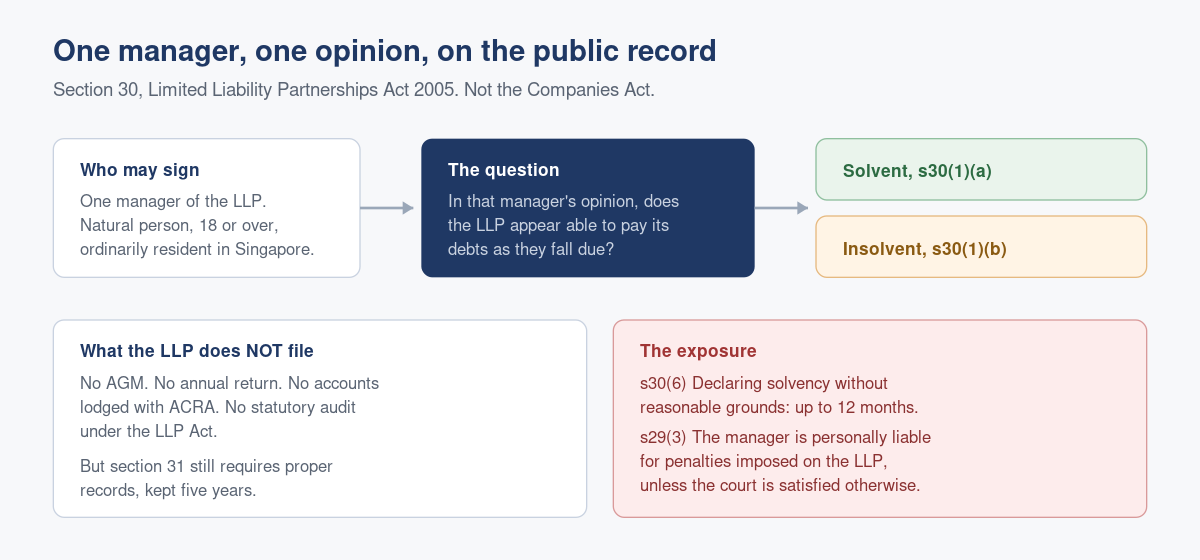
A Singapore LLP’s annual declaration is not a return of accounts. It is a statement by one named manager, in that manager’s own opinion, that the LLP either can or cannot pay its debts as they fall due in the normal course of business. That is the whole of it, and it carries criminal liability.
Raffles Corporate Services works with a panel of experienced Singapore law firms who offer cost-effective and efficient legal service and advice. This article is general information only and is not legal advice.
Most LLP managers file it in about four minutes, tick the solvency box without pausing, and pay $30. Which is usually fine. But the thing being signed is a personal opinion on solvency, and section 30 of the Limited Liability Partnerships Act 2005 attaches real consequences to getting it wrong.
Note the governing statute. LLPs sit under the LLP Act 2005, not the Companies Act 1967. The deadlines, the penalties and the offences are all different from a company’s annual return, and conflating the two is the most common source of bad advice on this topic.
What an annual declaration actually is
Section 30(1) of the LLP Act 2005 requires every LLP to lodge with the Registrar a declaration by one of its managers stating that, in that manager’s opinion, the LLP either:
- appears as at that date to be able to pay its debts as they become due in the normal course of business; or
- does not appear as at that date to be able to pay its debts as they become due in the normal course of business.
Section 30(2) allows the declaration to carry such further prescribed particulars as ACRA requires, which is why the Bizfile form also asks you to confirm the LLP’s entity details before you can proceed.
Three things follow from that wording, and they are worth spelling out.
It is a cash-flow test, not a balance sheet test. The question is whether debts can be met as they fall due, in the ordinary course. An LLP with negative net assets but comfortable cash flow can properly declare solvency. An LLP sitting on illiquid assets and unable to meet next month’s payroll cannot.
It is a point-in-time opinion. “As at that date.” You are declaring what you believe today, not guaranteeing next year.
It belongs to a person, not the firm. The Act says “a declaration by one of its managers”, and “in that manager’s opinion”. You cannot file it as a collective view of the partners.
What an annual declaration is not
This is where LLPs get confused, usually by advice written for companies.
| Companies (Companies Act 1967) | LLPs (LLP Act 2005) |
|---|---|
| Must hold an AGM | No AGM requirement |
| Annual return lodged after the AGM, under section 197 | Annual declaration lodged under section 30 |
| Financial statements lodged with ACRA, subject to exemptions | No requirement to lodge accounts with ACRA |
| Audit unless the small company exemption applies | No statutory audit requirement under the LLP Act |
| Deadline keyed to financial year end | Deadline keyed to registration date, then to the last declaration |
The LLP still has to keep proper books. Section 31 requires accounting and other records sufficient to explain its transactions and financial position and to allow true and fair profit and loss accounts and balance sheets to be prepared, retained for at least five years from the end of the relevant financial year, and open at all times to inspection by the partners. Failure carries, for an individual offender, a fine of up to $10,000 or imprisonment of up to two years, or both.
So the accounts are not filed. They are still required to exist, and they are the only honest basis on which a manager can form the solvency opinion being declared.
Who files, and who is on the hook
Every LLP must have at least one manager who is a natural person, at least 18, of full legal capacity and ordinarily resident in Singapore. That is section 29(1).
Section 29(3) is the provision managers should read twice. A manager is answerable for the doing of everything the LLP is required to do under sections 30, 33 and 34, and is personally liable for all penalties imposed on the LLP for contravening those sections, unless the manager satisfies the court that they should not be so liable.
In practice that means the manager cannot treat a late annual declaration as the firm’s problem. It is theirs, unless they can persuade a court otherwise.
A corporate service provider can file on the LLP’s behalf through Bizfile, and most do. That changes who operates the keyboard. It does not change who holds the statutory duty.
What the filing itself involves
You will need Corppass access to the LLP, which is a separate exercise and not a same-day one. Sort it out well before the deadline.
In Bizfile you confirm the LLP’s entity information first, then the system populates the declaration dates for you, then you state whether the LLP is able or unable to pay its debts, then you pay. The fee is $30 and the register updates immediately. You also receive a free electronic Business Profile afterwards, downloadable for 60 days. Download it the same day: it is the cleanest contemporaneous proof that the declaration was lodged.
One oddity worth knowing in advance. The underlying eService is labelled around annual returns, which is confusing given that an LLP does not file an annual return at all. You are in the right place.
Our step-by-step walkthrough of filing the LLP annual declaration in Bizfile covers each screen, and logging in to Bizfile as a business user covers the Corppass route.
The offences nobody reads
Section 30 sets out a tiered set of offences, and the tiers tell you what ACRA is actually worried about.
| Conduct | Provision | Maximum exposure |
|---|---|---|
| LLP fails to lodge the declaration in time | s30(5) | Fine up to $5,000, plus a deeming consequence under the Fifth Schedule |
| Manager declares solvency without reasonable grounds for that opinion | s30(6) | Individual: fine up to $5,000, or up to 12 months’ imprisonment, or both |
| Someone feeds the manager false or misleading information for the declaration, knowing or where they ought to have known | s30(7) | Individual: fine up to $10,000, or up to 2 years’ imprisonment, or both |
| Any of the above committed with intent to defraud creditors or for a fraudulent purpose | s30(8) | Individual: fine up to $15,000, or up to 3 years’ imprisonment, or both |
Section 30(6) is the one that should change behaviour. The offence is not lying. It is declaring solvency without having reasonable grounds for the opinion. A manager who ticks the box without looking at the numbers has no reasonable grounds, whether or not the LLP turns out to be solvent.
Section 30(7) matters for partners and finance staff who are not the manager. If you hand the manager figures you know, or should know, are misleading, the offence reaches you directly.
What goes wrong: the deemed insolvency trap
Here is the consequence almost nobody knows about, and it is the strongest argument for filing on time.
Paragraph 3(2)(d) of the Fifth Schedule to the LLP Act 2005 provides that, for the purposes of a court winding up on the ground that the LLP is unable to pay its debts, the LLP is deemed to be unable to pay its debts where it fails to lodge a declaration as required under section 30, and that deeming continues until a declaration of solvency under section 30(1)(a) is lodged.
Read the effect of that. An LLP that simply forgets to file is not merely late. It is statutorily deemed insolvent for winding-up purposes, and stays deemed insolvent until it files a solvency declaration. Any creditor who wants leverage has a ready-made route to the court, and the LLP has removed its own best answer.
The second failure mode is quieter. Section 63 allows the Registrar to strike a defunct LLP off the register where there is reasonable cause to believe it is not carrying on business or not in operation. That starts with a letter giving 30 days to show cause, then a Gazette notice, then striking off 60 days later. Sustained non-filing is exactly the kind of signal that invites it.
Third: late lodgement penalties. ACRA charges $300 for an annual declaration filed up to three months late, and $600 beyond that, for due dates from 14 January 2022. They are applied automatically in Bizfile when you file, and under section 29(3) the manager may personally carry them.
Frequently asked questions
Does an LLP have to file financial statements with ACRA?
No. Unlike a company, a Singapore LLP does not lodge accounts with ACRA and has no statutory audit requirement under the LLP Act 2005. It must still keep accounting records under section 31 for at least five years, open to inspection by the partners, and those records are what the manager’s solvency opinion has to rest on.
Can a partner sign the annual declaration instead of a manager?
No. Section 30(1) requires a declaration by one of the LLP’s managers, expressing that manager’s own opinion. A partner who is not also a manager cannot give it. If the LLP has no qualifying manager, that is a separate contravention of section 29(1) and needs fixing before the declaration can be lodged.
What happens if the LLP is genuinely insolvent?
You still file, and you declare insolvency. Declaring insolvency is a lawful option expressly provided for in section 30(1)(b). Declaring solvency without reasonable grounds is an offence under section 30(6) carrying up to 12 months’ imprisonment for an individual. Not filing at all triggers the deemed insolvency in the Fifth Schedule.
How much does it cost to file an LLP annual declaration?
The filing fee is $30, paid in Bizfile at the point of submission. There is no charge for filing early. If you are late, the late lodgement penalty of $300 or $600 is added automatically on top of the fee, depending on whether you are within three months of the deadline or past it.
Who receives the reminder before the deadline?
ACRA emails about one month ahead, to the registered email addresses of position holders recorded in Bizfile, including managers and partners. Pop-up alerts also appear when you log in. The reminder is a courtesy, not a legal trigger, and our note on ACRA filing reminders explains why missing one is no defence.
Getting the declaration right, not just filed
The annual declaration is cheap, quick and easy to treat as a formality. The reason to take it seriously is that section 30 puts a named individual’s opinion on the public record, and section 29(3) puts that individual personally behind the penalties.
Ten minutes with the management accounts before you tick the box is the difference between a considered opinion and an offence under section 30(6). That is not a heavy lift. It just has to happen.
Raffles Corporate Services acts as corporate secretary and filing agent for Singapore LLPs and companies, tracks declaration dates from the statutory clock rather than from ACRA’s reminder, and prepares the underlying accounts so the manager has something real to form an opinion on. If your LLP’s last declaration date is a mystery, that is worth a conversation now rather than after the deadline.
For the timing rules in detail, see our companion piece on LLP annual declaration deadlines. If your LLP holds beneficial owners behind nominees, the Register of Registrable Controllers guide covers a parallel obligation that carries no ACRA reminder at all.
— The Editorial Team, Raffles Corporate Services
Need help with corporate secretarial or compliance matters?
If you would like help with your company's corporate secretarial, governance or compliance requirements, email [email protected] or WhatsApp +65 8501 7133.
Our team can assist with corporate secretarial, accounting and tax matters. Where legal advice is needed, advisers from our associated law firms can assist.