
Most Singapore companies must file their financial statements with ACRA in XBRL, a structured data format, as part of the annual return. Which template you use depends on your size and whether you are publicly accountable, and getting the wrong one is the usual reason a filing stalls.
Raffles Corporate Services works with a panel of experienced Singapore law firms who offer cost-effective and efficient legal service and advice. This article is general information only and is not legal advice.
XBRL is not a summary of your accounts. It is your accounts, tagged element by element against ACRA’s taxonomy so that the figures can be read by machines rather than people. That is why the work is fiddly, why the validation rules are unforgiving, and why it is almost always done last, in a rush, days before the annual return is due.
Here is how to work out what you owe, in what format, and which errors to expect.
Do you have to file financial statements at all?
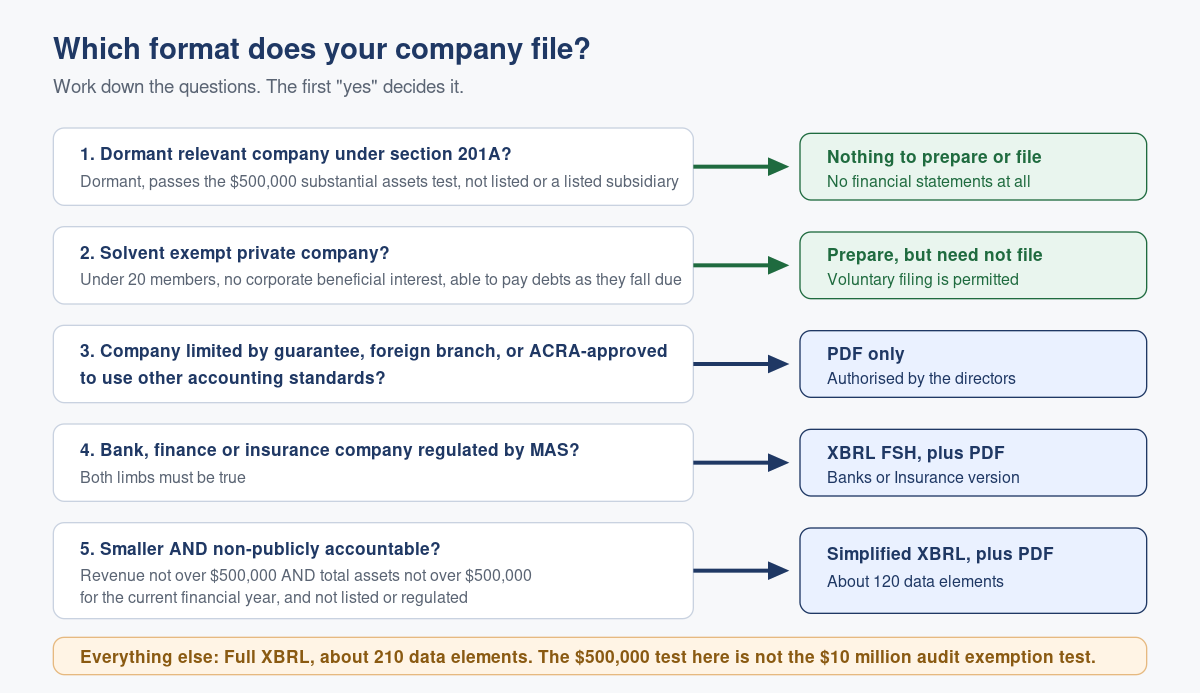
Every Singapore-incorporated company must prepare financial statements, other than a dormant relevant company, and must file them with ACRA unless an exemption applies. Two exemptions matter in practice.
Dormant relevant companies
A company that meets all of the conditions in section 201A of the Companies Act 1967 does not have to prepare or file financial statements at all. Broadly, it must have been dormant either since incorporation or since the end of the previous financial year, it must pass a substantial assets test, and it must not be a listed company or a subsidiary of one.
The substantial assets test is met if total assets did not exceed $500,000 at any time during the financial year, or, for a parent company, if consolidated group total assets did not exceed $500,000 at any time during the year. Note the wording: at any time, not at year end. A balance that spiked in March and was gone by December still counts.
Solvent exempt private companies
A solvent exempt private company (EPC) does not have to file financial statements, although it may choose to. You need both halves.
Exempt private company status. Either the company has fewer than 20 members with no corporation holding a beneficial interest in its shares, directly or indirectly, or it is a private company owned by the Government and declared an EPC by Gazette.
Solvency. The company is able to meet its debts as and when they fall due. You make an online declaration to that effect when you file the annual return.
An EPC that is insolvent loses the relief and must file. So does a private company the moment a corporation acquires a beneficial interest in its shares, which is the point most founders miss when they insert a holding company.
One thing worth knowing before you file voluntarily: financial statements filed as part of the annual return can be purchased by anyone. Your competitors included.
Which template applies to your company
| Your company | What you file |
|---|---|
| Smaller and non-publicly accountable, including insolvent EPCs | Simplified XBRL financial statements, plus a PDF of the financial statements authorised by the directors |
| Banks, finance and insurance companies regulated by MAS | XBRL FSH (Banks) or XBRL FSH (Insurance), plus a PDF authorised by the directors |
| Companies limited by guarantee, or companies approved by ACRA to use other accounting standards | PDF of the financial statements authorised by the directors only |
| All other Singapore-incorporated companies required to file, including insolvent EPCs that are not both smaller and non-publicly accountable | Full XBRL financial statements |
| Solvent EPCs filing voluntarily | Optional. Either XBRL in the template matching their size and accountability status, or a PDF |
| Foreign company with a Singapore branch | PDF of the financial statements authorised by the directors only |
What “smaller” means here, and why it is not the audit threshold
This is the trap. The $10 million thresholds you know from audit exemption and the small company test have nothing to do with XBRL. ACRA’s filing test uses a completely different and much lower bar.
A smaller company for XBRL purposes is one where both of the following are true for the current financial year:
- revenue does not exceed $500,000; and
- total assets do not exceed $500,000.
Both, not two of three, and measured on the current year rather than on a two-year lookback. Four further points on the measurement:
- Use the financial statements you are required to prepare under the Companies Act.
- If you have a subsidiary, associate or joint venture, use consolidated figures, unless you are exempt from preparing consolidated financial statements under the accounting standards or by ACRA.
- Apply the $500,000 threshold regardless of how long the financial year is. A fifteen-month first year gets no allowance.
- For financial statements in a foreign currency, translate revenue at average rates over the year and total assets at the closing rate at year end.
A non-publicly accountable company is one that is not listed and not in the process of listing in Singapore or overseas, and is not a bank, merchant bank, licensed finance company, payment institution or designated payment system operator, not a licensed insurer, Lloyd’s Asia Scheme foreign insurer or registered insurance broker, not an approved exchange, clearing house, recognised market operator or approved holding company, not a capital markets services licence holder, licensed financial adviser, registered fund management company, licensed trust company or approved collective investment scheme trustee, and not one of a short list of other regulated entities including licensed trade repositories, benchmark administrators, the Central Depository System operator, trustee-managers of listed registered business trusts, designated financial holding companies and licensed credit bureaux.
For an ordinary trading SME the answer is yes, you are non-publicly accountable. If you hold any MAS licence, check the list properly.
How much data each template wants
| Template | Approximate data elements | What it captures |
|---|---|---|
| Full XBRL | About 210 | Primary statements and selected notes |
| Simplified XBRL | About 120 | Complete financial performance and position statements, plus selected notes |
| XBRL FSH (Banks) | About 80 | Highlights for banking companies |
| XBRL FSH (Insurance) | About 80 | Highlights for insurance companies |
The three ways to prepare the file
- ACRA’s BizFinx preparation tool. Free, and the default route for most companies and corporate service providers. New versions of the preparation tool and the multi-upload tool were released on 25 February 2026, alongside ACRA Taxonomy 2026. If you still have an older version installed, uninstall it before installing the new one.
- Approved accounting software. Some accounting platforms generate a compliant XBRL file directly from the ledger, which removes most of the transcription risk.
- A corporate service provider. The common choice where the accounts are already prepared externally.
Whichever route you take, you then upload the file and lodge it as part of the annual return in Bizfile. If you are new to that interface, what Bizfile actually is and logging in as a business user through Corppass cover the mechanics, and how to file your annual return step by step covers the transaction itself.
One timing rule catches people out. An uploaded XBRL file is held for 14 days from the date of upload. If you do not complete the annual return within that window, the file lapses and you upload it again. Uploading early and filing late is not a strategy.
What goes wrong, and what it costs you
The cost of an XBRL error is rarely a penalty. It is delay, at exactly the moment you have none left. A filing that fails validation on the last day of your annual return deadline becomes a late lodgement, and late lodgement does carry a penalty.
The XBRL does not match the AGM financial statements. The figures and the format in the XBRL file must match the financial statements laid before members. The usual culprits are a mismatch in the level of rounding (thousands in one, units in the other), a currency indicator set to the wrong currency, the wrong presentation format, missing cash flow fields, an omitted profit or loss from discontinued operations, or the wrong accounting standard selected. SFRS and SFRS for Small Entities are different selections and cannot be swapped.
The text block is incomplete. The “disclosure of complete set of financial statements” text block has to contain the whole set: statement by directors, auditor’s report where there is one, the four primary statements and the notes. It must be legible and identical to the financial statements presented at the AGM. Truncated pastes produce the Misc_005 and Misc_041 errors. Misc_041 is one of the errors for which you can apply to ACRA for an exemption if you are satisfied the full set really is there.
The cover page date is in the wrong format. The date on the cover page must be a long date in day, month, year order, for example 31 December 2025. Anything else produces a BR32 error. This is the most trivially avoidable rejection in the whole process.
Totals do not equal the sum of their parts. Correlated_070 and Misc_040 errors mean a parent field does not agree to its child fields. Recurring offenders are total land and buildings (freehold land plus leasehold land and buildings), total vehicles (ships, aircraft, motor vehicles and other vehicles), and carrying value, which must equal gross carrying amount less accumulated depreciation, amortisation and impairment. Watch for double counting when a subtotal has already been included.
Property, plant and equipment is half done. Misc_040 and Misc_102 also appear where the analysis of net book value by measurement basis is blank: both “at cost” and “at valuation” need completing, and they must add to the closing net book value. Crossstatement_046 and 047 mean the PPE template is simply incomplete. Right-of-use assets accounted for as PPE belong inside the PPE balance and its movements, not in a category of their own.
Expenses are tagged by function when the template wants nature. The income statement template collects expenses by nature. If your financial statements present by function, you still have the nature breakdown in the notes, and that is what you map across on a best-fit basis.
First-year consolidation columns are filled with zeros. If you are consolidating for the first time and the financial statements show no prior year group figures, leave the prior year group column blank. Do not enter $0.
Prior year data will not import. You can only import saved XBRL.zip files prepared under ACRA Taxonomy 2022 or later, and even then not every element carries across between taxonomy versions. Check every comparative rather than assuming the import handled it.
Frequently asked questions
Does my company have to file financial statements in XBRL?
Most Singapore-incorporated companies do, as part of the annual return. The main exceptions are dormant relevant companies meeting section 201A, solvent exempt private companies, companies limited by guarantee and foreign branches, the last two of which file a PDF instead. Everyone else files Full XBRL or Simplified XBRL depending on size and accountability.
What is the difference between Full XBRL and Simplified XBRL?
Full XBRL captures around 210 data elements covering the primary statements and selected notes. Simplified XBRL captures around 120 and is available only to companies that are both smaller (revenue and total assets each not exceeding $500,000 for the current financial year) and non-publicly accountable. Simplified filers also lodge a PDF of the directors’ authorised financial statements.
Is the XBRL “smaller company” test the same as audit exemption?
No, and they are frequently confused. Audit exemption uses a $10 million revenue or total assets threshold and a 50 employee criterion assessed over two preceding financial years. The XBRL smaller company test uses $500,000 for both revenue and total assets, assessed on the current financial year. A company can be audit exempt and still file Full XBRL.
How long does ACRA keep my uploaded XBRL file?
Fourteen days from the date of upload. If the annual return is not filed within that period the upload lapses and you will need to upload the file again. If an uploaded file turns out to be wrong, you do not delete it, you simply upload a corrected file.
Who can prepare the XBRL file?
Anyone with access to the company’s Bizfile account and the financial statements. In practice it is prepared using ACRA’s free BizFinx preparation tool, by accounting software that generates a compliant file, or by a corporate service provider. Responsibility for the accuracy of what is filed stays with the directors.
What happens if the XBRL figures do not match our audited accounts?
The file will usually fail validation, and where it does not, you have filed something inconsistent with what the directors approved. Since the directors carry personal responsibility for the financial statements, that is a problem worth avoiding. Reconcile the XBRL back to the signed accounts before you lodge.
Do the XBRL early, not last
The pattern we see every year is identical. The accounts are finalised, the AGM is held, everyone relaxes, and then the XBRL is attempted four days before the annual return deadline, at which point a rounding mismatch and an incomplete PPE note turn into a late filing.
Raffles Corporate Services prepares and lodges XBRL financial statements for Singapore companies as part of the annual compliance cycle, reconciled line by line back to the signed accounts, with the template decision documented rather than guessed. If your last filing was painful, or you are not certain which template you should be using, that is a short conversation.
ACRA publishes the taxonomy files, validation rules and preparation tools on its XBRL filing pages, the statutory basis is in the Companies Act 1967, and you can read more on Singapore corporate secretarial practice at Singapore Secretary Services.
— The Editorial Team, Raffles Corporate Services
Need help with this?
Raffles Corporate Services can handle the ACRA filings, compliance documentation and records for you, and where court proceedings or legal advice are needed, we work with a panel of experienced Singapore law firms who offer cost-effective and efficient legal service and advice.
Email: [email protected]
Call, SMS or WhatsApp: +65 8501 7133