
A members’ voluntary winding up is how a solvent company closes when it has assets to realise, surplus to return to shareholders, or anything else that makes a simple strike off inappropriate. The gateway is a declaration of solvency: the directors must be able to say the company will pay its debts in full within 12 months.
Raffles Corporate Services works with a panel of experienced Singapore law firms who offer cost-effective and efficient legal service and advice. This article is general information only and is not legal advice.
That declaration is not a form. It is a personal exposure. Get it wrong and the director who signed it faces a fine, or imprisonment, or both, and the law presumes against them if the debts are not in fact paid.
This is part 1 of three. Part 2 covers creditors’ voluntary winding up, where the company cannot pay. Part 3 covers court-ordered compulsory winding up.
When you need a winding up rather than a strike off
Striking off is cheaper, free in fact, and faster. Most small Singapore companies close that way. But strike off requires the company to own nothing and owe nothing, and a great many companies that have finished trading are not in that position.
Choose a members’ voluntary winding up when the company is solvent and any of the following is true.
| Situation | Why strike off will not work |
|---|---|
| The company still holds assets to be realised and distributed | Strike off requires no assets. Property left in a dissolved company is expensive to recover |
| There is a surplus to return to shareholders | A liquidator is the clean mechanism for distributing it, with a record of how it was done |
| There are creditors who will be paid in full, but not immediately | Strike off requires no liabilities at all, including contingent ones |
| Shareholders want a formal, documented close | Liquidation produces an account of how the winding up was conducted |
| A parent, lender or overseas regulator requires a liquidation | Strike off is an administrative removal, not a liquidation |
Where the company genuinely has nothing on either side of the balance sheet, use the strike off route instead. That process is covered in our separate guides on striking off a local company.
The declaration of solvency, and why directors should take it seriously
Section 163 of the Insolvency, Restructuring and Dissolution Act 2018 sets out the gateway. Before the notices of the general meeting are sent out, the directors, or a majority of them where there are more than two, must declare that they have inquired into the company’s affairs and have formed the opinion, at a meeting of directors, that the company will be able to pay its debts in full within a period not exceeding 12 months after the winding up commences.
Four conditions attach to that declaration, and missing any of them makes it ineffective.
- It must be made at the directors’ meeting itself, not circulated afterwards for signature.
- A statement of affairs must be attached, in the prescribed form, showing the company’s assets and the amount expected to be realised from them, its liabilities, and the estimated expenses of the winding up, made up to the latest practicable date.
- It must be made within the five weeks immediately before the resolution for voluntary winding up is passed.
- It must be lodged with the Registrar of Companies before the notices of the general meeting go out.
The personal risk
A director who makes the declaration without reasonable grounds for the opinion commits an offence under section 163(4) of the IRDA, punishable by a fine not exceeding $5,000, or imprisonment for a term not exceeding 12 months, or both.
Worse, section 163(5) reverses the burden. If the resolution is passed within five weeks of the declaration and the debts are then not paid in full within the period stated, it is presumed that the director did not have reasonable grounds, until they show otherwise.
So do the arithmetic properly. Include the contingent items: tax not yet assessed, a lease not yet surrendered, employment claims not yet crystallised. A declaration made on optimistic numbers is exactly what section 163(5) is designed to catch. Directors’ duties already sharpen as solvency comes into doubt, as the Park Hotel ruling on duties to creditors sets out.
The process, in order
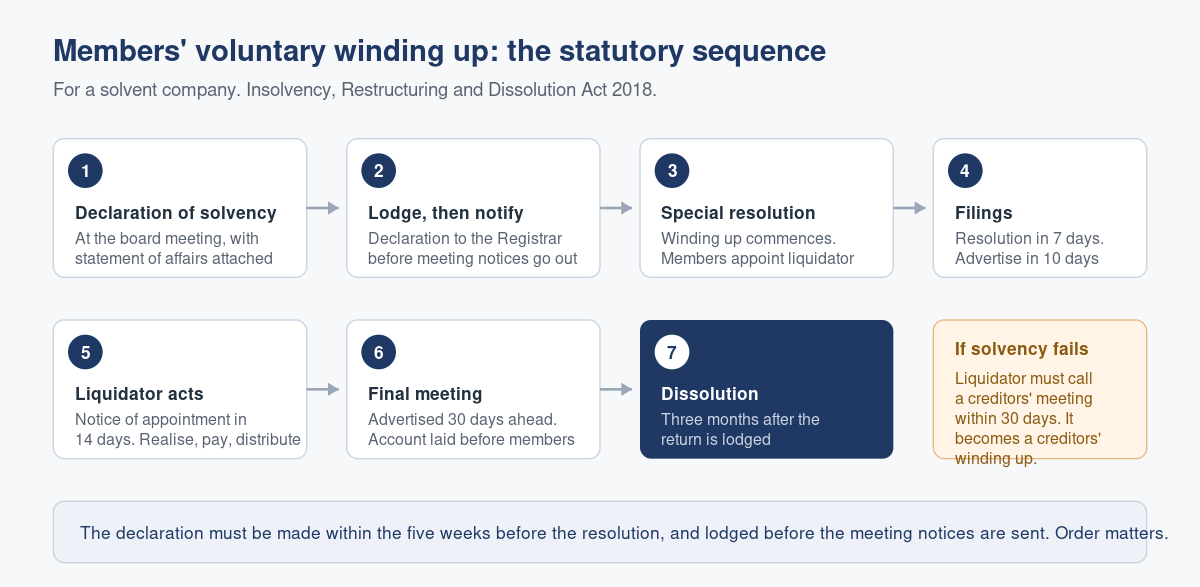
- Board meeting. The directors inquire into the company’s affairs, form the solvency opinion and make the declaration, with the statement of affairs attached.
- Lodge the declaration with the Registrar of Companies, before the notices of the general meeting are sent.
- Send out notices of the general meeting to members.
- Members pass a special resolution to wind the company up voluntarily. Under section 161(6) of the IRDA, this is the moment the voluntary winding up commences, where no provisional liquidator has been appointed.
- Members appoint the liquidator and fix the remuneration, under section 164 of the IRDA. On appointment, the directors’ powers cease, except so far as the liquidator or the company in general meeting with the liquidator’s consent allows them to continue.
- Lodge the resolution with the Registrar within seven days of it being passed, and advertise notice of it in the Gazette and at least one English local daily newspaper within 10 days. Section 160(2) of the IRDA sets both deadlines, and failing them is an offence carrying a fine not exceeding $5,000 and a default penalty for the company and every officer in default.
- Liquidator lodges notice of appointment and the address of the liquidator’s office with the Registrar of Companies and the Official Receiver within 14 days of appointment, under section 191 of the IRDA. ACRA’s “Manage winding up” eService handles this filing.
- The liquidator realises assets, pays creditors in full and distributes the surplus to members. Throughout, the company must use the words “in liquidation” after its name on invoices, orders, business letters, correspondence and its website, under section 194 of the IRDA.
- Final meeting. When the affairs are fully wound up, the liquidator makes up an account of how the winding up was conducted and calls a general meeting to lay it before members.
- Dissolution. Three months after the return of the final meeting is lodged, the company is dissolved.
The end of the process is more prescriptive than people expect
Section 180 of the IRDA governs the final stage and it is tightly specified. The meeting must be called by an advertisement in the Gazette and at least one English local daily newspaper, stating the time, place and object of the meeting, published at least 30 days beforehand, with a copy sent to the Official Receiver within seven days of publication.
Within seven days after the meeting, the liquidator lodges a return of the holding and date of the meeting with the Registrar of Companies and the Official Receiver, with the account attached. If no quorum turned up, and the quorum is two members, the liquidator lodges a return saying so instead, which keeps the process moving.
The company is then dissolved three months after that return is lodged. The Court can defer that date on application.
Two points nobody tells you
The liquidator in a members’ voluntary winding up does not have to be a licensed insolvency practitioner. Section 47(2)(b) of the IRDA expressly carves a members’ voluntary winding up liquidator out of the licensing regime. Section 47(3) does require that person to give the Official Receiver written notice of their appointment in the prescribed form.
That carve out is narrow and it is not an invitation to appoint the cheapest available person. The liquidator takes over the company, displaces the board, and is responsible for getting the distributions and the filings right. But it does mean a solvent close does not automatically require insolvency counsel, which materially changes the cost.
The moment a members’ voluntary winding up stops being solvent, it converts. Under section 165 of the IRDA, if the liquidator forms the opinion at any time that the company will not be able to pay its debts in full within the declared period, the liquidator must immediately summon a creditors’ meeting: for a day not later than 30 days after forming that opinion, with at least seven days’ notice to creditors, advertised in the Gazette and an English local daily newspaper, and with a statement of the company’s assets and liabilities laid before it.
The creditors may then appoint their own liquidator in place of the members’ appointee. Either way, the winding up proceeds from that point as a creditors’ voluntary winding up, which is the subject of part 2.
What goes wrong
The declaration is lodged late, or out of sequence. It has to be lodged with the Registrar before the meeting notices go out, and made within five weeks before the resolution. Companies routinely do these in the wrong order, and an ineffective declaration means there is no members’ voluntary winding up at all.
The seven-day and 10-day deadlines after the resolution are missed. Lodging the resolution and advertising it are easy to forget in the flurry after a meeting. Both carry offences.
The statement of affairs is optimistic. Assets valued at book rather than realisable value, winding up expenses understated, tax provisions missing. This is what triggers section 163(5).
Share transfers happen after commencement. Section 162(3) of the IRDA makes any transfer of shares after commencement void, unless made to or with the sanction of the liquidator. Deals agreed before the resolution and completed afterwards are a recurring problem.
“In liquidation” is left off the paperwork. Section 194 of the IRDA requires it on correspondence and on the company’s website. Default carries a fine not exceeding $10,000 and a default penalty for the company and for officers and liquidators who knowingly permit it.
The company keeps trading. Section 162(1) requires the company to cease business from commencement, except so far as the liquidator considers it necessary for the beneficial winding up.
Frequently asked questions
What is the difference between a members’ voluntary winding up and a creditors’ voluntary winding up?
Solvency. A members’ voluntary winding up requires the directors to declare that the company will pay its debts in full within 12 months of commencement. Without that declaration, the winding up is a creditors’ voluntary winding up, and the creditors, rather than the members, control the appointment of the liquidator.
How long does a members’ voluntary winding up take?
Usually six to twelve months, and rarely less. The realisation of assets and settlement of tax drive the timetable. The tail end alone is fixed by statute: the final meeting needs 30 days of advertised notice, and the company is dissolved three months after the return of that meeting is lodged.
Can we do a members’ voluntary winding up instead of striking off just to be safe?
You can, and sometimes you should, but it costs real money and takes far longer. If the company genuinely has no assets, no liabilities and no registered charges, striking off is the proportionate route. Winding up earns its cost where there are assets to distribute or creditors to pay out.
Who can be the liquidator in a members’ voluntary winding up?
The members appoint the liquidator in general meeting and fix the remuneration. Section 47(2)(b) of the Insolvency, Restructuring and Dissolution Act 2018 exempts a members’ voluntary winding up liquidator from the insolvency practitioner licensing requirement, though the appointee must give the Official Receiver written notice of the appointment.
What happens to the directors once a liquidator is appointed?
Their powers cease under section 164(2) of the IRDA, except so far as the liquidator, or the company in general meeting with the liquidator’s consent, approves their continuance. The directors remain directors on the register, and their duties and potential liabilities do not disappear, but they no longer run the company.
Can we start a voluntary winding up if a creditor has already applied to court?
Not freely. Section 184 of the IRDA provides that where an application has been made to the Court to wind up the company on the ground that it cannot pay its debts, the company must not resolve to wind up voluntarily without the Court’s permission. Deal with the court application first.
Choosing the right exit is the whole decision
Almost every expensive closure we see started with the wrong route. A company with a subsidiary shareholding applied for strike off. A company with an unpaid intercompany balance declared solvency it could not support.
Raffles Corporate Services helps Singapore companies work out which of strike off, members’ voluntary winding up or a creditors’ process actually fits, then handles the corporate secretarial side of whichever one you take. If your company is somewhere between “we have stopped trading” and “we have closed”, that is a conversation worth having early.
You can reach us through Raffles Corporate Services, or read more on Singapore corporate secretarial practice at Singapore Secretary Services. The provisions cited above are on Singapore Statutes Online, and ACRA’s winding up eServices sit on acra.gov.sg.
— The Editorial Team, Raffles Corporate Services
Need help with this?
Raffles Corporate Services can handle the ACRA filings, compliance documentation and records for you, and where court proceedings or legal advice are needed, we work with a panel of experienced Singapore law firms who offer cost-effective and efficient legal service and advice.
Email: [email protected]
Call, SMS or WhatsApp: +65 8501 7133