
Approval is not closure. From ACRA’s approval, the strike off runs for at least three months through two gazette notifications and two separate objection windows, and the company stays Live and fully compliance-bound the entire time. It is dissolved only when the final gazette notification is published.
Raffles Corporate Services works with a panel of experienced Singapore law firms who offer cost-effective and efficient legal service and advice. This article is general information only and is not legal advice.
That gap between “approved” and “gone” catches people out. Directors treat the approval notification as the end, stop watching the Bizfile inbox, and miss an objection letter. The company drifts back to Live status, the annual return obligation was running the whole time, and the exercise has to start again.
This is part 3 of three. Part 1 covers eligibility and part 2 covers the application. This one covers the waiting.
The sequence, stage by stage
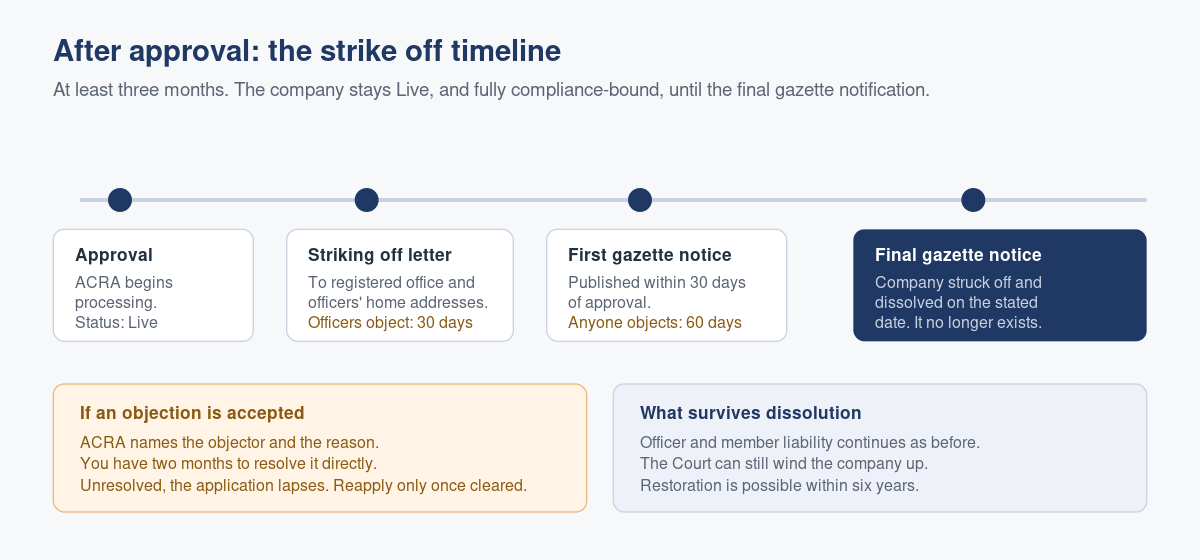
| Stage | What happens | Timing |
|---|---|---|
| Approval | ACRA accepts the application and begins processing. Company remains Live | Immediate, or after all endorsements are in |
| Striking off letter | ACRA writes to the registered office and to officers’ residential addresses | Shortly after approval |
| Officers’ objection window | Company officers may object to the strike off | 30 days from the date of the letter |
| First gazette notification | The company’s name is published with notice of the intention to strike it off | Within 30 days of approval |
| Public objection window | Any person may object and show cause | 60 days from the first gazette notification |
| Final gazette notification | The company’s name is published as struck off | After the objection period closes |
| Dissolution | The company ceases to exist from the date stated | On publication of the final gazette notification |
The statutory backbone is section 344A of the Companies Act 1967. Subsection (3) is the letter to the company, its directors, secretaries and members, with 30 days to show cause. Subsection (4) requires the Registrar to wait 60 days after publishing the gazette notice inviting objections. Subsection (5) is the actual striking off, and subsection (6) is the line that matters: on publication of that notice in the Gazette, the company is dissolved.
Why the letters matter more than the gazette
Almost nobody reads the Government Gazette. ACRA’s letters, on the other hand, go to the company’s registered office and to the residential addresses of its officers, and those letters are the practical notice.
If the registered office has lapsed, or the officers’ residential addresses in ACRA’s records are out of date, the letters do not land. That is a live cause of failed strike offs. The remedy is boring and cheap: update the addresses before you apply, and keep the registered office live until the final gazette notification appears.
What an objection actually does
Section 344C of the Companies Act 1967 lets any person deliver an objection to the Registrar, in the prescribed form, before the date stated in the notice. The ground is that there is reasonable cause why the name should not be struck off, including that the company does not in fact satisfy the grounds for striking off.
Objectors are usually one of three parties.
An unpaid creditor. A supplier, a landlord or a lender who has spotted the gazette notice, or more often has been told by someone that the company is closing. Their objection is that the company has a liability, which contradicts the declaration made in the application.
A government agency. An outstanding tax filing, an unpaid CPF contribution, an unresolved regulatory matter.
A shareholder or former officer. Usually someone who disputes that the directors had authority, or who says assets remain to be distributed.
If ACRA accepts the objection, the company is told who objected and why, and the company gets a window of two months to resolve the matter directly with the objector. Resolve it and the strike off continues. Fail to resolve it within that window and the application lapses. You can apply again, but only once the objection has actually been cleared, which means paying the creditor, filing the return, or getting the objector to withdraw in writing.
That is the honest answer to “can we just push through”. No. An objection is a stop, not a delay.
What survives dissolution
A struck off company no longer legally exists. That does not wipe the slate.
Officer and member liability continues. Section 344A(7)(a) of the Companies Act 1967 preserves the liability of every officer and member as if the company had not been dissolved. Dissolution is not an amnesty for a director who signed a personal guarantee, or who acted in breach of duty while the company traded.
The Court can still wind the company up. Section 344A(7)(b) expressly preserves that power. A creditor who discovers assets or misconduct after dissolution has a route.
Assets do not vanish, they change hands. Property still standing in the name of a dissolved company does not simply belong to its former shareholders. Leaving a bank balance, a shareholding or a piece of intellectual property behind is a genuinely expensive mistake to fix, and it is one of the reasons the “no assets” criterion is not a formality.
Records still have to be kept. Someone needs to hold the company’s books after dissolution. If a dispute surfaces, a former director with no documents is in a difficult position, and the reinstatement of statutory registers after a restoration is far harder than simply keeping them in the first place.
Restoration, in outline
A struck off company can come back. The Companies Act 1967 provides two routes, and which one is open to you depends on how the company was struck off.
Court-ordered restoration
Where the company was struck off on its own application, restoration is by court order, and the application must be made within six years of the striking off. The court can restore the name to the register and give directions to put the company and everyone else back in the position they would have been in.
Once the order is filed on Bizfile, ACRA processes it and the company’s status returns to Live. This is a litigation exercise with its own costs, and the division of labour between your corporate secretary and your lawyers is worth understanding before you start: our note on the CSP and counsel handoff covers that.
Administrative restoration
Section 344D of the Companies Act 1967 allows a former director or former member to apply to the Registrar, rather than the Court, to restore a company’s name. The application must reach the Registrar within six years of dissolution, and it is not available if a court application is already on foot.
The important limit: this route applies to companies struck off by the Registrar under section 344, that is, where ACRA initiated the strike off because it believed the company was not carrying on business. It is not the route for a company that applied to be struck off and then changed its mind years later.
Separately, section 344F lets the Registrar restore a company struck off through the Registrar’s own mistake, which expressly excludes a mistake caused by wrong or misleading information in the strike off application itself.
The effect of restoration
Section 344G treats a restored company as having continued in existence as if it had never been struck off. There is one useful piece of relief in subsection (2): the company and its directors are not liable to the penalty for failing to file financial statements for a financial year where the filing deadline fell between the striking off and the restoration. Applications to the Court for consequential directions must be made within three years of the restoration.
What goes wrong in the waiting period
Nobody watches the inbox. The single most common failure. Assign one person to check the Bizfile notifications and the registered office post weekly until the final gazette notification appears.
The registered office is given up too early. Companies terminate their registered address service the week they apply. Three months later the letters bounce and the strike off fails.
A bank account is left open. A live account is an asset and it attracts interest, which is income. Close accounts before you apply, not after.
Compliance obligations are treated as suspended. They are not. The company is Live throughout. If the strike off fails, every annual return and financial statement filing deadline that passed in the meantime was a real deadline, with late lodgement penalties attached. See also the recurring themes in the Companies Act 1967 common mistakes note.
Frequently asked questions
How long does striking off take from start to finish?
At least three months from ACRA’s approval of the application, and longer if anyone objects. The sequence is a striking off letter with a 30-day objection window for officers, a first gazette notification within 30 days of approval, a 60-day public objection window, and then the final gazette notification that dissolves the company.
Is my company still required to file annual returns while the strike off is running?
Yes. The company remains Live and registered with ACRA until the final gazette notification is published. Every filing obligation continues. If the strike off fails, those deadlines were real and the late lodgement exposure is real, so do not let the filings lapse on the assumption that closure is certain.
What happens if a creditor objects?
ACRA notifies the company of the objector’s identity and their reason. The company then has two months to resolve the matter directly with the objector. If it is not resolved in that window, the application lapses, and a fresh application can only be made once the objection has actually been cleared.
Can a struck off company be brought back?
Yes, within six years. A company struck off on its own application is restored by court order. A company struck off on the Registrar’s initiative may also be restored administratively by applying to the Registrar under section 344D of the Companies Act 1967. Restoration treats the company as having continued in existence throughout.
Does dissolution wipe out the directors’ liabilities?
No. Section 344A(7) of the Companies Act 1967 preserves the liability of every officer and member as if the company had not been dissolved, and preserves the Court’s power to wind up a struck off company. Personal guarantees, breaches of duty and statutory offences survive the company.
What happens to money still in the company’s bank account?
It should not be there. A company applying for strike off is declaring it has no assets. Funds left behind, and any unclaimed tax credits, end up with the Insolvency and Public Trustee’s Office, and former shareholders have to claim them through that office, with processing fees and delay. Empty the accounts first.
The last three months are the part people stop paying attention to
Which is exactly backwards. The application takes ten minutes. The three months afterwards are where a strike off is actually won or lost, and almost every failure traces back to a letter nobody received or an objection nobody answered.
Raffles Corporate Services keeps the registered office live, monitors the Bizfile notifications, and tells you the day the final gazette notification appears. If your company is somewhere in this sequence and you are not certain where, we can find out in an afternoon.
You can reach us through Raffles Corporate Services, or read more on Singapore corporate secretarial practice at Singapore Secretary Services. The provisions above are on Singapore Statutes Online.
— The Editorial Team, Raffles Corporate Services
Need help with this?
Raffles Corporate Services can handle the ACRA filings, compliance documentation and records for you, and where court proceedings or legal advice are needed, we work with a panel of experienced Singapore law firms who offer cost-effective and efficient legal service and advice.
Email: [email protected]
Call, SMS or WhatsApp: +65 8501 7133