
You can withdraw a striking off application at any point before the company is actually struck off, it costs nothing, and it takes effect immediately. The catch is who is allowed to do it: only the person who lodged the original application, or someone from the same corporate service provider firm.
Raffles Corporate Services works with a panel of experienced Singapore law firms who offer cost-effective and efficient legal service and advice. This article is general information only and is not legal advice.
That single restriction causes more trouble than anything else in this process. Companies change secretaries, directors resign, service providers get replaced, and the one person authorised to press the button is no longer around.
Here is how the withdrawal actually works, who can do it, and the practical traps in the gap between “we changed our mind” and “the register says Live again”.
What withdrawal actually is
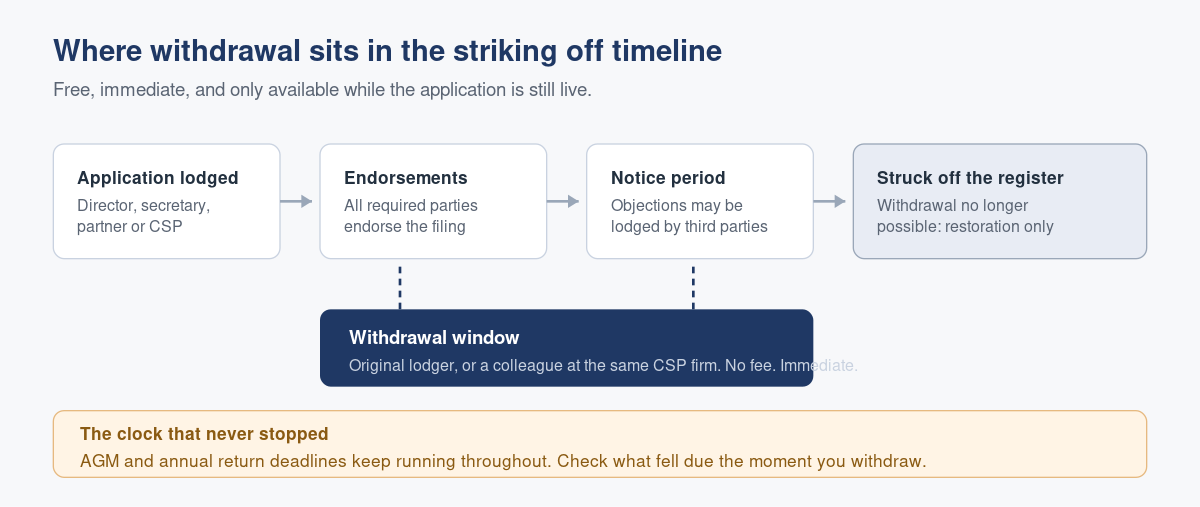
Striking off is not a single event. It is a sequence: the entity applies, the Registrar reviews it, a notice period runs during which objections can be lodged, and only at the end does the Registrar strike the name off the register.
Withdrawal is the statutory escape hatch inside that sequence. Section 344B of the Companies Act 1967 is headed “Withdrawal of application”, sitting immediately after section 344A, which governs striking off on application by the company. The structure of the Act tells you the important thing: withdrawal is a right that belongs to the applicant, and it is exercised against a live application, not against a completed strike off.
Once the company has actually been struck off, withdrawal is no longer the remedy. At that point you are into restoration, which is slower, harder and sometimes needs a court. We cover that separately in our guide on applying to restore a struck off business entity.
When companies actually use it
The usual triggers are commercial rather than technical:
- A buyer appears for the business or for the shell, and the company is suddenly worth more alive than dead.
- A contract, a receivable or a bank balance surfaces that nobody had accounted for.
- A director realises the company still holds an asset, a lease, an intellectual property registration or a subsidiary shareholding.
- The group restructuring that justified the closure gets rethought.
- A creditor objects, and the cleanest response is to withdraw, settle, and reapply later. Where the objector is willing to lift the block instead, see our guide on clearing an objection to striking off.
- A nominee director wants out and the strike off was the wrong tool for the job, a scenario we examine in our note on the trapped nominee director’s exit.
Who is allowed to withdraw it
Not the company. A specific person.
| Entity type | Who can lodge the withdrawal |
|---|---|
| Local company | The lodger who submitted the striking off application: a director, the company secretary, or the CSP that filed it |
| Limited liability partnership | The lodger who submitted the striking off application: a partner, or the CSP that filed it |
| Foreign company | The authorised representative who submitted the striking off application |
There is one useful widening of that rule. If a corporate service provider filed the original application, anyone from the same CSP firm can file the withdrawal. So a staff change inside your corporate secretary’s office is not fatal. A change of corporate secretary firm is a different matter.
The second condition is that the application must have been approved for processing, with all required endorsements obtained. An application still waiting on a director’s or shareholder’s endorsement is not yet in a state that can be withdrawn. If that is where you are, the practical answer is usually to let the application lapse for want of endorsement rather than to chase a withdrawal.
The steps, in order
You will need Corppass access to the entity. If you have never set that up, see our note on setting up Corppass for a Singapore company, because that comes first and it is a separate exercise.
- Get two things in front of you: the unique entity number of the entity being struck off, and a clear statement of why you are withdrawing. Bizfile asks for reasons, and you can select more than one.
- Log in to Bizfile and choose Business User, which routes you through Corppass. Our walkthrough on logging in to Bizfile as a business user covers the login itself.
- Check the entity name showing in the top menu bar and on the dashboard. If you hold positions in several entities, or you are a CSP acting for clients, select the right profile before you go any further. Withdrawing against the wrong entity is an avoidable and embarrassing error.
- Open the Manage striking off eService and click Start.
- Confirm the entity details on screen match the entity you intend to rescue.
- Select your reasons for withdrawing, then choose Review and confirm.
- Read the summary, tick the declaration, and submit.
There is no fee. Approval is immediate, not queued for review, so you will have your confirmation in the same session.
What happens after you withdraw
Two things, and the second one is the one people miss.
Your entity goes back to “Live”. It stays registered with ACRA as if the striking off application had not been made. Contracts, bank mandates and licences that depend on the entity being on the register are safe.
Your withdrawal is published. ACRA maintains a public list of entities that withdrew their striking off applications. Anyone doing diligence on you can see that you applied to close and then changed your mind. That is usually harmless, but it is worth knowing before a bank or a counterparty raises it.
What goes wrong in practice
The compliance clock never stopped. This is the expensive one. A striking off application does not suspend your obligations under the Companies Act 1967. Annual general meetings still fall due. Annual returns still fall due. Companies that applied for striking off in, say, February, drifted through the notice period, then withdrew in September, routinely discover they have missed an AGM deadline and an annual return deadline in the interim. Those attract late lodgement penalties whether or not you were mid-closure at the time.
The fix is unglamorous: the moment you withdraw, pull your filing deadlines and check what fell due while you were not looking.
The lodger has gone. If a director lodged the application and then resigned, or the CSP was disengaged, the people left standing may not be able to withdraw. In that situation you are looking at either re-engaging the original CSP for a single filing, or letting the strike off proceed and then dealing with restoration, which is a materially worse outcome.
Nobody told the accountant. Companies mid-strike-off often stop bookkeeping. When the withdrawal happens, there is a gap in the records and, if the company is later audited or sold, a period that nobody can account for.
Withdrawal is treated as a reset. It is not. If you intend to close the entity later, you start the striking off process again from the beginning, including the notice period and the objection window.
Frequently asked questions
How much does it cost to withdraw a striking off application?
Nothing. ACRA charges no fee for the withdrawal, and approval is immediate rather than queued for officer review. The real cost is any compliance that fell due while the application was pending, such as a missed annual return, which carries its own late lodgement penalty.
Can a new company secretary withdraw an application filed by the previous one?
Only if both work for the same corporate service provider firm. The right to withdraw sits with the original lodger and with colleagues at the same CSP, not with whoever currently holds the office. If your CSP has changed, expect to go back to the previous firm for that one filing.
Does withdrawing stop ACRA from striking the company off later?
It stops this application only. The company returns to Live status and remains on the register. If you decide to close it afterwards, you file a fresh striking off application and go through the notice and objection period again from the start.
Is the withdrawal made public?
Yes. ACRA publishes a list of entities that withdrew their striking off applications, and it is publicly searchable. It rarely causes a practical problem, but assume a bank, an acquirer or a counterparty conducting diligence will see it.
Our company was struck off last month. Can we still withdraw?
No. Withdrawal only works against a live application. Once the name is off the register you need a restoration application instead, which may be administrative or may require a court order depending on how the company was struck off.
Do we need to hold an AGM during the striking off process?
Yes, if one falls due. Applying for striking off does not suspend any obligation under the Companies Act 1967. Until the company is actually struck off, it must hold its annual general meeting and file its annual return in the normal way.
Changing your mind is cheap, missing the follow-up is not
The withdrawal itself takes a few minutes and costs nothing. The work sits on either side of it: making sure the right person is available to file, and cleaning up the compliance that accumulated while the entity was in limbo.
Raffles Corporate Services files striking off applications and withdrawals for Singapore companies and LLPs, and we keep the annual return and AGM calendar running throughout, so a change of plan does not become a penalty. If your entity is currently mid-strike-off and the commercial picture has changed, that is a short conversation.
You can reach us through Raffles Corporate Services, or read more on Singapore corporate secretarial practice at Singapore Secretary Services.
— The Editorial Team, Raffles Corporate Services
Need help with this?
Raffles Corporate Services can handle the ACRA filings, compliance documentation and records for you, and where court proceedings or legal advice are needed, we work with a panel of experienced Singapore law firms who offer cost-effective and efficient legal service and advice.
Email: [email protected]
Call, SMS or WhatsApp: +65 8501 7133