
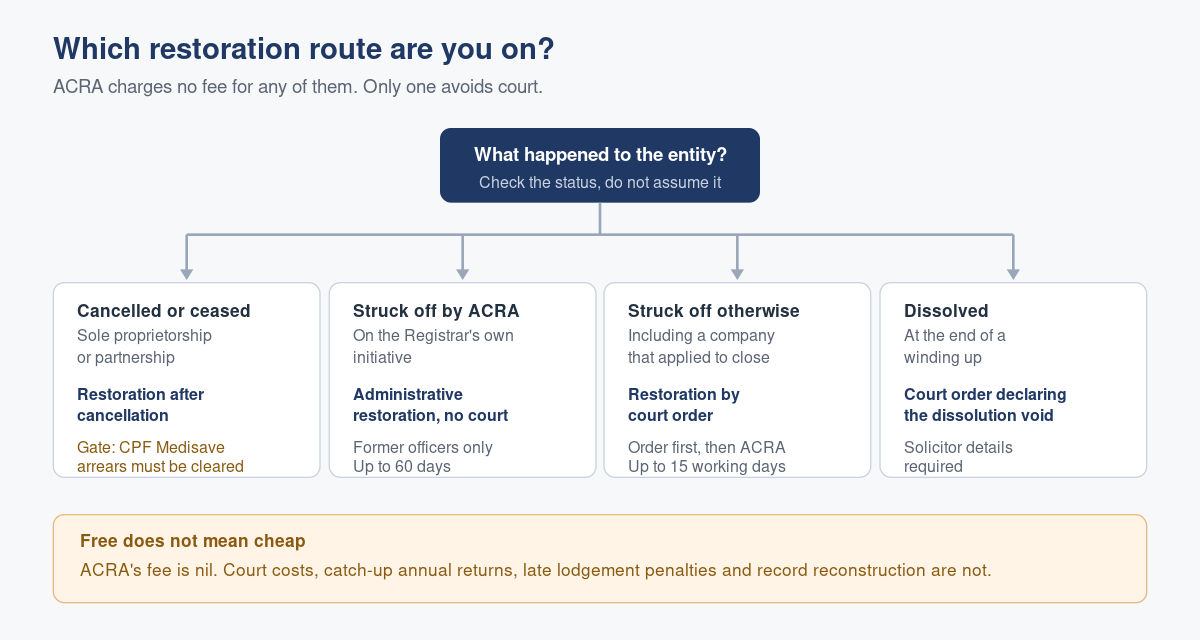
Yes, a Singapore entity that has been struck off, cancelled, ceased or dissolved can be brought back to Live status. ACRA charges no fee for the application. There are four distinct routes, and only one of them avoids a trip to court, so the first question is never “how do I apply” but “which route am I on”.
Raffles Corporate Services works with a panel of experienced Singapore law firms who offer cost-effective and efficient legal service and advice. This article is general information only and is not legal advice.
Getting that wrong is the single most expensive mistake in this area. Applicants who assume the administrative route is available, prepare for it, then discover they needed a court order lose weeks and pay for the legal application anyway.
The four routes, and how to tell which is yours
Restoration is four procedures, each with its own statutory home and evidentiary burden. What determines your route is not what you want. It is what happened to the entity, and what kind of entity it is.
| Your situation | Route | Statutory basis | Realistic timeline |
|---|---|---|---|
| Sole proprietorship or partnership that was cancelled or ceased | Restoration following cancellation | Business Names Registration Act framework | Some applications resolve immediately, others go for review |
| Company, LLP or foreign branch struck off by ACRA on its own initiative | Administrative restoration | Section 344D Companies Act 1967 (companies), section 67 LLP Act 2005 (LLPs), section 377A Companies Act 1967 (foreign branches) | Up to 60 days |
| Company, LLP or foreign branch struck off in circumstances where the administrative route is not open | Restoration by court order | Section 344(5) Companies Act 1967 (companies), section 68(4) LLP Act 2005 (LLPs), section 377B(5) Companies Act 1967 (foreign branches) | Up to 15 working days at ACRA, after you have obtained the order |
| Company dissolved at the end of a winding up | Court order declaring the dissolution void | Section 208(2), Insolvency, Restructuring and Dissolution Act 2018 | Depends on the court timetable, then ACRA processing |
The distinction that catches people out
Administrative restoration is reserved for entities that ACRA struck off on its own initiative, typically for persistent non-filing. It is a Registrar-level decision, and section 344E of the Companies Act 1967 governs how the Registrar decides those applications.
The practical consequence is worth stating plainly. If your company applied for its own striking off and got what it asked for, the administrative route is not open to you. You are looking at a court application. Directors who voluntarily closed a company, then found a forgotten bank account or a live contract, frequently discover this only after preparing the wrong application.
One further safety valve exists. Section 344F of the Companies Act 1967 allows the Registrar to restore a company deregistered by mistake. That is a narrow provision for ACRA’s own errors, not a general remedy for a change of heart.
What each route requires you to produce
Restoration following cancellation, for sole proprietors and partnerships
The shortest route, but with one gate that stops applications dead: the CPF Medisave contributions of every business owner or partner must be up to date with the CPF Board. Sort that out first, because the application will not succeed while arrears remain.
You will need appeal reasons and supporting documents. Individual applicants must previously have been an active position holder in the cancelled or ceased business.
Administrative restoration
The ACRA-only route. You will need appeal reasons, supporting documents and any necessary letters of undertaking. Applicants must be former position holders of the struck off entity: former directors or members for companies and foreign branches, former partners for LLPs. If you are filing for another party under an authorisation, the letter of undertaking is not optional.
The requirement that most often derails these applications concerns property. When a company is struck off, property it still held can vest in the Official Receiver. Where that has happened, you need the Official Receiver’s written consent as a supporting document, and obtaining it takes time that sits outside ACRA’s 60-day processing window.
Restoration by court order
Here ACRA’s role is administrative. The work is at the court, and the ACRA filing is the last step. You will need the UEN, a copy of the court order, its reference number and date, your appeal reasons and supporting documents. Budget for legal costs, because this is not a filing you can sensibly do unrepresented. Our note on the handoff between your corporate secretary and counsel sets out where the CSP’s role stops and the lawyer’s begins.
Order of court declaring the dissolution void
For a company dissolved at the conclusion of a winding up, rather than struck off. Alongside the court order, its reference number and date, ACRA asks for solicitor information, appeal reasons and supporting documents.
The steps, in order
- Identify your route before you touch Bizfile. Check what actually happened to the entity, not what you assume happened. Pull a Business Profile if you are unsure of the exact status and date. If the entity has not yet been struck off, you do not need any of this: you simply withdraw the striking off application, which is free and immediate.
- Clear the gating conditions first. CPF Medisave arrears for the cancellation route. Official Receiver consent for administrative restoration where property has vested. The court order itself for the two judicial routes.
- Log in to Bizfile and select Business User for Corppass. If Corppass has expired or lapsed for the entity, which is common for a struck off company, log in with Singpass instead.
- Confirm the correct entity name is showing on the top menu bar and dashboard. CSPs should select the Corporate Service Provider tab and the right firm before proceeding.
- Open the Apply to restore business entity eService, select your restoration type, enter the UEN, then choose Retrieve Information and Start.
- Complete the details for your route. Enter appeal reasons, upload supporting documents and, where applicable, the court order, its reference number and date.
- For administrative restoration, complete the declarations covering the property of the struck off company, the lodgement of company documents and the payment of outstanding fees.
- Enter an email address for notifications, review everything, tick the declaration and submit.
ACRA’s fee for the restoration application is nil. Processing runs up to 60 days depending on the route and the complexity of the documents. Notifications land in your Bizfile inbox.
What happens after approval
For the cancellation route there are three possible outcomes, and only one of them means you are finished.
Live. The entity is active again. Log out of Bizfile completely and log back in as a Business User before attempting any further filings, because the session will otherwise still be carrying the old status.
Registration expired but not renewed. The restoration succeeded, but the registration itself had expired in the meantime. You must file a Renew Business Registration before you can trade.
Submitted to ACRA for review. The application is with the processing team. Nothing further for you to do until they come back.
There is a Corppass wrinkle worth planning for. If you already hold Corppass access, log out fully and back in to see the updated status. If you do not have Corppass for the entity, you cannot get it the same day: wait until the next business day, apply for access, and only then log in as a Business User. Our guide on assigning Corppass e-service roles covers who should hold what.
What goes wrong in practice
Restoration puts the entity back, not the records. Section 344G of the Companies Act 1967 deals with the effect of restoration, and the broad principle is that the company is treated as having continued in existence. That does not rebuild your statutory registers, minute book or accounting records, which went cold the day the entity was struck off. Reconstruction is a separate exercise, and we set out how to approach it in our guide to restoring statutory registers and records.
The outstanding filings did not disappear. A restored company is a Live company, and a Live company owes annual returns and annual general meetings. Entities that sat struck off for two or three years come back owing multiple years of filings, each capable of attracting late lodgement penalties. Factor that in before deciding whether restoration is worth it.
Assuming free means cheap. ACRA’s application fee is nil, and that is the only free part. A court order carries legal costs, catch-up filings carry preparation fees and penalties, and reconstructing several years of accounting records is real work.
Underestimating the Official Receiver step. If property vested, the written consent is a hard requirement that moves at its own pace. Start it the day you decide to restore, not after ACRA asks.
Restoring the wrong thing. Sometimes what the applicant actually needs is a fresh incorporation. If the entity held nothing of value and has no name worth protecting, a new company is faster and cleaner. Restoration earns its cost when there is something specific to recover: a bank balance, a property interest, a licence, a contract, an intellectual property registration, or a claim that only the entity itself can bring.
Frequently asked questions
How much does it cost to restore a struck off company in Singapore?
ACRA charges no fee for the restoration application itself. The real costs sit elsewhere: legal fees if your route requires a court order, preparation fees and late lodgement penalties for the annual returns and financial statements that fell due while the entity was off the register, and the work of reconstructing records.
How long does restoration take?
Administrative restoration runs up to 60 days depending on complexity and documentation. Where you have already obtained a court order, ACRA takes up to 15 working days to process the application. That excludes the time to obtain the order itself, which depends entirely on the court’s timetable.
Our company applied for its own striking off. Can we use administrative restoration?
No. Administrative restoration is reserved for entities that ACRA struck off on its own initiative, usually for persistent non-filing. A company that applied for and obtained its own striking off is on the court order route, which means instructing solicitors and obtaining an order before filing with ACRA.
Who is allowed to apply for administrative restoration?
Former position holders of the struck off entity. For companies and foreign company branches, that means former directors or members. For LLPs, former partners. If you are filing on behalf of someone else under an authorisation, you must upload the necessary letters of undertaking with the application.
What happens to company property while the entity is struck off?
Property the entity still held can vest in the Official Receiver. If that has happened, you will need the Official Receiver’s written consent as a supporting document for an administrative restoration application. Obtaining that consent is a separate process with its own timeline, so start it early.
Work out the route before you spend anything
Most restoration applications that stall do so because the applicant picked the wrong route, or left a gating condition, a CPF arrear or an Official Receiver consent, until the end.
Raffles Corporate Services assesses restoration routes for Singapore companies, LLPs, foreign branches and sole proprietorships, prepares the Bizfile application, and handles the catch-up filings that follow. If an entity you are connected with has come off the register, we can usually tell you in one conversation whether restoration is worth it, including the honest version where a fresh incorporation is the better call.
You can reach us through Raffles Corporate Services, or read more on Singapore corporate secretarial practice at Singapore Secretary Services.
— The Editorial Team, Raffles Corporate Services
Need help with this?
Raffles Corporate Services can handle the ACRA filings, compliance documentation and records for you, and where court proceedings or legal advice are needed, we work with a panel of experienced Singapore law firms who offer cost-effective and efficient legal service and advice.
Email: [email protected]
Call, SMS or WhatsApp: +65 8501 7133