
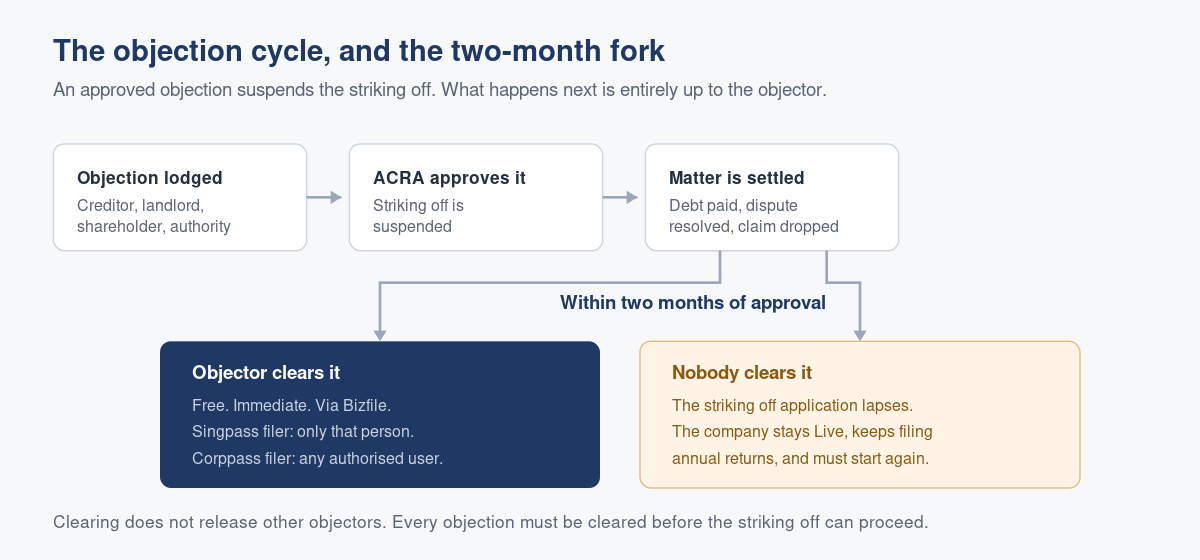
If you lodged an objection against a company’s striking off and the underlying issue has since been resolved, you clear it yourself through Bizfile. It is free, it takes effect immediately, and you must do it within two months of ACRA approving your objection. Miss that window and the company’s striking off application lapses entirely.
Raffles Corporate Services works with a panel of experienced Singapore law firms who offer cost-effective and efficient legal service and advice. This article is general information only and is not legal advice.
That last point is the one worth reading twice. An uncleared objection does not simply sit there harmlessly. It kills the application, and the company has to start the whole striking off process again.
So if you are the objector and you have been paid, settled, or otherwise got what you wanted, clearing the objection is not a courtesy. It is the difference between the company closing cleanly and the company going round the loop a second time.
What an objection does, and what clearing it does
Section 344C of the Companies Act 1967 is headed “Objections to striking off”. It gives any person with a legitimate interest, most commonly a creditor, a landlord, a tax authority, a former employee or a shareholder in dispute, the ability to block a company’s self-initiated striking off during the notice period.
The mechanism is blunt by design. An approved objection suspends the striking off. It does not adjudicate anything, it does not prove the debt, and ACRA does not decide who is right. It simply stops the company disappearing while a claim is outstanding.
Clearing the objection is the mirror image: you tell ACRA that, from your side, the matter is done and you no longer wish to block the striking off. Again, ACRA is not adjudicating. It is recording that the person who put the brake on has taken it off.
If you are on the other side of this, that is, you want to lodge an objection rather than lift one, our companion guide on objecting to a striking off application covers the grounds, the timing and what ACRA will and will not accept.
Who can clear the objection
This depends entirely on how the objection was filed in the first place, and it is where most of the friction arises.
| How the objection was filed | Who can clear it | Practical consequence |
|---|---|---|
| By an individual using Singpass | Only that same individual | If that person has left the creditor firm, changed roles or is uncontactable, nobody else can lift it |
| By a business entity using Corppass | Any authorised Corppass user within that entity | Staff turnover is survivable, as long as someone still holds the relevant Corppass role |
| By a corporate service provider using Corppass | Any authorised Corppass user within that CSP firm | A colleague can pick it up if the original filer is unavailable |
File through Corppass, not personal Singpass
The lesson for creditors is simple and worth building into your process. If your organisation objects to strike-offs with any regularity, file through Corppass in the entity’s name, not through an employee’s Singpass. An objection filed by a departing credit controller under personal Singpass becomes an orphan the day that person leaves, and the only route out is to approach ACRA directly and explain the position.
For the mechanics of the two login routes, see our notes on logging in to Bizfile as an individual with Singpass and logging in to Bizfile as a business user via Corppass.
The steps, in order
Two prerequisites before you start: ACRA must have approved your original objection, and the outstanding matter must actually be resolved. You will also need the unique entity number of the company or LLP you objected against.
- Go to Bizfile and log in. Choose Individual User and Singpass if you objected personally. Choose Business User and Corppass if you objected on behalf of an entity or as a CSP.
- If you are logging in for an entity, confirm the correct entity name is showing on the top menu bar and dashboard before you do anything else.
- If you are a corporate service provider, open the Corporate Service Provider tab on the profile selection page, pick your firm from the list if you belong to more than one, then select the client entity you are acting for.
- From the top menu, select Deregister, then choose Local company or Limited liability partnership as appropriate.
- Select Submit/Clear objection against striking off, then click Start.
- Enter the UEN of the entity you objected against and work through the clearance details.
- Review the summary, complete the declaration, and submit.
There is no fee, and the clearance is processed immediately rather than queued for officer review. You will get a confirmation in your Bizfile inbox.
The two-month rule, and why it matters to both sides
If an objection is not cleared within two months, the striking off application lapses.
For the company, this is a genuine cost. Lapsing is not a pause. The application is gone, and closing the entity means filing afresh, serving the notice period again, and exposing the company to a fresh round of objections. Meanwhile the company remains Live, which means annual general meetings and annual returns keep falling due, and missing them attracts late lodgement penalties in the usual way.
Why lapsing helps nobody
For the objector, the consequence is subtler. Lapsing gets you nothing. Your debt is no closer to being paid. You have simply forced the directors to repeat an administrative exercise while the company continues to exist and continues to accrue its own compliance costs. If your aim is recovery, the leverage was in the objection window, not in letting it lapse.
The pragmatic position for most creditors is therefore: object promptly, use the objection as the lever to get the conversation started, settle, then clear within the two months so that everyone can move on.
The company has a lever of its own here. Rather than wait for an objection to lapse, directors can simply withdraw the striking off application, which is free and immediate, deal with the creditor properly, and reapply once the position is clean.
What goes wrong in practice
Settlement happens, clearance does not. By far the most common failure. The invoice is paid, the parties shake hands, and nobody in the creditor’s finance team remembers that there is a filing to make. Two months pass. The company’s application lapses and the directors are left restarting a process they thought was finished. Build the clearance into your settlement checklist, alongside releasing any security and updating the ledger.
The objection was filed under a personal Singpass. When that person leaves, the objection cannot be cleared by anyone else in the organisation through the normal eService. This is entirely preventable by filing through Corppass in the first place.
Clearing too early. Clearance is not conditional and it is not reversible through the same mechanism. If you clear the objection on the strength of a promise to pay rather than actual payment, you have given away your leverage and the company can proceed to strike off. Once an entity is struck off, pursuing it means restoration proceedings, which is a far heavier exercise than holding an objection open for another fortnight. Our note on applying to restore a struck off business entity sets out what that involves.
Multiple objectors, one clearance. If several parties objected, clearing yours does not release the others. The striking off remains blocked until every objection is cleared or lapses. Companies that settle with the loudest creditor and assume the path is now free are often surprised.
Objecting to make a point. An objection is a compliance tool, not a negotiating weapon. Using it to obstruct a legitimate closure where you have no real claim wastes everyone’s time and leaves you holding an obligation to clear it anyway.
Frequently asked questions
How long do I have to clear an objection to striking off?
Two months from ACRA’s approval of your objection. If you do not clear it within that period, the company’s striking off application lapses. The company stays on the register, and it must file a fresh striking off application if it still wants to close.
Does it cost anything to clear an objection?
No. ACRA charges no fee for either lodging or clearing an objection against striking off, and the clearance is processed immediately rather than queued for review. You will receive a confirmation notification in your Bizfile inbox once it goes through.
The colleague who filed our objection has left. Can I clear it?
Only if the objection was filed through Corppass in your entity’s name, in which case any authorised Corppass user in the organisation can clear it. If it was filed under that person’s personal Singpass, only they can clear it through the eService, and you will need to approach ACRA directly to explain.
If I clear my objection, will the company be struck off immediately?
Not necessarily. Clearing your objection removes your block, but the striking off can only proceed once every objection has been cleared and the statutory notice period has run its course. If another creditor also objected, the application stays suspended until they clear theirs.
Can I object again after clearing?
Clearing signals that your matter is resolved, so you should treat it as final for that application. If the company later files a fresh striking off application and you have a genuine outstanding claim at that point, you can object again within the new notice period.
Do I need the company’s consent to clear my objection?
No. The objection is yours and the clearance is yours to make. The company cannot clear it for you, and it cannot compel you to clear it. In practice the company will chase you, because until you act its application is going nowhere.
Closing cleanly is a two-sided exercise
Most striking off applications that fail do not fail because ACRA refused them. They fail because an objection was lodged, settled, and never lifted.
Raffles Corporate Services manages striking off applications and objection traffic for Singapore companies and LLPs, on both sides of the table. If you are a company waiting on an objector who has gone quiet, or a creditor sitting on an objection you no longer need, we can tell you quickly where the filing stands and what has to happen next.
You can reach us through Raffles Corporate Services, or read more on Singapore corporate secretarial practice at Singapore Secretary Services.
— The Editorial Team, Raffles Corporate Services
Need help with this?
Raffles Corporate Services can handle the ACRA filings, compliance documentation and records for you, and where court proceedings or legal advice are needed, we work with a panel of experienced Singapore law firms who offer cost-effective and efficient legal service and advice.
Email: [email protected]
Call, SMS or WhatsApp: +65 8501 7133