

Almost every LLP that gets into trouble with ACRA does so in one of five ways: it drops below two partners, it loses its qualifying manager, its registered office stops working, it fails to file a change within 14 days, or it misses the annual declaration. None of these is exotic. All of them are quiet.
Raffles Corporate Services works with a panel of experienced Singapore law firms who offer cost-effective and efficient legal service and advice. This article is general information only and is not legal advice.
The reason they are quiet is that an LLP feels like a partnership. There is no board, no AGM, no auditor knocking on the door. The people running it are usually the people who own it, so nothing internal forces a compliance moment. Meanwhile the Limited Liability Partnerships Act 2005 imposes a set of continuing obligations that do not care how informal the business feels.
The stakes are specific. The whole commercial point of an LLP is that liability sits with the entity, not the individuals. Section 12 of the Limited Liability Partnerships Act 2005 is what delivers that protection. One of the five failures below switches it off.
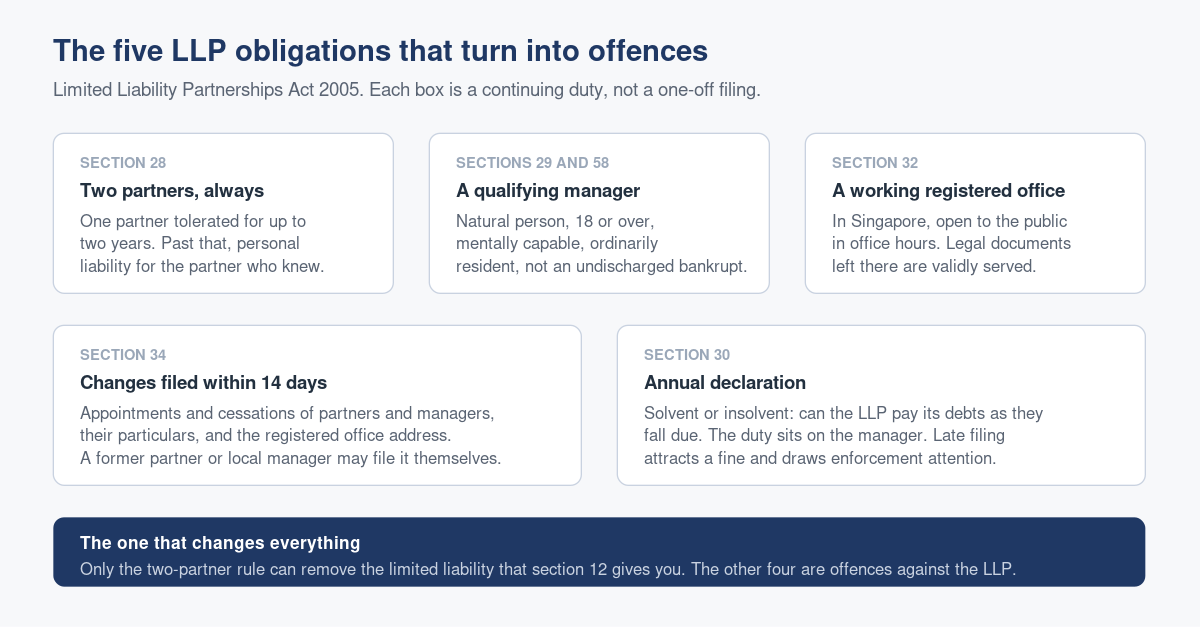
The five at a glance
| Requirement | Provision | What non-compliance leads to |
|---|---|---|
| At least two partners at all times | Section 28 | Personal liability for LLP obligations if the shortfall runs beyond two years and business continues |
| At least one qualifying manager, particulars and consent lodged | Section 29 | Offence; the LLP has no lawful point of accountability for filings |
| An undischarged bankrupt must not act as manager without leave | Section 58 | Offence carrying a fine and possible imprisonment |
| A registered office in Singapore, open to the public in office hours | Section 32 | Offence, plus valid service of legal documents you never see |
| Changes in particulars filed within 14 days | Section 34 | Offence; ACRA’s register becomes wrong, which is the thing ACRA cares most about |
| Annual declaration of solvency or insolvency filed on time | Section 30 | Fine for late filing, and eventually enforcement or striking off |
Dropping below two partners: the offence that costs you the LLP’s whole point
An LLP must have two partners. If one leaves, dies or is removed, you do not commit an instant offence. You start a clock.
The Act gives you up to two years to operate with a single partner. Run past that and continue carrying on business, and the protection in section 12 stops applying to the new obligations. A partner who was a partner when those obligations arose, and who knew the LLP had been running short-handed for more than two years, becomes personally liable for them, jointly with the LLP and with any other partner in the same position.
Read that list of conditions carefully, because it tells you exactly how the trap works in practice. Liability attaches to the partner who knew. In a two-person LLP where one partner has left, the remaining partner always knows. There is no plausible ignorance.
What actually happens
The common version is not a dramatic falling-out. It is a small professional LLP where one of the two partners winds down, retires or emigrates. The remaining partner keeps the practice going because the clients are still there, means to bring in a new partner, and does not get round to it. Eighteen months becomes thirty.
Nobody sends a warning letter when the two years expire. The consequence only surfaces when there is a debt worth chasing, and by then the creditor’s adviser has pulled the LLP’s register of partners and worked out the dates.
If you are heading towards a genuine one-person business, the honest answer is usually to restructure rather than drift: convert, or close the LLP properly and carry on in a different vehicle. Our overview of closing an LLP sets out the routes, and striking off an LLP covers the administrative one in detail.
The manager requirement, and why it fails silently
Every LLP needs at least one manager, and the manager is the person ACRA holds accountable for the entity’s filings. Section 29 sets the qualifying conditions. The manager must be a natural person, so no corporate appointments, at least 18 years old, mentally capable of managing their own affairs, and ordinarily resident in Singapore. Particulars and a signed consent to act have to be lodged with ACRA in the prescribed form.
Three of those four conditions are stable once satisfied. The fourth is not.
Ordinarily resident in Singapore is a status, not a box you tick once. A manager who relocates abroad, whose employment pass is not renewed, or who gives up permanent residence may stop satisfying it without anyone filing anything. The LLP then has a manager on ACRA’s register who no longer qualifies, which is functionally the same as having no manager at all.
Separately, section 58 restricts an undischarged bankrupt from acting as an LLP manager without leave of the High Court or the Official Assignee. Acting without that leave is an offence in its own right, carrying a fine and the possibility of imprisonment. This is the provision that catches the LLP whose manager quietly became bankrupt through a personal guarantee on an unrelated business.
A registered office that does not work is worse than none
Your LLP must maintain a registered office in Singapore, and it must be open and accessible to the public during normal office hours. It does not have to be where you trade. A registered office in the CBD and a workshop in an industrial estate is entirely normal.
The requirement matters for one blunt reason: service. Anyone who wants to serve legal documents on your LLP can do it by leaving them at the registered office or posting them there by registered post. Service is good whether or not you read what arrives. A writ, a statutory demand or a winding up application delivered to an address you abandoned two years ago has still been served.
Change of registered office address is a change in particulars, so it goes in within 14 days.
The address you forgot you had
The classic failure is an LLP whose registered office is the office of a former accountant or corporate service provider. The engagement ended, the mail stopped being forwarded, and nobody updated Bizfile. The LLP is now both committing a registered office offence and exposed to unanswered service, which is a combination that ends in default judgments.
Fourteen days, and the register nobody checks
Section 34 requires an LLP to notify ACRA of changes in its particulars within 14 days. That covers the appointment or cessation of partners and managers, changes to their own particulars such as name, identification or residential address, and the LLP’s registered office address.
Fourteen days is short enough that it only works if somebody owns it. Where an LLP has no corporate secretarial support, the obligation falls between the partners and nobody picks it up.
The Act also allows a former partner or a local manager to make the filing themselves if they believe no general partner will do it. That is a useful safety valve if you have left an LLP and the remaining partners are dragging their feet on recording your departure, because until it is filed the register still shows you as a partner and the outside world will treat you accordingly.
Do not forget the separate controller obligations. The LLP Act 2005 carries its own register of registrable controllers regime, running in parallel to the one companies deal with. Our guide to the register of registrable controllers explains the mechanics, and the duties there sit on the entity, on the controllers and on anyone who ought to know.
The annual declaration
Every LLP must file an annual declaration stating whether it is solvent or insolvent, meaning whether it can pay its debts as they fall due. Section 30 is the source of the obligation, and the duty sits on the manager.
Late filing attracts a fine. It also puts the LLP on ACRA’s radar, which is the part people underestimate: a persistent failure to file is one of the clearest signals a regulator has that an entity is no longer being run, and it invites the eradication end of the enforcement spectrum rather than the education end. Our note on ACRA’s enforcement approach sets out how that escalation actually works.
There is no financial statement to lodge with the declaration for most LLPs, so the filing itself is quick. The hard part is the honesty of the declaration. Signing a solvency declaration for an LLP that cannot in fact pay its debts is a different and more serious problem than filing late.
What goes wrong, in order of how often we see it
- Nobody owns the calendar. Two partners, both fee-earning, neither treating filings as their job. Everything above follows from this.
- A partner leaves and the two-year clock starts unnoticed. Nothing prompts you at month 24.
- The manager’s residency lapses. Emigration or a non-renewed pass, with no corresponding filing.
- The registered office goes stale. Usually after changing or dropping a service provider.
- A change is filed late because nobody realised 14 days meant 14 days. It is not a month and it is not “before year end”.
The fix is unglamorous and cheap: one named person, inside or outside the LLP, who holds the register and the deadlines, and who is told when anything about a partner or a manager changes.
Frequently asked questions
How long can my LLP operate with only one partner?
Up to two years. Beyond that, if the LLP keeps carrying on business, a partner who knew about the shortfall can be held personally liable for obligations incurred after the two years, alongside the LLP. The limited liability protection in the LLP Act 2005 does not cover those obligations.
Can a company be the manager of an LLP?
No. The manager must be a natural person, at least 18 years old, mentally capable and ordinarily resident in Singapore. A corporate entity cannot hold the role. Partners can be companies, but the manager position has to be filled by an individual whose particulars and consent are lodged with ACRA.
What happens if my LLP’s registered office address is out of date?
Two problems at once. Failing to maintain a proper registered office is an offence under the LLP Act 2005, and legal documents left at or posted to the registered address are validly served even if you never receive them. Update the address in Bizfile within 14 days of any change.
Who is liable if the LLP files a change late?
The obligation sits on the LLP and is administered in practice by the manager, so enforcement typically lands there. A former partner or a local manager may file the notification themselves if they believe no general partner will do so, which is worth knowing if you have left an LLP that has not recorded your departure.
Is a late annual declaration serious, or just a fine?
It is both. There is a fine for late filing, and repeated failure is one of the strongest signals to ACRA that an entity is no longer operating. That can lead to enforcement action or to the LLP being struck off the register, which would end its existence as a legal entity.
The cheapest compliance you will ever buy
LLP compliance is genuinely light. Two partners, one qualifying manager, a working address, changes in within 14 days, one declaration a year. There is no audit, no AGM and, for most LLPs, no accounts to lodge. That is precisely why it gets neglected: there is not enough of it to build a habit around.
Raffles Corporate Services holds the registers and the deadlines for LLPs and companies across a range of sizes, files changes inside the statutory window, and checks the things that expire quietly, such as a manager’s residency. If you are not certain your LLP currently satisfies all five requirements above, that is a short conversation and almost always a quick fix.
You can reach us through Raffles Corporate Services, or read more on Singapore corporate secretarial practice at Singapore Secretary Services.
— The Editorial Team, Raffles Corporate Services
Need help with corporate secretarial or compliance matters?
If you would like help with your company's corporate secretarial, governance or compliance requirements, email [email protected] or WhatsApp +65 8501 7133.
Our team can assist with corporate secretarial, accounting and tax matters. Where legal advice is needed, advisers from our associated law firms can assist.