
There are two ways to close a Singapore limited liability partnership. If the LLP is dormant, owns nothing and owes nothing, you strike it off, which is free and takes about three months. If it still has debts or assets, you wind it up, which needs a liquidator.
Raffles Corporate Services works with a panel of experienced Singapore law firms who offer cost-effective and efficient legal service and advice. This article is general information only and is not legal advice.
Everything else is detail. The mistake that costs partners money is choosing the wrong route, or worse, choosing neither and simply walking away from the LLP while it remains on the register, quietly accumulating annual declaration defaults in the names of the partners and the manager.
An LLP is a body corporate with its own legal personality under Section 4 of the Limited Liability Partnerships Act 2005. It does not evaporate because the partners stopped trading. Somebody has to take it off the register deliberately.
Strike off or wind up: how to tell which one you need
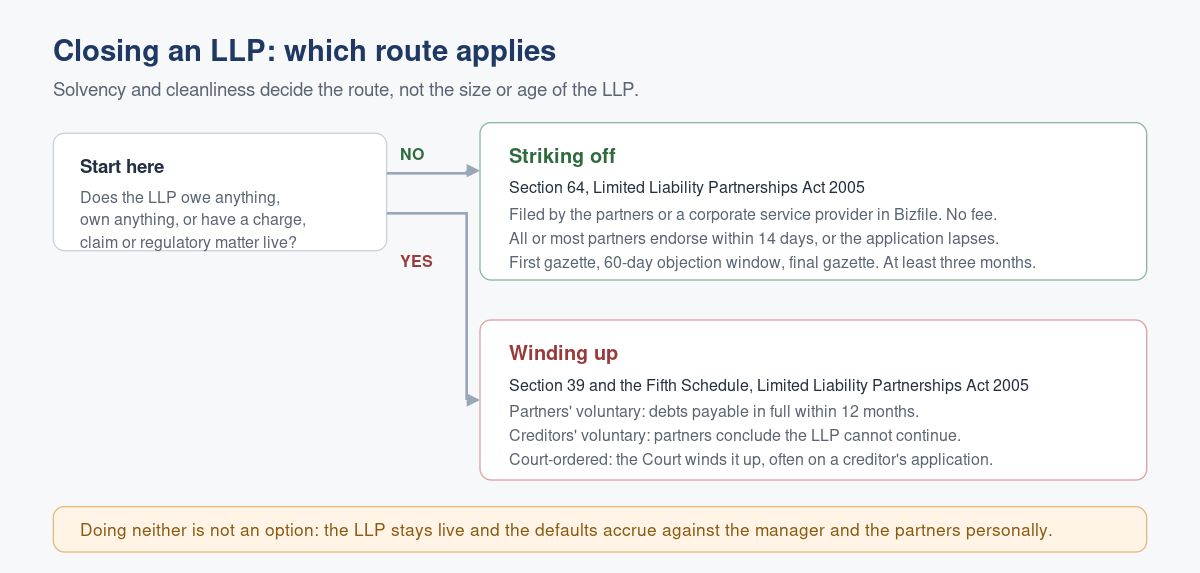
The dividing line is solvency and cleanliness, not size or age.
Striking off is an administrative removal under Section 64 of the Limited Liability Partnerships Act 2005. You are asking the Registrar to delete a name that no longer corresponds to a functioning business. It is free, it is filed in Bizfile, and it suits the overwhelming majority of small LLPs that simply stopped trading.
Winding up is a formal liquidation. A liquidator is appointed, assets are realised, creditors are paid in order, whatever is left goes to the partners, and a series of notifications are filed with ACRA. It is governed by Section 39 of the Act and by the Fifth Schedule, which imports the winding up machinery. It costs real money in professional fees and takes considerably longer.
| Question | Strike off | Wind up |
|---|---|---|
| Does the LLP still owe anybody money? | No, nothing outstanding | Yes, debts remain |
| Does it still own assets? | No, nothing at all | Yes, assets to realise |
| Is there a charge registered against it? | Must be none | Charges can be dealt with |
| Any live litigation or regulatory action? | Must be none | Can be managed in the liquidation |
| Who runs the process? | The partners, or a corporate service provider | A liquidator |
| Cost of the ACRA filing | Free | Filing fees plus liquidator’s fees |
| Realistic duration | About three months, longer if anyone objects | Months to years |
| Statutory basis | Section 64, Limited Liability Partnerships Act 2005 | Section 39 and the Fifth Schedule |
If you can answer “no, nothing” to the first four questions honestly, you are a striking off case. If you cannot, you are not, and no amount of optimism will change that.
What striking off actually involves
The application is made through Bizfile using the “Apply to strike off business entity” eService. Partners can file it themselves, or a registered corporate service provider can file on their behalf, provided the CSP has confirmed that a majority of partners consent.
There are no supporting documents to prepare. What there is instead is a declaration, and the declaration is the whole exercise. You are telling the Registrar that the LLP has no unpaid debts to any government agency, no registered charges, no pending or threatened legal proceedings, no ongoing regulatory or disciplinary action, no assets and no liabilities, and that the partners agree.
A false declaration here is not a paperwork slip. It is a statement to the Registrar that can trigger investigation and prosecution.
Once submitted, the other partners must endorse the application in Bizfile within 14 days, or it lapses and you start again. If a CSP filed it, that endorsement step is not required, because the CSP has already taken the consents.
After approval, ACRA publishes the LLP in the First Gazette, then waits out a 60-day objection window before publishing the Final Gazette. The ACRA gazettes are public, which is exactly why creditors and counterparties find out. From approval to final removal, budget at least three months.
The detailed mechanics, including the objection traps and how to withdraw, are set out in our guide to striking off an LLP.
What winding up actually involves
Winding up has three flavours, and which one applies depends on whether the LLP can pay its debts.
Partners’ voluntary winding up
The solvent route. The partners are satisfied that the LLP can pay its debts in full within 12 months of the winding up starting, and they say so formally. A liquidator is appointed, the estate is realised and distributed, and the required notifications go to ACRA.
Creditors’ voluntary winding up
The insolvent route taken voluntarily. The partners conclude the LLP cannot continue because of its debts. Creditors are convened, the proposal is put to them, and if they agree a liquidator is appointed. Control effectively passes to the creditors at that point.
Court-ordered winding up
Someone, often an unpaid creditor, applies to the Court. The Court orders the winding up and a liquidator is appointed, or the Official Receiver acts. The partners are no longer driving. This is the route you end up in when you ignore the other two.
Once a liquidation is running, the filings are made through Bizfile’s winding up eServices: notice of appointment of the liquidator, notice of cessation, the liquidator’s account of receipts and payments and statement of position, and the return relating to the final meeting. The courts’ powers over a liquidator in a Singapore liquidation are covered in our note on removing or replacing a liquidator.
Before you file anything: the five loose ends
These are the items that stall an otherwise straightforward closure.
- Outstanding tax. Settle the LLP’s position with IRAS first. An LLP is tax transparent, so the partners are assessed on their share, but the LLP’s own filing obligations still have to be closed out. Check the position on IRAS.
- Outstanding tax credits. If the LLP is owed money by IRAS when it is dissolved, that credit does not follow the partners automatically. It goes to the Insolvency and Public Trustee’s Office, and recovering it afterwards means a claim and, usually, a processing fee. Claim it before you close.
- Registered charges. A charge sitting in the charge register is a hard stop on striking off. Discharge it and have the discharge registered first.
- The LLP’s registered address and email. ACRA writes to the registered office and to the partners’ and managers’ addresses during the striking off process. If those addresses are stale, the letters go nowhere, the process can fail, and the LLP reverts to “Live” status. Update them before you apply, not after.
- The register of registrable controllers. The LLP’s controller obligations run until it is off the register. Our guide to the register of registrable controllers sets out what has to be maintained in the meantime.
What goes wrong in practice
Partners stop filing and hope. This is the commonest failure by a wide margin. The LLP stops trading, nobody files the annual declaration, and the manager accumulates defaults in his or her own name. The LLP stays on the register. Enforcement lands on individuals, not on a dormant shell.
One partner does not endorse. Two partners agree, the third has moved overseas and does not check Bizfile. Fourteen days pass, the application lapses, and everyone assumes it went through. Nobody discovers otherwise until a bank or a counterparty pulls the record.
A creditor objects during the 60-day window. A supplier with an unpaid invoice sees the First Gazette and objects. The LLP then has a limited period to resolve the issue, and if it does not, the application lapses. You cannot reapply until the objection is cleared. This is nearly always a case of somebody declaring “no debts” without actually checking the payables ledger.
Striking off used to escape a real liability. Removal from the register is not a discharge of obligations that were concealed, and a struck off entity can be restored. Section 67 of the Limited Liability Partnerships Act 2005 provides for administrative restoration to the register, and Section 70 deals with the effect of restoration. A creditor who finds out later has a route back.
Books thrown away on dissolution. Section 71 of the Limited Liability Partnerships Act 2005 deals with retention of books and papers after striking off. Do not clear the office out on the assumption that dissolution ends the record-keeping question.
Frequently asked questions
How long does it take to close an LLP in Singapore?
A clean striking off takes at least three months from ACRA’s approval, made up of the first gazette publication, a 60-day objection window and then the final gazette. A winding up takes considerably longer, typically many months, because the liquidator must realise assets, deal with creditors and complete a series of filings.
Does it cost anything to strike off an LLP?
The Bizfile application to strike off a business entity carries no fee. Withdrawing the application is also free. Winding up is different: there are filing fees, and the liquidator’s professional costs are the real expense. Tidying up before you file, such as discharging a charge, can also carry its own costs.
What happens to the partners after the LLP is struck off?
The LLP ceases to exist and is removed from the register. Limited liability under Section 12 of the Limited Liability Partnerships Act 2005 protects partners from the LLP’s obligations generally, but it does not protect a partner who made a false declaration to the Registrar, and it does not prevent the entity being restored to the register if something was concealed.
Can we strike off an LLP that still has a bank account with money in it?
No. The striking off criteria require the LLP to own nothing and owe nothing. A funded bank account is an asset. Close the account and distribute the balance to the partners in accordance with the LLP agreement before applying, and keep the records showing you did so.
Do we still need to file the annual declaration while the striking off is pending?
The LLP stays “Live” on the register until the final gazette. Statutory obligations attach to a live entity, so do not treat a pending application as a licence to stop filing. If you are unsure of your position, check it before the application rather than after the enforcement letter arrives.
What if we simply stop using the LLP and never file anything?
The LLP remains registered and the obligations continue to run against the manager and the partners personally. That is the expensive version of closing a business: enforcement action against individuals over an entity that generates no revenue. Closing it properly is cheaper than ignoring it.
Closing it cleanly, once
Most LLP closures we see are late rather than complicated. The partners agreed to stop trading eighteen months ago, nobody filed, and the tidy-up now involves back filings and penalty exposure before the striking off application can even be made.
The order matters: settle tax, clear charges, empty and close accounts, update the registered addresses, get the partners lined up to endorse, then file. Doing it in that sequence is the difference between three months and a year.
Raffles Corporate Services closes LLPs, partnerships and companies for Singapore business owners, including the awkward ones where filings have lapsed and the partners have scattered. If you are not sure whether your LLP qualifies for striking off or needs a winding up, that assessment is a short conversation.
You can reach us through Raffles Corporate Services, or read more on Singapore corporate secretarial practice at Singapore Secretary Services.
— The Editorial Team, Raffles Corporate Services
Need help with this?
Raffles Corporate Services can handle the ACRA filings, compliance documentation and records for you, and where court proceedings or legal advice are needed, we work with a panel of experienced Singapore law firms who offer cost-effective and efficient legal service and advice.
Email: [email protected]
Call, SMS or WhatsApp: +65 8501 7133