

A Singapore branch is not a new company. It is your existing foreign company, registered to operate here, which means the parent carries the liability, the parent’s constitution governs it, and the parent’s financial statements end up on ACRA’s public record. That last consequence is the one that changes minds.
Raffles Corporate Services works with a panel of experienced Singapore law firms who offer cost-effective and efficient legal service and advice. This article is general information only and is not legal advice.
An existing foreign business has four routes into Singapore: a branch, a subsidiary, a representative office, or re-domiciliation. This article deals with the branch, the one most often chosen for the wrong reason, usually a belief that it is simpler than a subsidiary. On the registration paperwork it is not.
Whichever route you pick, every foreign business must engage a registered corporate service provider to lodge the registration. You cannot file it yourself.
What a branch actually is
A branch, which ACRA calls a registered foreign company, is a direct extension of the foreign company with no separate legal personality. The consequences follow from that one fact:
- Liability. The foreign company is fully responsible for the branch’s obligations. There is no Singapore-level liability shield.
- Income and tax. A branch can trade and earn income here, but it is not a Singapore tax resident unless the foreign company is controlled and managed in Singapore, which affects treaty benefits and residency-based incentives.
- Shareholding. The foreign company is the only shareholder.
- Compliance. The branch must meet the statutory and disclosure requirements of the Companies Act 1967, and the foreign-company regime is heavier than the local one in one respect: disclosure of the parent.
That disclosure point deserves its own paragraph. Under section 373 of the Companies Act 1967 a registered foreign company files financial statements for its head office as well as for its Singapore branch operations. An active branch files audited statements covering the Singapore profit and loss, the assets used in Singapore operations and the liabilities arising from them. A dormant branch, as defined in section 205B, may file unaudited statements. Reliefs and waivers exist, including a waiver of the Singapore branch statements under section 373(12) and reliefs from audit or from form and content requirements under section 373(13A), but they are applications, not entitlements.
If your foreign parent is privately held and has never published accounts anywhere, have that conversation internally now rather than after the first filing is due.
Branch or one of the other three?
| Route | Legal status | Liability | Income and tax | Best suited to |
|---|---|---|---|---|
| Branch | Extension of the parent | Parent, in full | Yes. Not a Singapore tax resident unless controlled and managed here | Extending existing operations on the parent’s balance sheet |
| Subsidiary | Separate Singapore company owned by the parent | Limited to the subsidiary’s assets | Yes, taxed as a Singapore company | Full operations with a liability boundary |
| Representative office | Not separate, and temporary | Parent, in full | No income, no corporate tax | Market research before committing |
| Re-domiciliation | The parent becomes a Singapore company | Ordinarily limited | Yes, taxed as a Singapore company | Moving the legal home entirely |
Parts 2 and 3 take the subsidiary and the representative office in turn. A limited partnership or limited liability partnership is also open to foreign businesses, as ACRA’s guide to choosing a business structure sets out.
What ACRA requires before you can register
Two requirements decide whether a branch registration is ready.
A locally resident authorised representative
You must appoint at least one authorised representative who meets the local residency requirement. This is not a formality: the authorised representative can be held personally responsible if the registered foreign company fails to meet its legal requirements. Anyone considering taking the role for a client or an overseas employer should read it that way, and our note on nominee and local-representative arrangements is a useful reality check.
A Singapore registered office that behaves like one
The branch needs a Singapore registered office address for ACRA’s correspondence and notices. It does not have to be where you operate, but it must be a real address, it cannot be a P.O. box, and it must be open and accessible to the public for at least three hours during normal business hours on each business day. An unstaffed serviced address does not satisfy that.
Position holders also give a residential address, which members of the public can see when they buy information about the business. Filing a contact address as well keeps the residential address out of that product, costs nothing, and does not stop ACRA sending official letters to the residential address.
The documents, and the four-month rule
This is where branch registrations stall. You are proving the existence and constitution of a company formed elsewhere, so ACRA wants certified evidence.
| Document | Who may certify it |
|---|---|
| Certificate of incorporation | An official in the home country who holds the original and performs a role equivalent to ACRA’s |
| Constitution of the foreign company | That same official, a notary public, a director, manager or secretary of the foreign company by affidavit (by statutory declaration if formed within the Commonwealth), or the registered qualified individual lodging the documents who has verified authenticity |
| Latest financial statements from the home country, if required | As prepared in the home jurisdiction |
| Certified English translation of anything not in English | Outside Singapore: the official holding the original, a notary public or sworn translator there, or a Singapore consular officer. Inside Singapore: a person approved by ACRA |
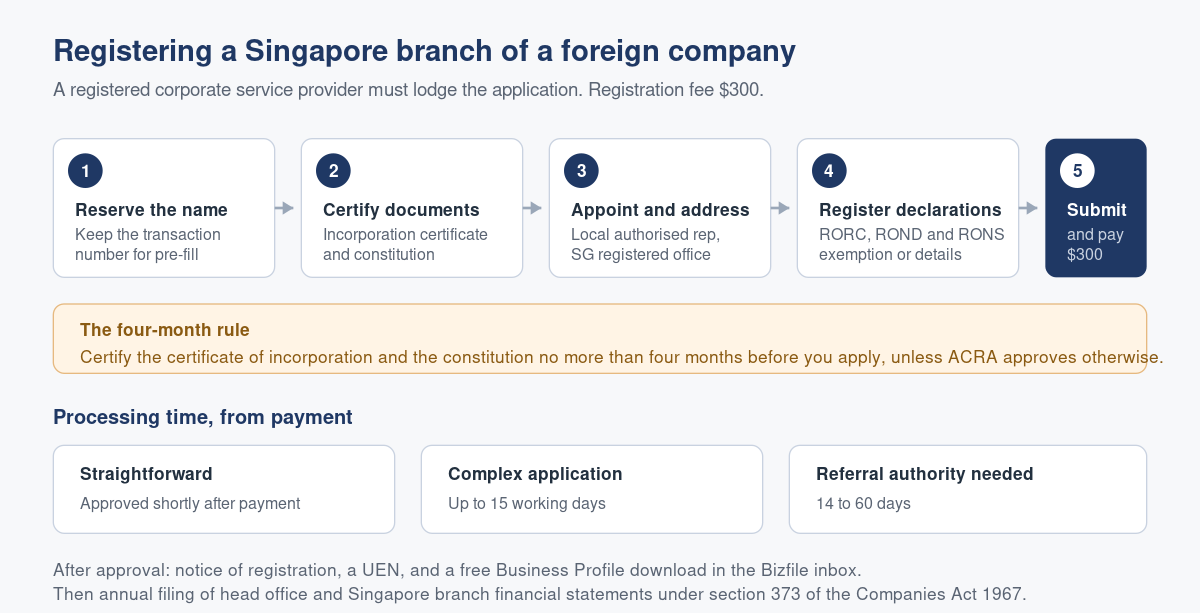
Now the trap. Certification of the certificate of incorporation and of the constitution must be done no more than four months before you apply, unless ACRA has approved otherwise. Certificates obtained a year ago for another purpose will not do, and groups that certify early then spend three months deciding on a name routinely have to redo it.
You also need an approved business name and its transaction number before you can start, so the name application comes first and is charged separately.
The registration itself, in order
- Reserve the name through Bizfile, and keep the transaction number, because it pre-fills the registration.
- Appoint your corporate service provider. A registered CSP must lodge the application using its own Corppass credentials.
- Assemble the foreign company’s details. Home country, home registration number, date of incorporation, legal form, whether it has share capital, and its registered office address at home.
- Assemble the branch’s details. Singapore registered office address, public office hours, business email address.
- Add the position holders. Officers and authorised representatives, individual or corporate, with identification details, appointment dates, residential and contact addresses.
- Make the register declarations. State whether the entity is exempt from the Registers of Nominee Directors and Nominee Shareholders, and from the Register of Registrable Controllers, giving nominator and controller details where it is not. If controllers cannot be identified, you declare that and give details of the individuals with executive control instead.
- Upload the certified documents, each with its certification details, plus translations.
- Review, declare and pay. ACRA’s registration fee is $300, by credit card, debit card or online banking.
Most registrations are approved shortly after payment. A complex application can take up to 15 working days, and one needing clearance from a referral authority takes 14 to 60 days. Plan your launch date around approval, not payment.
After approval, and what goes wrong
Once approved, the branch receives a notice of registration, a unique entity number, and a link to download a free copy of its Business Profile. Check the Bizfile inbox rather than waiting for an email.
Three things then go wrong, reliably.
The head office accounts nobody warned the parent about. The first section 373 filing comes due and the group discovers its consolidated accounts are going onto a public register in Singapore. If that is unacceptable, the answer was a subsidiary, and the decision needed to be made before registration.
Changes to the parent’s directors, unfiled. A registered foreign company must keep its registered director information current, and ACRA’s window for updating those changes is 30 days. Group-level board changes decided in a head office two time zones away do not reach the Singapore file by themselves.
The authorised representative who resigned in principle. The role is statutory and carries personal exposure, so it cannot simply be abandoned. Plan the succession first.
Our notes on common mistakes and rejection reasons for branch registrations and the branch office FAQ go item by item, and deregistering a foreign company branch is its own exercise. ACRA’s annual filing requirements for foreign companies set out the reporting side.
Frequently asked questions
Is a Singapore branch a separate legal entity from its parent?
No. A branch is the foreign company itself, registered to operate in Singapore. There is no separate legal personality and no liability boundary: the foreign company is fully responsible for the branch’s obligations. If you want a liability boundary, you want a subsidiary instead.
Can I register a Singapore branch myself, without engaging a service provider?
No. Every foreign business must engage a registered corporate service provider to lodge its Singapore registration, and the CSP files using its own Corppass credentials. This applies to all four routes, including the branch, and it is a requirement rather than a convenience.
How much does it cost to register a foreign company branch?
ACRA’s registration fee is $300, paid by credit card, debit card or online banking at the point of submission. The business name application is a separate, earlier transaction with its own fee. Your corporate service provider’s professional fee for preparing and lodging the application is separate again.
Does a Singapore branch pay Singapore corporate tax?
A branch can earn income in Singapore and is taxed on it, but it is not treated as a Singapore tax resident unless the foreign company is controlled and managed in Singapore. Non-residency affects access to treaty benefits and to residency-based incentives, so confirm the position before choosing this route.
Does registering a branch mean my parent company’s accounts become public in Singapore?
Generally yes. Under section 373 of the Companies Act 1967 a registered foreign company files head office financial statements as well as Singapore branch statements. Waivers and reliefs can be applied for, including under sections 373(12) and 373(13A), but they are not automatic.
Choosing the structure before you file, not after
The cost of choosing the wrong route is not the registration fee. It is the public disclosure you did not want, the liability you did not intend to leave with the parent, or the tax residency you assumed you had.
Raffles Corporate Services is a registered corporate service provider and files these registrations for foreign groups regularly. We will tell you which route fits, arrange the certifications inside the four-month window, and act as your Singapore registered office and filing agent afterwards. If you are weighing branch against subsidiary, have that conversation before any document is certified.
You can reach us through Raffles Corporate Services, or read more on Singapore corporate secretarial practice at Singapore Secretary Services.
— The Editorial Team, Raffles Corporate Services
Need help with corporate secretarial or compliance matters?
If you would like help with your company's corporate secretarial, governance or compliance requirements, email [email protected] or WhatsApp +65 8501 7133.
Our team can assist with corporate secretarial, accounting and tax matters. Where legal advice is needed, advisers from our associated law firms can assist.