

A representative office cannot trade. It cannot invoice, cannot sign a revenue contract, cannot earn income of any kind, and it cannot exist for more than three years. It is a licensed liaison desk for market research, registered with Enterprise Singapore rather than ACRA, and it is the right answer for a narrower set of businesses than the people selling it usually admit.
Raffles Corporate Services works with a panel of experienced Singapore law firms who offer cost-effective and efficient legal service and advice. This article is general information only and is not legal advice.
This is part three of three on how a foreign business can set up here. The branch, which is your parent operating in Singapore under its own name, is in the branch option. The subsidiary, which is a Singapore company owned by your parent, is in the subsidiary option.
Start with the agency point, because it causes more confusion than anything else here.
Enterprise Singapore, not ACRA
A representative office is not an ACRA registration. It is not a company, it has no UEN issued by ACRA on registration as a business entity, it does not appear on the ACRA register as an incorporated entity, and it is not governed by the Companies Act 1967.
Registration sits with Enterprise Singapore, under its representative office scheme. Some sectors go elsewhere again:
- Banking, finance, financial exchanges and insurance: the Monetary Authority of Singapore.
- Foreign law practices: the Ministry of Law.
- Everything else, including anyone intending to register an incorporated presence: ACRA.
This matters practically. If you ask ACRA about your representative office, you are asking the wrong regulator. If your corporate service provider quotes you a representative office alongside ACRA filings as though they are the same kind of thing, press them on it.
The entry criteria
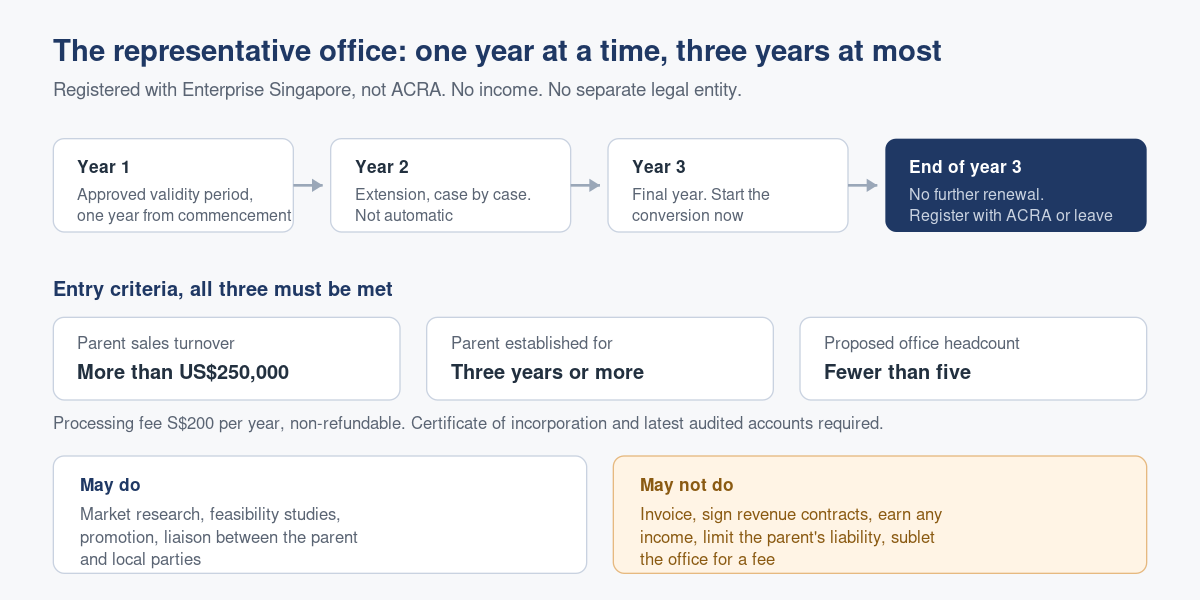
Enterprise Singapore publishes three thresholds that every new application from a foreign commercial entity must meet:
| Criterion | Threshold |
|---|---|
| Sales turnover of the foreign entity | More than US$250,000 |
| Years the foreign entity has been established | Three years or more |
| Proposed number of staff at the representative office | Fewer than five |
| Processing fee | S$200 per year, non-refundable |
Two documents are compulsory with a new application: the foreign entity’s certificate of incorporation or registration certificate, and its latest audited accounts. Anything not in English needs an official English translation.
The entity also needs a Corppass account before applying, and the nominated Corppass administrator must hold a valid NRIC or FIN. If nobody in the foreign entity holds one, the application has to be made through a local third party acting as proxy.
Read those criteria as a filter rather than a formality. The turnover and track record tests exist to keep the scheme for established businesses genuinely assessing the market. A two-year-old company with US$150,000 of turnover is not going to get a representative office, and should be looking at a subsidiary instead.
The three-year sunset
An approved representative office may operate for a validity period of one year from its commencement date. Extensions are granted case by case, up to a maximum of three years in total. After that the status is not renewed again.
That is not a soft deadline you can negotiate around in year four. It is the design of the scheme: the representative office exists so that you can find out whether Singapore works for you, and three years is Enterprise Singapore’s view of how long that should take. A business that still has a Singapore presence at the end of it is expected to register properly with ACRA, as a subsidiary, a branch, or by re-domiciling the parent.
Plan the conversion at the start of year three, not the end. Our sibling note on the three-year sunset goes through the timing in detail, and the common mistakes note covers what gets applications refused.
What the representative office may and may not do
| Activity | Permitted? |
|---|---|
| Market research and feasibility studies | Yes |
| Gathering information on customers, suppliers and competitors | Yes |
| Promoting the parent’s products and building local relationships | Yes |
| Acting as a liaison point between the parent and local parties | Yes |
| Issuing invoices or entering into revenue contracts | No |
| Earning any income, in Singapore or elsewhere, in its own right | No |
| Leasing its office space to another establishment for a fee | No |
| Operating as a separate legal entity, or limiting the parent’s liability | No |
| Continuing beyond three years | No |
Two obligations attach to the presentation of the office rather than to its activities. It must identify itself as a representative office registered in Singapore on its name plaque, letterheads, staff name cards and other communication materials. And Enterprise Singapore must be notified within one month of a change of name, a change of address or contact numbers, or the closure or upgrading of the operation. A representative office that does not comply with the scheme’s terms and conditions can be de-registered.
When the representative office is the wrong choice
This is the part worth reading twice, because the representative office is chosen for the wrong reason more often than it is chosen for the right one. It is usually picked because it looks cheap and light. It is cheap and light. It is also, for most businesses, a detour.
You intend to sell something
If there is any revenue in your Singapore plan, in year one or year two, the representative office is the wrong structure. It cannot invoice. Routing the invoice through the parent while the Singapore staff do the selling is not a workaround: it is a structure that invites a permanent establishment argument from IRAS on the parent, and a compliance problem with Enterprise Singapore on the office. Get incorporated instead.
You need to protect the parent
A representative office gives you nothing on liability. The parent is fully responsible for everything the office does, exactly as it would be for a branch. If limiting exposure is any part of why you are structuring at all, the subsidiary is the only one of the three that does it.
You want a tax outcome
A representative office has no income, so there is nothing to tax and no exemption to claim. It is not a Singapore tax resident and it cannot hold a certificate of residence, so it gives you no access to Singapore’s treaty network. Groups that set one up expecting a tax benefit have misunderstood the instrument.
You are already committed
If the decision to enter Singapore has actually been made, you are paying S$200 a year and a good deal of professional time for a structure whose entire purpose is to help you make a decision you have already made. Then you convert anyway. The representative office earns its keep when the answer is genuinely unknown and the cost of being wrong is high.
You need more than four people
The scheme expects fewer than five staff at the office. A team that needs to be larger than that is not doing market research any more.
What goes wrong in practice
Quiet trading. The single most common failure. A representative office staffed with commercially minded people starts closing deals, because that is what commercially minded people do. The invoices go out from head office, the relationships and negotiation sit in Singapore, and nobody at group level notices until a tax adviser asks where the contracts were concluded. The exposure is on both sides: de-registration by Enterprise Singapore, and a permanent establishment question on the parent.
Nobody diarises the renewal. Validity runs a year at a time. Extensions are discretionary and case by case, not automatic. An office that lets the date pass is not operating lawfully, and the fix is slower than the prevention.
The three-year cliff arrives unplanned. Incorporating a Singapore company takes days once the name is approved, but hiring transfers, work pass transfers, bank accounts, lease novations and customer contracts take months. Start the conversion at the beginning of the final year. Work pass holders in particular cannot simply be moved between employers without planning.
The office is used as a cheap address. Subletting the office space to another establishment for a fee breaches the terms and conditions. So does using the registration as a general-purpose Singapore front for activities the parent would rather not put on a company.
The name plaque and the name cards never get fixed. It reads like a trivial condition. It is a condition, and it is the one a reviewing officer can verify in thirty seconds.
Frequently asked questions
Is a representative office registered with ACRA?
No. Representative offices for commercial entities are registered with Enterprise Singapore under its representative office scheme. Banking, finance and insurance entities go to the Monetary Authority of Singapore, and foreign law practices to the Ministry of Law. ACRA handles incorporated structures: subsidiaries, foreign company branches and re-domiciliation.
Can a representative office hire staff and sponsor work passes?
It can employ a small team, with the scheme expecting fewer than five staff at the office. Employment pass eligibility is a separate assessment by the Ministry of Manpower against its own criteria, and it is not granted because a representative office exists. Check the Employment Pass requirements before you make offers.
What happens at the end of three years?
The representative office status is not renewed beyond a maximum of three years. If you intend to keep a Singapore presence, you register with ACRA before then, most commonly as a private limited subsidiary, or as a branch of the foreign company. Plan this twelve months out because staff, passes, leases and contracts all have to move.
Can a representative office open a bank account?
In practice it can usually open an account to fund local operating costs, but banks treat it as a non-trading liaison presence and the account is not intended to receive customer receipts. Expect the bank to ask what the money is for, and expect the answer “sales income” to be a problem.
Is a representative office cheaper than a subsidiary?
The government fee is lower. Enterprise Singapore charges S$200 per year, against $315 in ACRA fees to name and register a Singapore company. Total cost over three years is rarely lower once you add professional fees for a structure you will have to replace, and the subsidiary can trade from day one.
Does the parent company have to file anything in Singapore for the representative office?
Not with ACRA, because the representative office is not an ACRA-registered entity and has no annual return or financial statement filing. Enterprise Singapore must be notified within one month of changes to the office’s name, address, contact numbers or closure, and the entry criteria documents are submitted with the application itself.
Choosing once, properly
The representative office is a good instrument used narrowly: an established business with real turnover, genuinely unsure whether Singapore works, willing to spend a year finding out with a handful of people and no revenue. For everyone else it is a three-year delay on a decision they have already taken, followed by the incorporation they could have done at the start.
Raffles Corporate Services advises foreign businesses on which of the four structures actually fits their plan, registers the ACRA options, and handles the conversion when a representative office reaches the end of its run. If you are within a year of the three-year limit, that conversation should happen now rather than later.
You can reach us through Raffles Corporate Services, or read more on Singapore corporate secretarial practice at Singapore Secretary Services.
— The Editorial Team, Raffles Corporate Services
Need help with corporate secretarial or compliance matters?
If you would like help with your company's corporate secretarial, governance or compliance requirements, email [email protected] or WhatsApp +65 8501 7133.
Our team can assist with corporate secretarial, accounting and tax matters. Where legal advice is needed, advisers from our associated law firms can assist.