

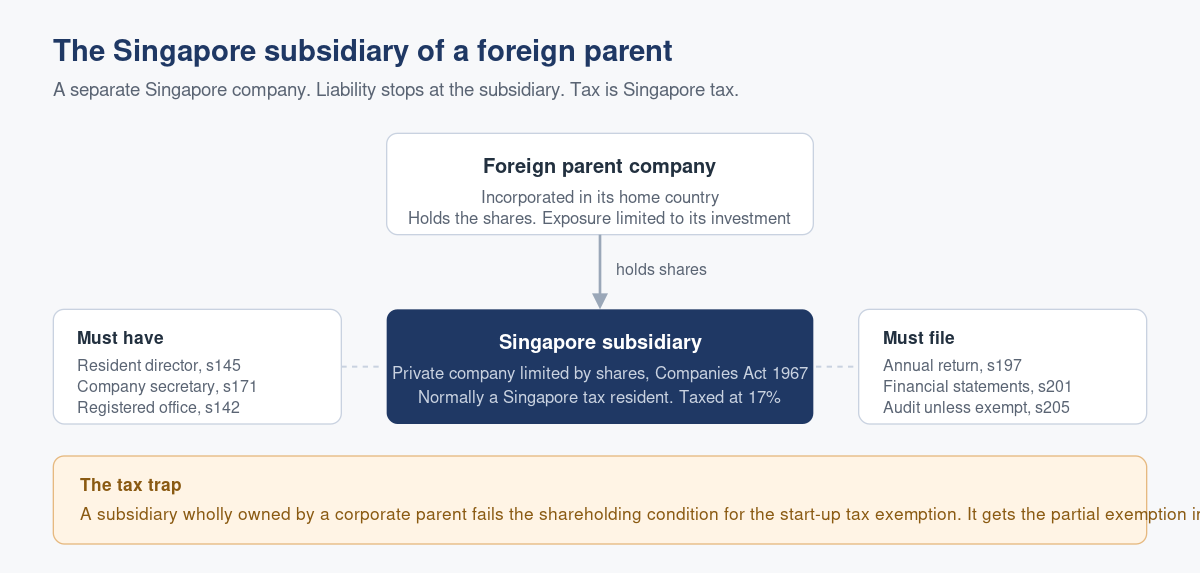
A subsidiary is a Singapore-incorporated private company whose shares are held by your foreign company. It is a separate legal person. Its debts are its own, its profits are taxed in Singapore at the Singapore rate, and your parent’s exposure stops at the money it has put in. That is the whole appeal.
Raffles Corporate Services works with a panel of experienced Singapore law firms who offer cost-effective and efficient legal service and advice. This article is general information only and is not legal advice.
This is part two of three on the ways a foreign business can set itself up here. The branch, which is your parent company operating in Singapore under its own name, is covered in the branch option. The representative office, which cannot trade at all, is covered in the representative office option.
If you are choosing between the three, the subsidiary is the default answer for a business that intends to actually sell something in Singapore and keep doing it. The other two are for narrower situations.
What a subsidiary is, in one paragraph
A subsidiary is not a special legal form. It is an ordinary Singapore private company limited by shares, incorporated under the Companies Act 1967, which happens to have a corporate shareholder incorporated somewhere else. There is no separate “foreign subsidiary” register and no separate rulebook. Once it exists it is treated for every purpose as a Singapore company: same annual return, same financial reporting, same directors’ duties, same penalties for filing late. That symmetry is why the subsidiary is clean, and why it is the most work.
The three things that make it worth doing
Liability stops at the subsidiary. Creditors of the Singapore company look to the Singapore company. With a branch, they look to your parent, because a branch is not a separate entity and there is nothing in between. If you are signing Singapore leases, hiring Singapore staff, taking on local trade credit or accepting Singapore customer liability, that distinction is the single biggest structural difference between the two routes.
It is normally a Singapore tax resident. A company incorporated in Singapore and managed here is generally a Singapore tax resident, which is what unlocks the certificate of residence, and with it access to Singapore’s tax treaty network on dividends, interest and royalties flowing in from the region. A branch is not a Singapore tax resident unless the foreign company is genuinely controlled and managed from Singapore, which for most branches it is not. IRAS sets out the residency test and how to obtain a certificate of residence.
It reads normally to everyone local. Banks, landlords, agencies, grant bodies and enterprise customers all understand a Singapore private limited company. A branch triggers extra questions at account opening, extra documents, and occasionally a flat refusal from a counterparty whose procurement system has no field for it.
What it commits you to
A subsidiary is a real company with real officers, and the obligations begin at incorporation, not when trading starts.
| Obligation | Where it comes from | What it means in practice |
|---|---|---|
| At least one director ordinarily resident in Singapore | Section 145, Companies Act 1967 | If nobody in your group lives here, you need a resident director, often on a nominee basis |
| A company secretary, appointed within six months | Section 171, Companies Act 1967 | The role is a statutory office, not administrative support |
| A registered office in Singapore, open to the public | Section 142, Companies Act 1967 | It does not have to be where you operate, but it must be a real address and not a P.O. box |
| Annual general meeting or the written route for private companies | Sections 175 and 175A, Companies Act 1967 | The accounts have to be put to the members every year |
| Annual return to ACRA | Section 197, Companies Act 1967 | Filed after the financial statements are done, on the clock |
| Financial statements | Section 201, Companies Act 1967 | Prepared under the applicable Singapore framework |
| Audit, unless exempt | Section 205, Companies Act 1967 | The small company exemption is a test, not an assumption |
| Registrable controllers, nominee directors and nominee shareholders registers | Companies Act 1967 | Declared at registration and maintained afterwards |
| A corporate service provider to register the entity | ACRA registration requirement for foreign businesses | Not optional, and it applies to every structure |
That last row is worth pausing on. ACRA requires a foreign business to engage a corporate service provider to register in Singapore, whichever structure it chooses. You cannot do it yourself from the parent’s office. The Corporate Service Providers Act 2024 also puts the provider under its own due diligence regime, which is why your first conversation involves more identity documents than you expected.
What it costs at ACRA
Government fees are $15 to apply for the business entity name and $300 to register the entity. That is $315, the same $315 a local founder pays. Anything beyond that in a quotation is professional fees for the provider, the resident director arrangement, the registered office and the secretarial work, and it should be itemised separately.
The tax point almost nobody gets right
Here is the trap, and it catches sophisticated groups.
Singapore’s headline corporate tax rate is a flat 17% of chargeable income. On top of that, IRAS operates two exemption schemes. The start-up tax exemption gives a qualifying new company 75% exemption on its first $100,000 of normal chargeable income and a further 50% on the next $100,000, for its first three consecutive years of assessment. The partial tax exemption, available to companies generally, gives 75% on the first $10,000 and a further 50% on the next $190,000. Both sit under Section 43 of the Income Tax Act 1947.
A subsidiary wholly owned by a foreign corporate parent does not qualify for the start-up exemption. The scheme caps the number of direct beneficial holders of the share capital at 20, and then asks that they all be individuals, or that at least one individual hold 10% or more of the issued ordinary shares. A single corporate shareholder fails that second limb. Companies whose principal activity is investment holding, or property development for sale or investment, are excluded outright as well.
Your subsidiary still gets the partial exemption, which is not nothing. But if your Singapore budget was built on the start-up numbers, it is wrong by a material amount in each of the first three years. Model this before you fix the shareholding: a structure with a genuine individual shareholder holding 10% or more produces a different tax outcome from one with none, and that is a decision you make once.
Subsidiary, branch or representative office
| Subsidiary | Branch | Representative office | |
|---|---|---|---|
| Separate legal entity | Yes | No | No |
| Parent liable for its debts | No, exposure limited to its investment | Yes, fully | Yes, fully |
| Can earn income in Singapore | Yes | Yes | No |
| Normally a Singapore tax resident | Yes | No, unless controlled and managed here | Not applicable, no income |
| Registered with | ACRA | ACRA | Enterprise Singapore |
| Start-up tax exemption available | No, if wholly owned by a corporate parent | No, not incorporated in Singapore | Not applicable |
| Time limit on the structure | None | None | Up to three years in total |
| Must engage a corporate service provider to register | Yes | Yes | See Enterprise Singapore’s own requirements |
What goes wrong in practice
Nobody owns the compliance calendar. The parent’s finance team assumes the corporate service provider is handling everything. The provider assumes it will be told when the accounts are ready. Twelve months pass, the annual return is late, and ACRA’s late lodgement penalties apply per late transaction. The fix is free: one named person at the parent, with the dates in their own calendar.
The resident director is treated as a formality. A nominee resident director appointed to satisfy Section 145 carries the full duties and the full exposure of any other director. Groups that treat the seat as a rubber stamp discover this at the worst moment. If your structure depends on a nominee, read our note on nominee shareholder arrangements and beneficial ownership disclosure first.
The subsidiary is incorporated before anyone checks the name. The parent’s global brand may already be taken here, or may collide with a controlled word that gets the application referred to another agency. Name approval comes first, always.
Funding goes in as debt with no paperwork. Undocumented parent-to-subsidiary funding becomes a problem at the first audit, the first bank facility and the first transfer pricing question. Decide at the outset whether the money is share capital or a loan, and paper it.
The group forgets that changes must be filed. Directors, officers, registered office, share transfers: all of them are filings with their own deadlines. Our Companies Act 1967 deep-dive FAQ covers the everyday ones.
Frequently asked questions
Can a foreign company be the only shareholder of a Singapore subsidiary?
Yes. A Singapore private company can have a single corporate shareholder, and that shareholder can be your foreign parent. The consequence is tax rather than corporate: a company wholly owned by a corporate shareholder does not meet the shareholding condition for the start-up tax exemption, so it falls back on the partial tax exemption instead.
Do I need to fly to Singapore to incorporate the subsidiary?
No. The registration is filed electronically through Bizfile by your corporate service provider, and identity verification is done on documents. You will need to engage a provider, because ACRA requires foreign businesses to register through one. What often does require attention in person is the bank account, and policies vary by bank.
Is a subsidiary more expensive to run than a branch?
Usually slightly, because the subsidiary needs a company secretary and its own set of Singapore financial statements. The branch avoids the secretary but has to file its parent’s head office financial statements with ACRA as well as branch accounts, which many groups find more intrusive and more work than a local audit.
Can I convert a branch into a subsidiary later?
There is no conversion mechanism. You would incorporate a new subsidiary, transfer the business, contracts, staff and assets across, and then deregister the branch. It is a real project, not a filing. Our note on deregistering a foreign company branch covers the closing half of that exercise.
What if my parent wants to move its own legal home to Singapore instead?
That is re-domiciliation, a fourth option in which the foreign company becomes a Singapore company rather than owning one. It is available only to companies that meet the eligibility conditions. Start with our note on re-domiciliation into Singapore.
Does the subsidiary need an audit?
Not necessarily. Singapore exempts small companies from audit on a statutory test, and a new subsidiary often passes it in its first years. Being part of a foreign group affects the test, because the group’s size can be relevant. Do not assume exemption: have it tested against your actual figures before you budget for no audit.
Getting the structure right the first time
The subsidiary is usually the right answer, but the version you incorporate matters more than most founders expect. Shareholding decides your tax exemption. Director residency decides who carries the statutory risk. The funding decision decides what your balance sheet looks like to a bank two years from now. All three are cheap to get right on day one and expensive to unwind.
Raffles Corporate Services registers Singapore subsidiaries for foreign parents, provides the resident director and company secretary where the group has nobody here, and runs the compliance calendar. If you are weighing subsidiary against branch, that is usually a clear answer once we know what you intend to sell and to whom.
You can reach us through Raffles Corporate Services, or read more on Singapore corporate secretarial practice at Singapore Secretary Services.
— The Editorial Team, Raffles Corporate Services
Need help with corporate secretarial or compliance matters?
If you would like help with your company's corporate secretarial, governance or compliance requirements, email [email protected] or WhatsApp +65 8501 7133.
Our team can assist with corporate secretarial, accounting and tax matters. Where legal advice is needed, advisers from our associated law firms can assist.