

A partnership or a private company can convert to a limited liability partnership through a single Bizfile lodgement for a modest fee, but the two routes are not equivalent. A partnership simply becomes an LLP. A company is dissolved and removed from the register of companies on conversion, and there is no undoing it.
Raffles Corporate Services works with a panel of experienced Singapore law firms who offer cost-effective and efficient legal service and advice. This article is general information only and is not legal advice.
That asymmetry is the whole story. Converting from a partnership is a straightforward upgrade: separate legal personality and limited liability for the partners, and very little given up. Converting from a private company is a genuine restructuring with tax, contractual and governance consequences, and a large proportion of the companies that ask about it should not do it.
Here are both routes, the eligibility rules in each, what happens on the day of conversion, and what goes wrong.
What an LLP is, and why people want one
A limited liability partnership is a body corporate with separate legal personality under the Limited Liability Partnerships Act 2005. It can own property, sue and be sued in its own name, and it survives changes in its partners. Under section 12, the partners are not personally liable for the LLP’s obligations merely by being partners, which is exactly what a general partnership cannot offer.
What it is not is a company. There are no shares, no share capital, no directors and no dividends. Profit is shared under the LLP agreement and taxed in the hands of the partners rather than at entity level. That treatment is usually the attraction for professional and consulting firms with a handful of principals, and usually the problem for a company that has been retaining profit inside the entity at corporate rates.
| Feature | General partnership | LLP | Private company |
|---|---|---|---|
| Separate legal entity | No | Yes | Yes |
| Partner or owner liability | Unlimited and personal | Limited, subject to the Act | Limited to unpaid share capital |
| Perpetual succession | No | Yes | Yes |
| Minimum participants | 2 partners | 2 partners (section 28) | 1 shareholder |
| Local presence requirement | Local manager where owners are not resident | At least one manager ordinarily resident in Singapore (section 29) | At least one locally resident director |
| Annual filing with ACRA | None | Annual declaration of solvency or insolvency (section 30) | Annual return and financial statements |
| Audit | Not applicable | No statutory audit requirement | Required unless exempt |
| Taxed at | Partner level | Partner level | Entity level |
Route one: partnership to LLP
Who is eligible
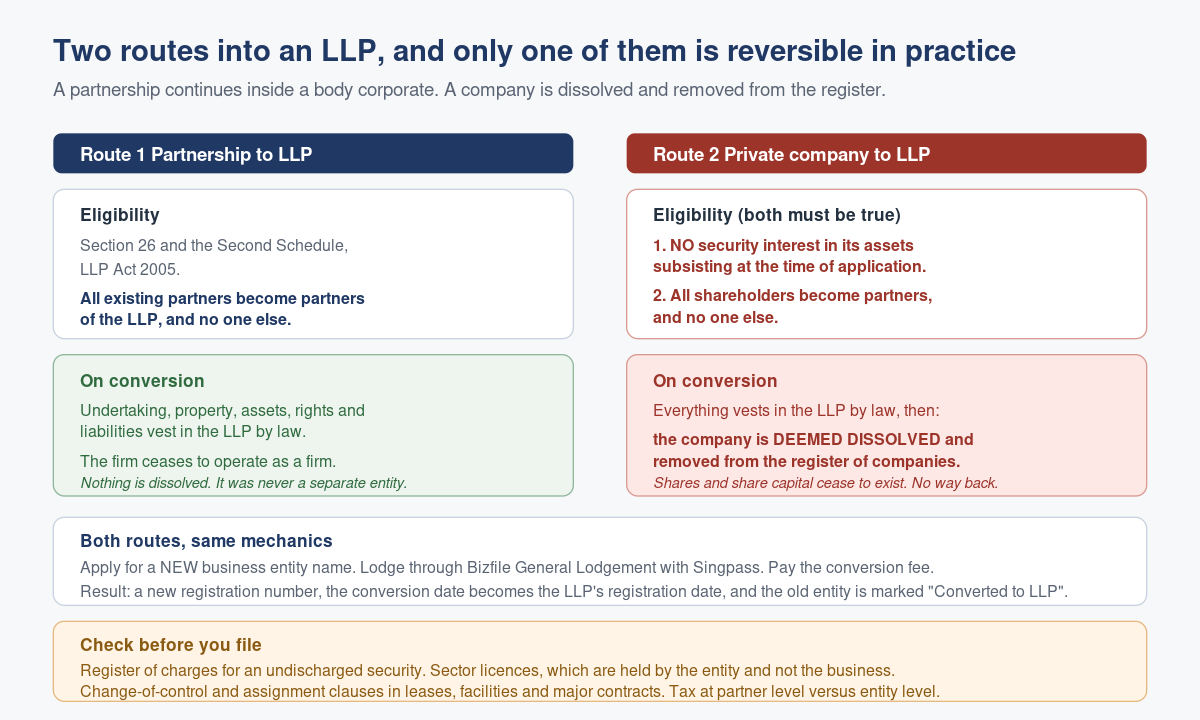
Conversion from a firm to an LLP is governed by section 26 of the LLP Act 2005 and the Second Schedule to that Act. The controlling condition is one of identity: all existing partners of the firm must become partners of the new LLP, and no one else may be a partner at the point of conversion.
Both halves of that bite. You cannot use the conversion to drop a partner who is leaving, nor to admit the partner who is joining. Either change must happen separately, before or after, with the line-up frozen at the moment of conversion.
What happens on conversion
The undertaking of the firm, together with its property, assets, interests, rights, privileges, liabilities and obligations, vests in the LLP by operation of law. Because a general partnership was never a separate legal entity, nothing is being dissolved in the company sense; the business simply continues inside a body corporate.
For most partnerships this is close to a free upgrade. The recurring obligations you acquire are the annual declaration of solvency or insolvency, a Singapore registered office, at least one manager ordinarily resident in Singapore, and proper accounting records under section 31 of the Act. In exchange, your personal assets are no longer exposed to a claim against the firm simply because you are a partner.
Route two: private company to LLP
Who is eligible
Conversion from a private company is governed by section 27 of the LLP Act 2005 and the Third Schedule. Under the Third Schedule, a company may apply to convert if and only if both of the following are true:
- There is no security interest in its assets subsisting or in force at the time of the application.
- The partners of the LLP comprise all the shareholders of the company and no one else.
The first condition stops most applicants. Any subsisting charge over the company’s assets, whether a bank debenture, an equipment financing security or a mortgage, blocks the conversion outright. You must discharge the security and have the satisfaction registered before you apply, which means negotiating with the lender first.
The second condition mirrors the partnership route. Every shareholder becomes a partner, nobody new joins. A company with a dormant minority shareholder who does not want to be a partner in a trading LLP, or with a corporate shareholder that cannot sensibly be an LLP partner, has a structural problem rather than a paperwork problem.
What happens on conversion, and this is the part to read
On the date of registration specified in the notice of registration, three things happen under the Third Schedule:
- The LLP comes into existence with all the attributes of a body corporate under the Act.
- All movable and immovable property vested in the company, together with all its assets, interests, rights, privileges, liabilities, obligations and undertaking, transfers to and vests in the LLP without further assurance, act or deed.
- The company is deemed to be dissolved and removed from the register of companies under the Companies Act 1967.
The company is gone. Its shares and its share capital cease to exist. There is no mechanism in the Act to convert back, so a company that later wants a corporate structure again must incorporate a new company and move the business across commercially.
Where property vesting in the LLP is registered with an authority, for example land, a vehicle or a registered trade mark, the LLP must notify that authority of the conversion and of its own particulars as soon as practicable after the date of registration. The vesting is automatic, but the registers do not update themselves.
The steps, in order
- Clear any security interest if you are converting a company. Discharge the charge and register the satisfaction with ACRA. Do not start anything else until this is done.
- Fix the partner line-up. Every existing partner or shareholder in, nobody else. Effect any admissions or retirements separately, outside the conversion.
- Apply for a new business entity name for the LLP. The LLP is a new registration with its own name application, not a renaming of the existing entity.
- Read the applicable Schedule to the LLP Act. The legal effects and the continuing responsibilities are set out there, not in a guidance note.
- Prepare the statements to be lodged. For a company conversion, a statement by all shareholders with the company’s name, registration number and date of incorporation, plus the registration particulars for the LLP itself.
- Lodge through Bizfile’s General Lodgement eService using Singpass. Our note on logging in to Bizfile as an individual covers the access side.
- Notify every registry and counterparty. New registration number, new legal form, and in most cases a new name.
The conversion fee is payable on lodgement and the name application is charged separately. Once approved, you receive a new registration number for the LLP, the date of conversion becomes the LLP’s registration date, and the previous entity’s status is updated in ACRA’s records to show that it converted to an LLP.
That last point is quietly useful. The public record shows continuity rather than a closure, which is easier to explain to a bank than a strike-off followed by a fresh registration would be. If you are looking at closure rather than conversion, our guide to closing a sole proprietorship or partnership covers that path.
What goes wrong in practice
The bank charge nobody remembered. A company with a floating charge granted years ago against a facility long since repaid, but never formally discharged and never registered as satisfied, cannot convert. Pull an ACRA register of charges before you plan anything.
Converting a company for tax reasons without modelling them. Moving from entity-level to partner-level taxation changes the answer for every partner individually, and it changes the answer for retained profits, for the partial tax exemptions a small company enjoys, and for any unutilised losses or capital allowances sitting inside the company. Model it before you file, because the decision is not reversible.
Assuming contracts follow quietly. The vesting is automatic in law, but a change of legal form and registration number will trip change-of-control, assignment and notification clauses in leases, facility agreements, licences and major customer contracts. Our note on the accounting considerations when restructuring or selling a business covers the wider diligence.
Trying to restructure ownership through the conversion. Combining a conversion with a buy-out or an admission in one transaction will be rejected, and unpicking it costs more than sequencing it properly would have.
Forgetting the LLP’s own obligations. An LLP files an annual declaration of solvency or insolvency and must keep proper accounting records. It needs a locally resident manager and a registered office. It is lighter than a company, not unregulated, and the managers carry personal exposure for the declaration.
Overlooking licences and permits. Sector licences are held by a legal entity. A new registration number often means a new licence application or, at best, a variation, and some regulators will not permit an LLP to hold the licence at all. Ask the regulator before you convert.
Frequently asked questions
Can I convert my Pte Ltd to an LLP and keep the company as well?
No. On conversion the company is deemed dissolved and removed from the register of companies. The LLP takes over all its property, assets, liabilities and obligations by operation of law, and the shares cease to exist. If you want both structures, you need a transfer of the business to a newly registered LLP instead.
Can we convert if a bank has a charge over our assets?
No. The Third Schedule to the LLP Act 2005 permits a company to convert only if there is no security interest in its assets subsisting or in force at the time of the application. You must discharge the security and register the satisfaction with ACRA first, which in practice means agreeing the release with the lender before you plan the conversion.
Does every shareholder have to become a partner?
Yes, and no one else may become a partner at conversion. The partners of the LLP must comprise all of the company’s shareholders and nobody additional. The same identity rule applies to a partnership conversion: all existing partners in, no new partners. Any change to the ownership line-up must be done as a separate step.
Do we keep our registration number and our business name?
No to the number. A conversion produces a new registration number for the LLP, and the date of conversion becomes the LLP’s registration date. You also apply for a new business entity name as part of the process. The previous entity’s status in ACRA’s records is updated to show that it converted to an LLP.
Can an LLP convert back to a private company?
Not by any conversion mechanism in the LLP Act 2005, which provides for conversion into an LLP and not out of one. Reversing the decision means incorporating a new company and transferring the business to it commercially, with fresh contracts, fresh licences and a full set of tax consequences. Treat the conversion as one-way.
What does an LLP have to file with ACRA each year?
An annual declaration of solvency or insolvency under section 30 of the LLP Act 2005, lodged by a manager. An LLP does not file financial statements with ACRA and is not subject to statutory audit, but section 31 requires it to keep accounting records sufficient to explain its transactions and financial position.
Decide with the numbers in front of you
Converting a partnership to an LLP is usually a good idea and rarely complicated. Converting a company to an LLP is occasionally a very good idea and always worth a careful look first, because the company does not survive the transaction.
Raffles Corporate Services will run the analysis before anything is filed: the charge position, the partner line-up, the tax comparison at partner level against the company position, the licences at risk, and the contract clauses a change of legal form will trigger. If the answer is that you should stay a company, we will say so. If it is that you should convert, we will handle the name application, the statements and the lodgement.
You can also read more on Singapore corporate secretarial practice at Singapore Secretary Services, and our Companies Act 1967 deep-dive FAQ covers the company-side obligations you would be leaving behind.
— The Editorial Team, Raffles Corporate Services
Need help with corporate secretarial or compliance matters?
If you would like help with your company's corporate secretarial, governance or compliance requirements, email [email protected] or WhatsApp +65 8501 7133.
Our team can assist with corporate secretarial, accounting and tax matters. Where legal advice is needed, advisers from our associated law firms can assist.