

Once you qualify, the transfer of registration is a general lodgement in Bizfile with a fee, a queue of roughly forty working days, and a document pack that has to be certified abroad before you file. The harder part is what happens after approval, because two deadlines start running immediately and missing one can cost you the registration.
Raffles Corporate Services works with a panel of experienced Singapore law firms who offer cost-effective and efficient legal service and advice. This article is general information only and is not legal advice.
This is part 2. Whether you qualify at all is a separate question, and it is settled in part 1, which covers the size test, the solvency test and the home-jurisdiction conditions. Do not start on the document pack until you have worked through that.
What follows assumes you have cleared eligibility and are ready to file.
Reserve the name first, and reserve it correctly
You cannot lodge a transfer of registration until you have an approved business name application for the Singapore company.
There is a trap inside the name application. Under the company type field, you must select either a private company limited by shares or a public company limited by shares. Any other selection produces an approved name that cannot be used for a transfer of registration, and you will have to start the name application again. This is the most common avoidable delay in the whole exercise.
Names that touch a regulated activity go to a referral authority for clearance. That is a separate queue sitting in front of the main queue, and ACRA states it can add up to fifteen working days. If your intended name contains a word like bank, insurance, education, school or media, assume a referral and plan for it.
The document pack
Almost every document in the pack has to be certified by someone abroad, which is why this stage takes longer than the ACRA queue itself.
| Document | Who may certify it | Notes |
|---|---|---|
| Certificate of incorporation | An official holding the original who performs a role equivalent to ACRA in your jurisdiction | Only that class of certifier is accepted |
| Constitution from your home jurisdiction | That same official, or a notary public, or a director, manager or secretary by affidavit (statutory declaration if the company was formed within the Commonwealth), or the registered qualified individual lodging your documents who has verified authenticity | Several routes, so pick the cheapest one available to you |
| Proposed Singapore constitution | Not certified | Drafted for the Singapore company, effective on registration |
| Audited financial statements for the last financial year stated in the application | Auditor | Scope depends on whether you are standalone, a parent or a subsidiary |
| Declarations from the corporate service provider, proposed secretary, proposed director, proposed lodger and foreign entity directors | The declarant | Prepared in PDF for lodgement |
| Certified English translations of anything not in English | Abroad: an official holding the original, a notary public, a sworn translator, or a Singapore consular officer in that jurisdiction. In Singapore: a person approved by ACRA | Translation and certification are two separate steps |
Certification has a shelf life. Supporting documents need to be certified within a defined window before you apply, which ACRA states as four months unless you have obtained its approval otherwise. Certify too early and you will be paying a foreign notary twice.
Which audited accounts you have to produce
The scope of the audited financial statements depends on where the applicant sits in its group.
| Applicant | What to submit |
|---|---|
| Standalone company, or a subsidiary | Audited standalone financial statements of the company |
| Parent company | Audited standalone financial statements, or unaudited standalone management accounts if standalone audited accounts do not exist, plus consolidated audited financial statements. Where consolidated accounts do not exist, the audited accounts of the larger subsidiary together with the organisation structure |
| Subsidiary with a Singapore parent entity, or a subsidiary re-domiciling alongside its parent | Audited standalone financial statements, or unaudited standalone management accounts if unavailable, plus the parent’s consolidated audited financial statements, or the consolidated audited accounts of the parent’s larger subsidiary with an organisation chart |
The pattern is consistent: audited numbers where they exist, a documented fallback where they do not, and no silence about a set of accounts that should exist.
Filing, fee and processing time
The transfer of registration is submitted through Bizfile’s General Lodgement eService, together with the supporting documents. It is not a self-service registration form of the kind used for a local incorporation. If Bizfile access is new to you, our note on logging in to Bizfile as a business user covers the Corppass route.
The application fee is non-refundable, and ACRA states processing at forty working days from a complete submission, with referral authority review capable of extending that. Two words there carry weight. Non-refundable means a refused application is a sunk cost, which is the argument for doing the eligibility work properly first. Complete means the clock does not start until ACRA has everything, so a pack missing one certified translation does not sit in the queue while you find it.
One point that quietly reassures most applicants: the financial statements you lodge, and the position holders’ dates of birth, residential addresses, mobile numbers and email addresses, are not made available for public purchase.
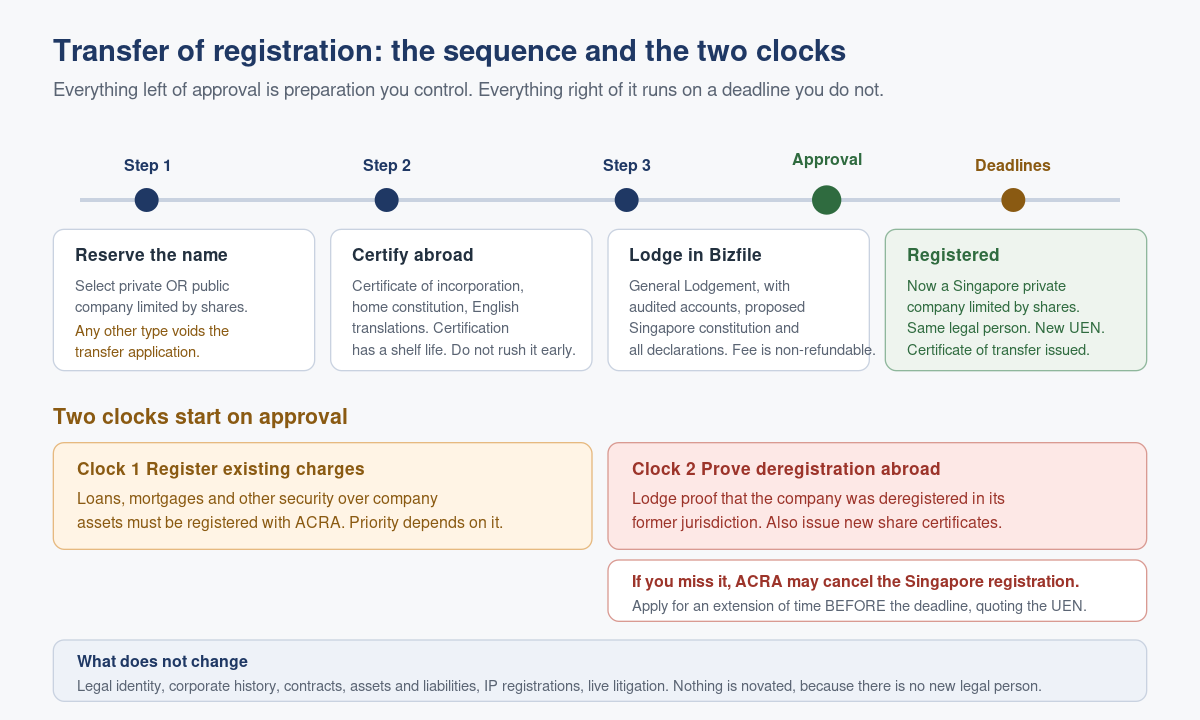
The two deadlines that start when you are approved
ACRA emails the outcome. On approval, your business is registered as a Singapore private company limited by shares and you receive a certificate confirming the registration of transfer. Then the clock starts, twice.
- Within 30 days, register any existing charges with ACRA. Loans, mortgages and other security interests over the company’s assets have to be registered here. Your security package did not disappear when you changed registers, and unregistered charges create a priority problem you will not want to explain to a lender later.
- Within 60 days, lodge proof through Bizfile General Lodgement that the company has been deregistered in its former jurisdiction, and issue new Singapore share certificates and debenture certificates to holders.
The deregistration proof is the sharp one. ACRA may cancel your Singapore registration if it is not produced on time. That is not a penalty in the ordinary sense; it unwinds the thing you paid for.
If the home jurisdiction is slow, you can apply for an extension of time before the current deadline expires, quoting the new Singapore UEN and the reason. ACRA states this as a per-application fee with immediate processing, granting a further sixty days per extension.
Plan the deregistration in parallel with the Singapore filing rather than after it. In several jurisdictions, deregistration cannot even be applied for until the foreign registration is confirmed, and the local process itself can run longer than sixty days. That sequencing problem is why extensions exist.
What changes, and what does not
What does not change
Your legal identity. Your corporate history. Your contracts, in their existing form and with their existing counterparties. Your assets and liabilities, which are not transferred anywhere because there is no transfer of ownership. Your intellectual property registrations, subject to notifying the relevant registries of the change in particulars. Your litigation, which continues with the same party on the record.
Say this to counterparties in writing early, because a change of registration often triggers a nervous email from a bank or a customer who assumes a novation is required.
What does change
You are now a Singapore company and the Companies Act 1967 applies to you in full, subject to the modifications in the Companies (Transfer of Registration) Regulations 2017. Practically, that means:
- A Singapore-resident director and a company secretary. Both are hard statutory requirements for a Singapore company, and both need to be in place from registration.
- A registered office in Singapore. Stated in the application, and required to be operational.
- A financial year that is defined by your application. Your first Singapore financial year starts immediately after the last financial year end stated in your transfer registration and ends on the first financial year end date you proposed in it. You may change that date later where the Companies Act allows, and our note on changing a Singapore company’s financial year end explains the mechanics and the tax consequences.
- Annual general meetings and annual returns. A listed company must hold its AGM within four months after financial year end; every other company has six months. Financial statements for the year are presented at that meeting. Where more time is needed, an extension may be applied for under section 175 of the Companies Act 1967, and prescribed fees apply.
- A register of registrable controllers. Singapore beneficial ownership obligations now bite. Our guide to the register of registrable controllers sets out who must be identified and by when.
- Statutory audit, unless you are exempt. Whether you qualify for small company audit exemption is a question about your Singapore financial years, not your history abroad. See our note on audit exemption for small companies.
- Singapore corporate tax. Re-domiciliation moves your registration; it does not by itself resolve where you are tax resident, what basis period applies, or how your pre-transfer tax attributes are treated. Take tax advice on that separately and early.
What goes wrong in practice
Certifying too early. A four-month certification window sounds generous until a referral authority adds two weeks to the name application and the audited accounts come back late. Certified documents that have gone stale have to be certified again, abroad, at full cost.
Treating deregistration abroad as an afterthought. The most expensive mistake available, because the consequence is cancellation of the Singapore registration rather than a fine.
Not appointing the Singapore officers in time. A resident director and a company secretary are not post-registration housekeeping. They are named in the application, and they have to be real people who have consented and who will actually respond.
Assuming no one needs to be told. Banks, insurers, licensing authorities, IP registries, landlords and major customers all hold records against your old registration number and place of incorporation. Nothing legally requires them to notice, and nothing stops them freezing an account when they do notice by accident.
Frequently asked questions
How long does a transfer of registration take from start to finish?
Budget several months rather than several weeks. ACRA’s stated processing time runs from a complete submission, and a referral authority review on the name can add to it. The genuine time sink is upstream: getting audited accounts finalised and getting documents certified by the right class of official abroad.
Do we get a new registration number?
Yes. You are issued a Singapore unique entity number on registration, and you will receive a certificate confirming the registration of the transfer. Your former registration number in the home jurisdiction ceases to identify the company once it is deregistered there, which is why every counterparty record needs updating.
What happens if we cannot deregister abroad within 60 days?
Apply to ACRA for an extension of time before the current deadline expires, quoting the new Singapore UEN and the reason. Extensions are granted in further sixty-day blocks for a per-application fee. If you simply let the deadline pass, ACRA may cancel the Singapore registration altogether.
Do our existing contracts need to be novated to the Singapore company?
No. There is no new legal person, so there is nothing to novate. The same company continues under a different register. Check your contracts anyway for change-of-domicile, change-of-control or notification clauses, because a few instruments treat a change of place of incorporation as a trigger event.
Are our financial statements made public when we lodge them with the application?
No. ACRA states that financial statements submitted with a transfer of registration, and position holders’ personal details such as date of birth, residential address, mobile number and email address, are not made available for public purchase. Ordinary company information in the register remains publicly searchable.
Can we change our financial year end after we land?
Yes, where the Companies Act permits it. Your first Singapore financial year is fixed by the dates stated in your application, and a later change follows the normal notification and approval rules. Because the basis period for tax follows the financial year, look at the tax consequences before you file the change.
The part worth paying someone to sequence
The transfer of registration itself is a single lodgement. The project around it is a sequencing exercise across at least two jurisdictions, and the cost of getting the order wrong is measured in re-certified documents and, at the far end, a cancelled registration.
Raffles Corporate Services runs inward transfers end to end: eligibility assessment, name reservation under the correct company type, the certified document pack, the Bizfile lodgement, the resident director and secretary appointments, and the post-approval deadlines. If your home jurisdiction is slow, we will have the extension application drafted before you need it.
Our documents required guide, the timeline and processing benchmarks and the costs and fees breakdown go deeper on each stage, and the re-domiciliation FAQ answers the questions that come up once a project is live. If you have not yet confirmed you qualify, go back to part 1 first.
— The Editorial Team, Raffles Corporate Services
Need help with corporate secretarial or compliance matters?
If you would like help with your company's corporate secretarial, governance or compliance requirements, email [email protected] or WhatsApp +65 8501 7133.
Our team can assist with corporate secretarial, accounting and tax matters. Where legal advice is needed, advisers from our associated law firms can assist.