

Lodging an alteration of your company’s constitution with ACRA costs nothing and is usually processed immediately. What it is not is optional. Section 26(2) of the Companies Act 1967 gives you 14 days from the date the resolution is passed, and a missed deadline is an offence for the company and every officer in default.
Raffles Corporate Services works with a panel of experienced Singapore law firms who offer cost-effective and efficient legal service and advice. This article is general information only and is not legal advice.
Passing the resolution and lodging it are two separate events, and business owners routinely treat them as one. The shareholders do the hard part, sign the document, file it in the minute book, and consider the matter closed. The change is then invisible to ACRA, to your bank, to your auditor and to any acquirer.
There is also a genuine trap on one of the three filing routes, where lodging too early is the mistake rather than lodging too late.
What an alteration of constitution actually is
A Singapore company’s constitution is the single document that replaced the old memorandum and articles of association. It sets out the internal rules: how directors are appointed, how shares are issued and transferred, how meetings are called, what majorities are needed for what.
Under section 26(1) of the Companies Act 1967, the constitution may be altered or added to by special resolution, unless the Act provides otherwise. Section 26(1AA) then does something useful: the alteration is deemed to form part of the original constitution from the date of the special resolution, or from any later date the resolution specifies. So you can pass a resolution today and have the change bite on 1 January.
Two limits are worth knowing before you draft anything:
- Entrenched provisions. Section 26A lets a company entrench provisions, so they can only be altered if conditions more demanding than a special resolution are met. Section 26(1) is expressly subject to section 26A, so read your own constitution before assuming three-quarters is enough.
- Legacy unalterable provisions. Under section 26(1B), a provision in the constitution immediately before 1 April 2004 that could not then be altered may now be altered only if all members agree. This catches older family companies more often than you would expect.
Still deciding whether a change is needed? Our guides on changing your company constitution and altering a constitution under section 26A cover the decision and the drafting. This article is about the lodgement.
The three filing routes, and how to pick yours
Bizfile does not offer a single generic “we changed our constitution” transaction. When you open the Application for Alteration of Constitution eService you must choose a type of alteration from a dropdown, and the type drives which fields appear, which documents you upload, and how long ACRA takes.
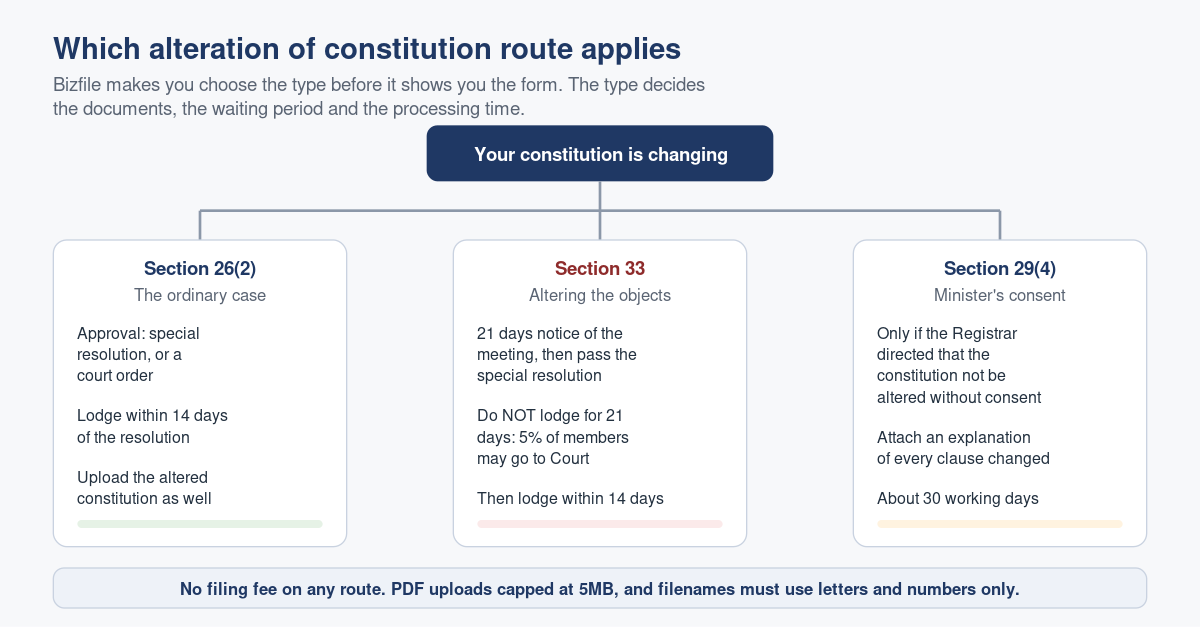
| Route | Use it when | Approval needed before filing | Processing |
|---|---|---|---|
| Alteration under section 26(2) | The ordinary case: any resolution, court order or other document that affects the constitution | Special resolution (or a court order, where the change comes from the court) | Immediate in most cases |
| Alteration for the Minister’s consent under section 29(4) | Your constitution contains a provision, inserted at the Registrar’s direction, that it may not be altered except with the Minister’s consent | The Minister’s consent, applied for through this filing | Typically 30 working days |
| Alteration to alter objects under section 33 | You are changing or removing the objects clause | Special resolution, plus the 21-day waiting period described below | Immediate in most cases, once the waiting period has run |
The section 29(4) route is the one most directors have never heard of, because it applies only to companies approved to register without “Limited” or “Berhad” in their name. Section 29(3) lets the Registrar impose conditions on that approval and direct that they be written into the constitution, including a condition that it not be altered without the Minister’s consent. That usually means a company limited by guarantee formed for a charitable, religious or educational purpose. Section 29 does not apply to a limited company registered as a charity under the Charities Act 1994; those sit under section 29A.
The section 33 trap: do not lodge early
If you are altering the objects in your constitution, the sequence is not the usual one, and getting it wrong is the commonest failure on this transaction.
Section 33 builds in a dissent window. Holders of at least 5% of the issued shares (or of any class of them), or of at least 5% in nominal value of the company’s debentures, may apply to the Court to cancel the alteration. Treasury shares are disregarded for that 5% calculation under section 33(5A). The application must be made within 21 days after the resolution was passed, and until the window closes the alteration has no effect except so far as the Court confirms it.
So the Act deliberately reverses the usual instinct:
- Give 21 days’ written notice of the meeting, specifying the intention to propose the resolution as a special resolution. Notice goes to all members, and to all trustees for debenture holders, or to the debenture holders themselves where their class has no trustee.
- Pass the special resolution.
- Wait. Section 33(8) says a copy of the resolution must not be lodged before the 21 days expire, or, if a Court application has been made, before the Court has determined it, whichever is later.
- Lodge within 14 days after the expiry of that 21-day period, or within 14 days after the Court determined the application, together with a copy of its order.
- The alteration takes effect on compliance with step 4, under section 33(10).
So an objects change has a minimum lead time of three weeks after the meeting before it can even be filed, and it is not effective on the date of the resolution; it is effective on lodgement.
What to have ready before you log in
The eService asks for structured details rather than letting you attach a bundle and hope. Depending on the route, expect to supply details of the constitution, the date of the meeting, the effective date, the date the minutes were signed and, where the change flows from the court, the order number and its date.
On documents, prepare PDFs of:
- The constitution as altered, or as newly adopted
- The resolution, court order or other document affecting the constitution
- Minutes signed by a representative of the holding company, where that is what you are filing
- For the section 29(4) route, a supporting explanation stating the clauses being altered, the proposed wording, why the company proposes the change, and any third-party approvals obtained
Each upload is capped at 5MB. There is also a filename rule that quietly rejects submissions: letters and digits only. No spaces, no full stops beyond the extension, no ampersands or currency symbols, no non-Latin characters. Constitution (Amended) 2026 & AGM.pdf will not go through. ConstitutionAmended2026.pdf will.
Filing is done by a company officer, typically a director or company secretary, logged in as a business user through Corppass. A corporate service provider files for a client by switching to its CSP profile first. See our guides on logging in as a business user and who should hold which e-service roles.
What goes wrong, and what it costs
The resolution is passed and never lodged. Section 26(2) requires the company, within 14 days after the resolution is passed or the order made, to lodge a copy of that resolution, order or other document, together with a copy of the constitution as adopted or altered unless the Registrar dispenses with it. Section 26(2A) makes default an offence: the company and every officer in default are each liable on conviction to a fine not exceeding $1,000, and also to a default penalty. Separately, ACRA applies late lodgement penalties to overdue transactions.
The constitution copy is left out. People lodge the resolution and stop. Lodging half of it leaves ACRA holding a resolution that changes a document it does not have.
The majority was wrong. A special resolution under section 184(1) needs not less than three-fourths of the members entitled to vote and voting, in person or by proxy, at a general meeting for which at least 14 days’ written notice was given by a private company, or 21 days by a public company, specifying the intention to propose it as a special resolution. Short notice is possible under section 184(2), but only if members holding at least 95% of the total voting rights agree. If your notice did not use the words “special resolution”, you may not have one at all.
The written resolution threshold was not checked. A private company or unlisted public company may pass a special resolution by written means under section 184A, but section 184A(3) requires agreement from members representing at least 75% of the total voting rights of all members entitled to vote, or a greater majority if the constitution demands one. That is a different test from a show of hands in a room.
Nobody updated the shareholders’ agreement. Where the two conflict, you have a dispute waiting: see shareholders’ agreement versus constitution.
Where this sits alongside the notice of resolution filings
There are two places a resolution reaches ACRA. If it changes the constitution, use the Alteration of Constitution transaction, because section 26(2) requires the altered constitution to go up with it. If it does something else the Act requires to be registered, use the Notice of Resolution eService, which also handles holding company minutes and financial assistance notices under section 76. Our companion guides cover which resolutions must be lodged with ACRA and why, filing an ordinary resolution and filing a special resolution.
Frequently asked questions
Does it cost anything to file an alteration of constitution?
No. ACRA charges no filing fee for this transaction. The cost sits elsewhere: getting the drafting right, and the late lodgement penalty plus statutory fine if you miss the 14-day window under section 26(2) of the Companies Act 1967.
How long do I have to lodge the change?
Fourteen days from the date the special resolution is passed or the court order made, under section 26(2). The exception is an alteration of objects under section 33, where you must not lodge until 21 days after the resolution, then have 14 days from the end of that period.
When does the change actually take effect?
For an alteration under section 26, it is deemed to form part of the constitution from the date of the special resolution, or a later date specified in the resolution. For an alteration of objects under section 33, it takes effect only once the resolution has been properly lodged.
Can a majority shareholder simply change the constitution?
Not always. A special resolution needs three-quarters of the votes cast, so 51% is not enough. Provisions entrenched under section 26A may require more, and a provision unalterable immediately before 1 April 2004 can now be altered only with the agreement of all members.
Do I need the Minister’s consent to change my constitution?
Only if your constitution contains a provision, inserted at the Registrar’s direction under section 29(3), saying it cannot be altered without that consent. This applies to companies approved to drop “Limited” from their name. Those filings take around 30 working days rather than being processed immediately.
Getting the sequence right the first time
Constitutional changes are cheap to execute and expensive to execute badly, because the failure is silent. Nothing bounces. The company carries on with a document ACRA has never seen, and the gap surfaces during due diligence, a bank facility review or a share sale.
Raffles Corporate Services drafts the resolutions, calculates the notice and waiting periods, and lodges inside the statutory window. If you have altered your constitution recently and are not certain it was filed, that is a five-minute check on our side. See also our Companies Act 1967 deep-dive FAQ and the Singapore company compliance calendar, or read more on Singapore corporate secretarial practice at Singapore Secretary Services.
— The Editorial Team, Raffles Corporate Services
Need help with corporate secretarial or compliance matters?
If you would like help with your company's corporate secretarial, governance or compliance requirements, email [email protected] or WhatsApp +65 8501 7133.
Our team can assist with corporate secretarial, accounting and tax matters. Where legal advice is needed, advisers from our associated law firms can assist.