

A name complaint asks ACRA’s Registrar to direct another business to change its name. It costs $200, is filed through general lodgement on Bizfile, and on the “too similar” ground it must reach the Registrar within 12 months of the other entity’s registration. After that, the statutory route closes.
Raffles Corporate Services works with a panel of experienced Singapore law firms who offer cost-effective and efficient legal service and advice. This article is general information only and is not legal advice.
The 12-month limit is the fact to take away. It sits in section 27(2A) of the Companies Act 1967 for companies and section 17(7) of the Business Names Registration Act 2014 for registered business names, and the Registrar is not permitted to consider a late application on that ground. No discretion, no extension.
Everything below is about building a complaint that succeeds inside that window.
The four grounds you can complain on
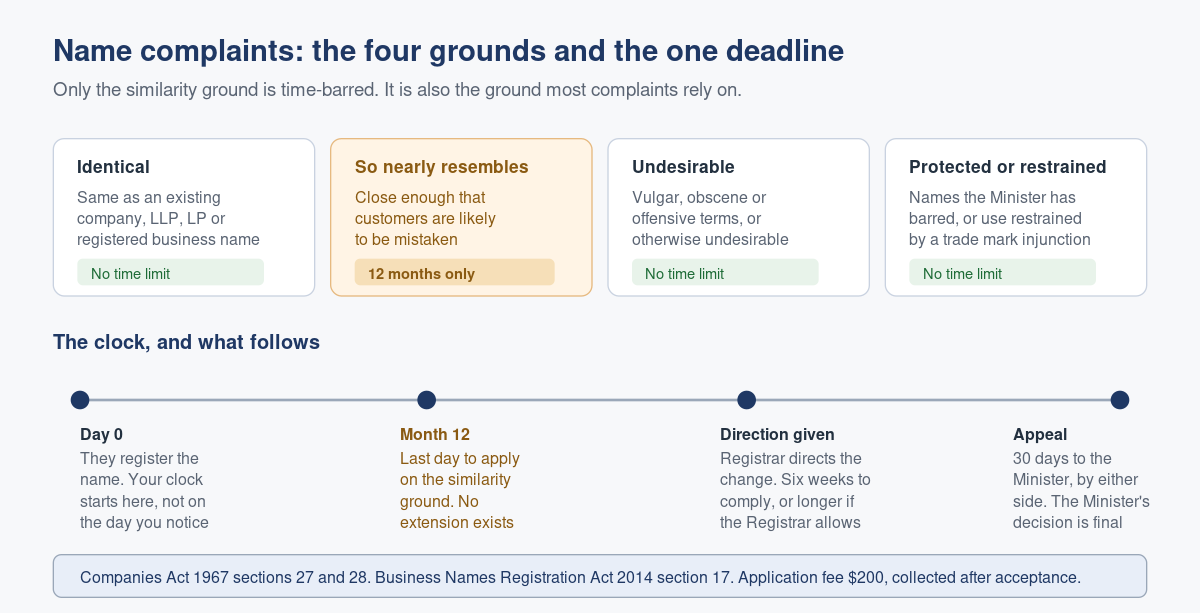
The Registrar’s power to direct a change of name is found in section 27(2) of the Companies Act 1967 for companies, in section 28(3) where the company arrived at the name by changing it, and in section 17(4) of the Business Names Registration Act 2014 for sole proprietorships and partnerships. The grounds are broadly parallel across the statutes.
| Ground | What it covers | Time limit to apply |
|---|---|---|
| Identical name | The name is the same as an existing company, corporation, LLP, limited partnership or registered business name | No 12-month limit |
| So nearly resembles as to be likely to be mistaken for it | The name is not identical but close enough to confuse customers | 12 months from the other entity’s registration, or from approval of its name change |
| Undesirable | Vulgar, obscene or offensive names, and names the Registrar considers otherwise undesirable | No 12-month limit |
| Protected or restricted | Names the Minister has directed the Registrar not to accept, and names whose use has been restrained by a Trade Marks Act 1998 injunction | No 12-month limit |
Note the asymmetry. Only one ground carries the 12-month deadline, and it is the ground most complaints actually rely on. If a name is genuinely identical, or genuinely offensive, lateness is not fatal. If your case is “close enough to confuse our customers”, the clock is running from the day they registered, not from the day you noticed.
Where the “identical” line really falls
Businesses tend to describe a rival’s name as identical when it is not. “Wee Trading” and “Wee International Trading” are not identical. They are potentially confusingly similar, which puts you on the deadline-bound ground rather than the open one. Be honest about which side of that line you are on before you plan the filing, because it changes your urgency completely.
Who can file, and what you need before you start
You need to be a business owner or an authorised representative, and you file through Bizfile using Corppass. If your Corppass access is not set up or the right e-service is not assigned to whoever is doing the filing, sort that out first. Our guide to Corppass e-service roles and who gets access covers which role a filer needs, and logging in to Bizfile as a business user covers the route in.
Before you draft anything, gather the following about the other business. Every one of these is available from a Bizfile search of their entity.
- The exact registered business name, spelled as registered
- Their Unique Entity Number (UEN)
- Their registered address, if available
- The type and location of their business activity
- Who their customers are
- Their registration date, which is what starts your 12-month clock
Then gather your evidence. This separates complaints that succeed from complaints that are merely irritated.
- Customer emails, letters or calls that came to you by mistake, or reached them by mistake. Actual misdirected communications are the strongest evidence of confusion there is.
- Invoices, payment records or financial records showing money or orders going to the wrong entity, or business lost because of the confusion.
- Correspondence between you and the other business. If you asked them to change and they refused, produce that. If you never asked, expect to be asked why not.
- Any court injunction restraining use of the words in question, including one granted under the Trade Marks Act 1998.
The Registrar is weighing whether the public is likely to be misled. Proof that people have already been misled is worth more than any assertion that they might be.
The steps, in order
- Check the other entity’s registration date on Bizfile and work out how much of the 12 months remains. Do this first, before anything else.
- Read ACRA’s published policy statement on business names and name complaints, and its guidance on acceptable company names, so that your complaint is framed against the criteria the Registrar actually applies.
- Pull the entity’s details from Bizfile: exact name, UEN, address, activity, registration date.
- Assemble the supporting documents listed above, with dates.
- Draft the written complaint. State the name complained about, the UEN, the address if known, the type and location of their activity, their customer base, and the basis of your complaint. Identify the ground you are relying on expressly.
- Open general lodgement on the Bizfile portal and submit the complaint with the supporting documents attached.
- Wait to be contacted about payment. ACRA collects the $200 application fee after the complaint is accepted, not at the point of submission. Payment is by credit card, PayPal, Google Pay or Apple Pay.
- Respond promptly to any request for further information. Complex cases take longer precisely because details have to be gathered from both parties and the submissions weighed.
What happens if you win
The Registrar directs the other entity to change its name. The entity then has six weeks from the date of the direction to comply, or a longer period if the Registrar allows one.
The consequences of ignoring a direction differ depending on the entity type, and the difference is substantial.
| Company | Registered business name | |
|---|---|---|
| Direction to change name | Companies Act 1967 section 27(2) or 28(3) | Business Names Registration Act 2014 section 17(4) |
| Time to comply | 6 weeks from the direction, or longer if allowed | 6 weeks from the direction, or longer if allowed |
| Consequence of non-compliance | The company and its officers are guilty of an offence, liable on conviction to a fine not exceeding $2,000 and to a default penalty | The Registrar may cancel the registration of the person and the business name |
| Appeal | To the Minister within 30 days of the decision. The Minister’s decision is final | To the Minister within 30 days of being informed. The Minister’s decision is final |
Note who can appeal. Both statutes give the right to the entity directed to change its name, and also to a complainant whose application was refused. If ACRA declines to act, you have 30 days to take it to the Minister.
One further point: where a court has granted an injunction under the Trade Marks Act 1998 restraining use of a name, both the Registrar and the Minister must accept that decision as correct. A judgment is binding on the decision-maker here, not merely persuasive.
What goes wrong in practice
The 12 months ran out while evidence was being gathered. By far the most common failure. Companies spend three quarters of the window building a file, then discover the deadline is weeks away. On the similarity ground, file inside the window and supplement afterwards rather than waiting for a perfect bundle.
Nobody was checking. The window runs from the other entity’s registration date, not from your discovery. A business that never searches the register can lose the right without knowing it existed. A short annual name search, built into your year-end routine, catches this.
The complaint is about branding, not about the register. A name complaint can change a registered name. It cannot stop a competitor using a trading style, a logo, a domain or a shop sign that is not their registered name. If the harm is really about brand confusion in the market, the remedies you want are a passing off action or trade mark enforcement, and our note on passing off and protecting your business name sets out what those deliver.
The evidence is annoyance rather than confusion. “Our customers might get confused” is a prediction. “Here are nine invoices their customers sent to us in the last four months” is a case. Bring the second.
You are the one who will have to change. Occasionally a company investigates, finds its own name was the later registration, and quietly withdraws. If that is you, the route is a change of name by special resolution: our guide to changing your company name covers the resolution and the filing.
Frequently asked questions
How much does a name complaint to ACRA cost?
The application fee is $200, payable by credit card, PayPal, Google Pay or Apple Pay. ACRA contacts you for payment after the complaint has been accepted rather than collecting it at submission. The fee is for the application, not a guarantee of the outcome.
How long do I have to file a name complaint?
If your ground is that the name is so similar to yours as to be likely to be mistaken for it, the application must reach the Registrar within 12 months of the other entity’s registration, or of the approval of its change of name. The identical, undesirable and restricted grounds carry no such limit.
Can I file a name complaint if I have no registered trade mark?
Yes. A name complaint is a registry process under the Companies Act 1967 and the Business Names Registration Act 2014, and it does not require a trade mark. A trade mark, and better still a court injunction restraining use of the name, strengthens the case considerably.
What happens if the other business ignores the direction to change?
For a company, the company and its officers commit an offence and are liable on conviction to a fine not exceeding $2,000 and to a default penalty. For a registered business name, the Registrar may cancel the registration of the person and the business name outright.
Can the other side appeal against a decision to make them change?
Yes. An entity aggrieved by the Registrar’s direction may appeal to the Minister within 30 days, and the Minister’s decision is final. The same right runs the other way: if the Registrar refuses to give a direction, the complainant may appeal within 30 days of being informed.
Will ACRA deal with my dispute with the other business?
No. ACRA decides whether the registered name should stand. It does not award damages, order an apology, or adjudicate the underlying commercial quarrel. For the wider boundaries of what ACRA will and will not investigate, see our guide to the complaints ACRA actually handles.
The cheapest version of this problem is the one you catch early
A name complaint filed in month three, with two misdirected invoices attached, is a straightforward matter. The same complaint in month fourteen is not a matter at all.
Raffles Corporate Services runs register checks for the companies we act for, which is how these things get noticed while they can still be fixed. If someone has registered a name uncomfortably close to yours, the first question is how long you have left, and that takes ten minutes to answer.
You can also read more on Singapore corporate secretarial practice at Singapore Secretary Services. The governing provisions are on Singapore Statutes Online, and ACRA’s own process page sits under complaints and appeals.
— The Editorial Team, Raffles Corporate Services
Need help with corporate secretarial or compliance matters?
If you would like help with your company's corporate secretarial, governance or compliance requirements, email [email protected] or WhatsApp +65 8501 7133.
Our team can assist with corporate secretarial, accounting and tax matters. Where legal advice is needed, advisers from our associated law firms can assist.