

Filing a declaration of solvency in Bizfile costs nothing, takes a few minutes and is processed immediately. It is also the filing that decides whether the rest of your solvent winding up is legally valid, because everything after it depends on the declaration having been made properly and lodged in the right order.
Raffles Corporate Services works with a panel of experienced Singapore law firms who offer cost-effective and efficient legal service and advice. This article is general information only and is not legal advice.
Most people discover the sequencing problem too late. The declaration is not a form you complete because the system asks for it. It is a statutory act performed by the directors at a board meeting, and the Bizfile filing is simply how that act is recorded with the Registrar. Do the filing without doing the board meeting first, and you have filed a record of something that never happened.
This guide covers the filing itself: who may submit it, what you need in hand before you start, how local companies and limited liability partnerships differ, and the mistakes that force companies to start the whole process again.
Where this filing sits in the process
A members’ voluntary winding up (for a local company) or a partners’ voluntary winding up (for an LLP) is the route for an entity that can pay its debts in full. It runs through three separate Bizfile submissions, in a fixed order, inside a single eService called “File winding up of business entity”.
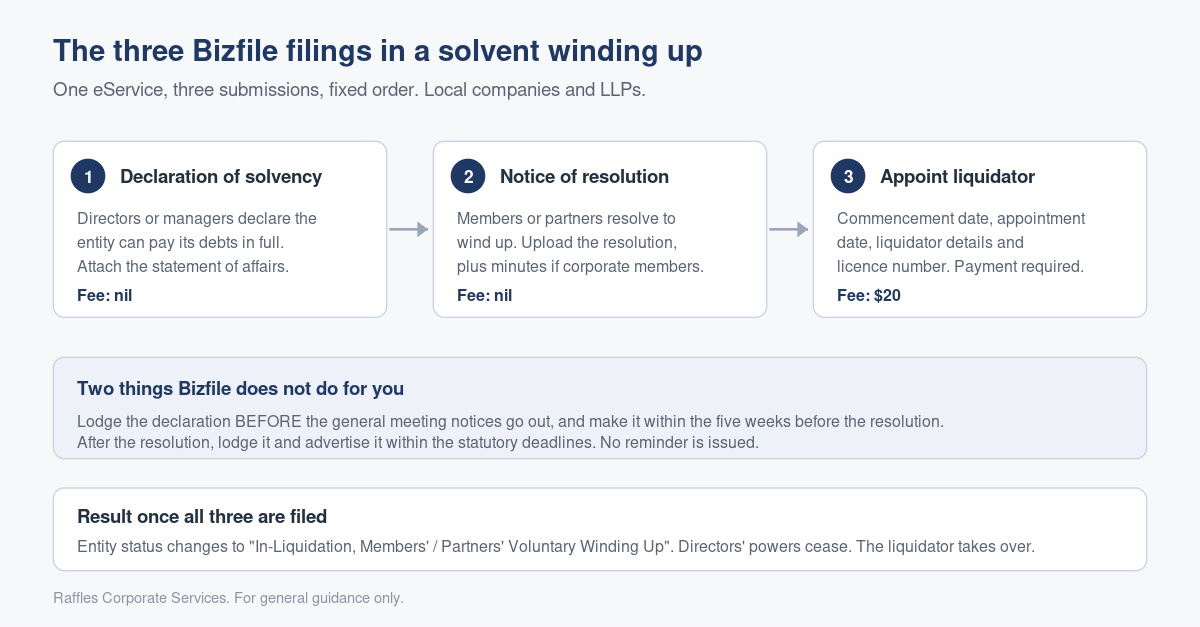
| Filing | What it records | Fee |
|---|---|---|
| 1. Declaration of solvency | The directors’ or managers’ declaration that the entity can pay its debts in full | Nil |
| 2. Notice of resolution | The members’ or partners’ resolution to wind up voluntarily | Nil |
| 3. Appointment of liquidator | Who is taking over the entity and from what date | $20 |
Each filing has its own guide in this series: this one, then the notice of resolution, then appointing a liquidator. For the wider question of whether liquidation or striking off is the right route at all, start with winding up a local company.
You cannot skip a step and you cannot reorder them. Bizfile carries the details forward from one filing to the next, so the second and third submissions display what you already filed. That is convenient, but it also means an error in the first filing propagates.
The three filings above are separate from the two statutory deadlines that follow the resolution and are covered in our guide on filing the notice of resolution. Bizfile does not remind you about those.
What a declaration of solvency actually is
Under section 163 of the Insolvency, Restructuring and Dissolution Act 2018, the directors, or a majority of them where there are more than two, must declare at a meeting of directors that they have inquired into the company’s affairs and formed the opinion that the company will be able to pay its debts in full within a period not exceeding 12 months after the winding up commences.
Four things have to be true, and each of them is a common point of failure:
- The declaration is made at the directors’ meeting, not circulated for signature afterwards.
- A statement of affairs is attached, showing assets and the amount expected to be realised from them, liabilities, and the estimated expenses of the winding up, made up to the latest practicable date.
- It is made within the five weeks immediately before the resolution for voluntary winding up is passed.
- It is lodged with the Registrar before the notices of the general meeting go out to members.
Point four is the one Bizfile cannot enforce and nobody checks. The system will happily accept a declaration filed a week after the meeting notices were emailed. The Registrar’s record will look fine. The winding up will not be.
We cover the substantive law, the personal exposure under section 163(4) and the reversed burden of proof in section 163(5) in a separate piece on the declaration of solvency in a members’ voluntary liquidation. Read that before you sign anything. This article deals with getting the filing itself right.
Who can file it
Three categories of filer can submit the declaration through Bizfile:
- A director of the local company. One or more directors may file.
- A manager or partner of the LLP.
- A registered corporate service provider, filing on behalf of a client entity.
Note the distinction between making the declaration and filing it. A CSP can submit the transaction, but the CSP is not declaring solvency. The directors or managers made that declaration at their meeting, and their names go into the filing. The filer is a messenger.
You will need Corppass access to the entity being wound up. If you have never used the business user route, our guide on logging in to Bizfile as a business user covers the Corppass step, and if you hold positions in several entities, switching profiles in Bizfile is worth reading first. Filing a winding up against the wrong entity is not a mistake you want to explain.
What to have ready before you open the eService
Bizfile will not let you save halfway through a partially prepared submission in any useful way, so assemble everything first.
For a local company
| Item | Detail |
|---|---|
| Date of the directors’ meeting | The date the declaration was passed. Must be today or earlier. |
| Names of directors | Those who attended the meeting and made the declaration. |
| Statement of affairs | A single file to upload. |
The director names are selected from a dropdown drawn from ACRA’s records. If a director does not appear, there is an “Others” option that lets you type the name in free text. That option exists for a reason, but it is also a warning light: a director who made the declaration but is not in ACRA’s register of directors suggests an unfiled appointment sitting somewhere in your file. Fix that before you wind the company up, not after.
For an LLP
| Item | Detail |
|---|---|
| Date of the declaration | The date it was made. Must be today or earlier. |
| Names of managers | The managers who made the declaration. |
| Statement of affairs | A single file to upload. |
The LLP route runs on the Limited Liability Partnerships Act 2005, which applies a modified version of the corporate winding up regime rather than the IRDA sections directly. The Bizfile screens look almost identical, but do not assume the underlying obligations map one to one. Where an LLP’s position is unusual, check the statute rather than the analogy.
The filing, step by step
- Log in to Bizfile and select Business User to authenticate through Corppass.
- Check the entity name and UEN shown in the top menu bar. This is the entity you are about to wind up.
- If you are filing as a CSP, select the Corporate Service Provider tab on the profile selection page, and pick the right firm if you belong to more than one.
- Open the File winding up of business entity eService and click Start.
- Verify the entity details, then select Members’ / Partners’ voluntary winding up as the type of winding up.
- Enter the meeting or declaration date and select the directors or managers who made the declaration. Save.
- Upload the statement of affairs and click Review and confirm.
- Read the review page properly, tick the declaration box and submit.
You will get an on-screen acknowledgement and a notification in your Bizfile inbox. There is no fee and no waiting period. The next step is the notice of resolution.
What goes wrong
The order is reversed. Meeting notices go out, then someone remembers the declaration and files it. The declaration has to be lodged before those notices are sent. There is no cure for this other than starting again with a fresh board meeting, a fresh declaration and fresh notices.
The five-week window expires. The declaration is made, then the general meeting slips by a fortnight because a shareholder is travelling. If the resolution is passed more than five weeks after the declaration, the declaration no longer supports it.
The statement of affairs is written optimistically. Assets at book value rather than realisable value. No provision for the tax that has not been assessed yet. Nothing for the lease that has not been surrendered, the employee claim that has not crystallised, or the cost of the winding up itself. An optimistic statement of affairs is precisely what the reversed burden in section 163(5) is built to catch, and the person carrying that risk is the director, personally.
A director’s name is missing from ACRA’s records. The “Others” free-text option papers over it at the point of filing, but the underlying gap remains. Directors are meant to be notified to ACRA within 14 days of appointment, and this is a bad moment to discover that did not happen. Our note on the ACRA alerts companies miss covers how these gaps usually accumulate.
Nobody checked solvency properly. A members’ voluntary winding up that turns out to be insolvent does not simply fail. It converts, and the liquidator must summon a creditors’ meeting. What was a controlled, director-led close becomes a creditors’ process with creditors choosing the liquidator.
Frequently asked questions
Does filing the declaration of solvency start the winding up?
No. The winding up commences when the members pass the special resolution, not when the declaration is filed. The declaration is a precondition that must exist and be lodged before the meeting notices go out. Filing it alone changes nothing about the company’s status.
How much does it cost to file a declaration of solvency?
Nothing. There is no fee for the declaration of solvency or for the notice of resolution. The only fee in the three-filing sequence is $20, payable when you file the appointment of the liquidator.
Can our corporate secretary make the declaration for us?
No. Only the directors, or a majority of them where there are more than two, can make the declaration, and they must do it at a board meeting after inquiring into the company’s affairs. A corporate service provider can file the submission, but cannot supply the opinion.
What if one director refuses to sign?
Where there are more than two directors, a majority is enough. Where there are two, both must make it. A refusal is worth taking seriously rather than working around, because it usually means that director sees a liability the others have not priced in.
Can we backdate the declaration in Bizfile?
Bizfile accepts the current date or a past date, so you can record a board meeting that genuinely happened earlier. That is not the same as backdating. Recording a date on which no meeting took place is a false statement in a filing with the Registrar.
Does an LLP file the same declaration?
Functionally yes. The LLP version is made by the managers rather than directors, and it is a partners’ voluntary winding up rather than a members’. The Bizfile screens and the statement of affairs requirement are substantially the same.
Getting the sequence right the first time
A solvent close is one of the few corporate processes where the paperwork order matters more than the paperwork content. Board meeting, declaration, lodgement, notices, resolution, appointment. Get those out of sequence and you do not have a defective winding up, you have no winding up.
That is the part Raffles Corporate Services takes off your desk. We run the board meeting and the statement of affairs alongside the Bizfile filings, so the dates line up and the five-week window does not quietly expire while a shareholder is away. If you are closing a solvent company or LLP this year, a short conversation before the first board meeting saves a great deal of work afterwards.
You can read ACRA’s own overview of winding up a local company, check the statutory wording in the Insolvency, Restructuring and Dissolution Act 2018 on the Singapore Statutes Online site, and reach the eService itself through Bizfile. More on Singapore corporate secretarial practice at Singapore Secretary Services.
— The Editorial Team, Raffles Corporate Services
Need help with corporate secretarial or compliance matters?
If you would like help with your company's corporate secretarial, governance or compliance requirements, email [email protected] or WhatsApp +65 8501 7133.
Our team can assist with corporate secretarial, accounting and tax matters. Where legal advice is needed, advisers from our associated law firms can assist.