

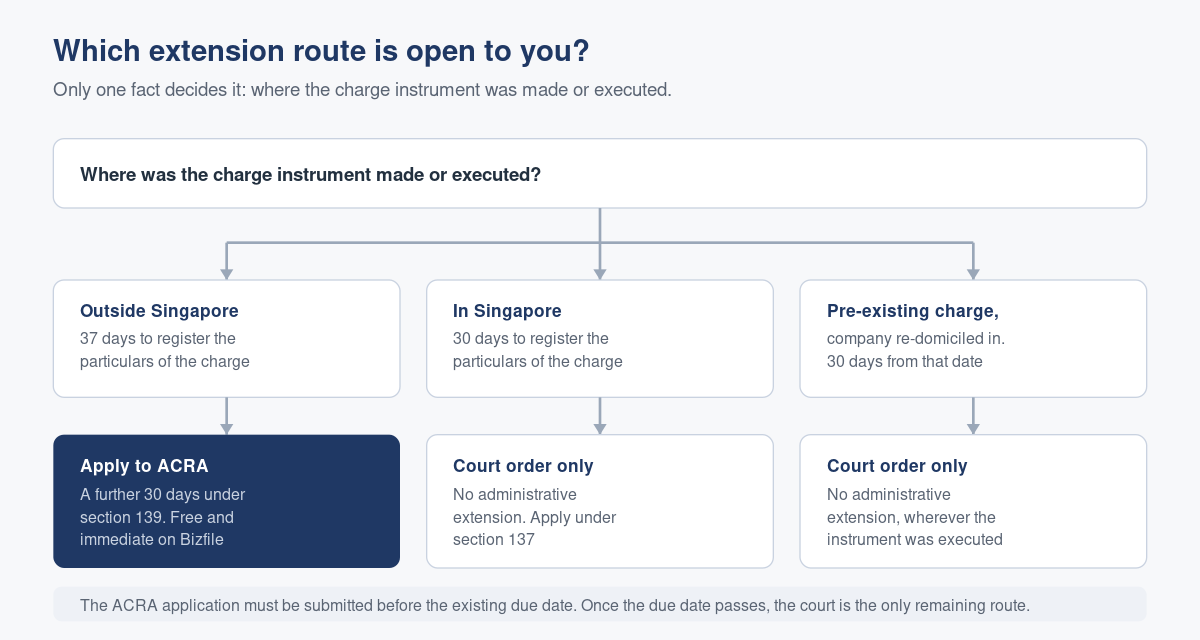
You can apply to ACRA for a 30 day extension to register a charge only where the charge instrument was made or executed outside Singapore. For a charge executed in Singapore there is no administrative extension at all: the only route is a court order. And in either case, the application has to reach ACRA before the existing deadline expires.
Raffles Corporate Services works with a panel of experienced Singapore law firms who offer cost-effective and efficient legal service and advice. This article is general information only and is not legal advice.
That last sentence is where most of the damage happens. Companies discover the problem late, assume an extension is available as a matter of course, and find the eService will not accept the application because the due date has already gone. At that point the only remaining option is an application to court, which costs real money and takes real time.
Here is how the two routes differ, who can apply, and what the consequences are if you miss both.
The deadlines you are working against
Charges granted by Singapore registered companies, whether local, re-domiciled or foreign, must be registered with ACRA. The registration regime sits in the Companies Act 1967, in the division running from section 131 to section 141. If you need the underlying mechanics, our guide to registering company charges with ACRA under section 131 covers what is registrable and how the filing works.
ACRA’s published position on the clock is as follows:
| Where the charge was created | Time to register | Extension available from ACRA? |
|---|---|---|
| In Singapore | 30 days | No. Court order only |
| Outside Singapore | 37 days | Yes. A further 30 days under section 139 |
| Pre-existing charge, company re-domiciled into Singapore | 30 days from re-domiciliation | No. Court order only |
The longer period for instruments executed abroad exists for an obvious practical reason: the original document has to physically reach the people who will file the particulars. The extension under section 139 is an extension of that same allowance, granted because documents crossing borders do not always cooperate.
Section 139 of the Companies Act 1967 is headed “Documents made out of Singapore”, and it is the provision ACRA relies on when it grants the extension administratively. The alternative route, section 137, is headed “Extension of time and rectification of register of charges”, and that is the court’s jurisdiction. You can read both on the Singapore Statutes Online version of the Companies Act 1967.
Who can apply, and what ACRA asks for
Two categories of filer may submit the application: a position holder of the entity, meaning a director, secretary or equivalent officer, and a corporate service provider acting for the entity.
The application itself is short. You will need:
- The chargor’s unique entity number.
- The date the charge was created.
- The country in which the charge instrument was made or executed.
- The reason you need the extension.
There is no fee, and the application is processed immediately rather than sitting in a queue for a human decision. The extended period and the new due date are calculated by the system once you enter the creation date.
Be honest in the reason field. It is a short free text box and there is a temptation to write something anodyne. The value of a considered answer is not that ACRA will scrutinise it, it is that you will have a contemporaneous record of why the filing slipped, which is exactly the document you will want if the charge is ever challenged.
The steps, in order
You will need Corppass access to the entity. If that is not yet in place, start there, because it is not something you can arrange inside the deadline. Our note on who should have Bizfile access covers how the e-Service roles are assigned.
- Log in to Bizfile using your Corppass business user credentials.
- Confirm that the entity name on the top menu bar and dashboard is the company you intend to file for.
- From the main menu, open Manage, then select Apply for extension of time.
- Start the transaction from the introduction page.
- Check the entity details, then select the extension type for registration of a charge under section 139 from the dropdown.
- Enter the date the charge was created and the country where the instrument was made or executed, and state your reason for the extension.
- The extended period and the new due date are calculated for you. Review them.
- Check everything on the review page, tick the declaration, and submit.
You will see a confirmation on screen, and a notification confirming approval will land in your Bizfile inbox.
What happens if you simply miss the deadline
This is not a filing where lateness is absorbed by a penalty and forgotten.
It is a criminal offence. Failure to register a registrable charge is an offence under the Act, and company officers, including directors and secretaries, may be fined. ACRA’s published position is a fine of up to $1,000 for officers.
The charge may become void against the liquidator and other creditors. This is the consequence that actually matters, and it is the lender’s problem as much as the borrower’s. An unregistered charge does not disappear as between the company and the chargee, but its effectiveness against a liquidator and against other secured creditors is what gives it commercial value. Lose that, and a lender who thought it held security discovers it ranks as an unsecured creditor in the only situation where security was ever going to be needed.
That exposure is why lenders’ solicitors chase registration so hard in the days after completion, and why “we will file it next week” is a sentence that should never be said about a charge. If you want a sense of how these arguments run once things have gone wrong, see our pieces on challenging the validity of a Singapore fixed or floating charge and priority disputes between registered charges.
The court route, and why you want to avoid it
Where no administrative extension is available, or where the deadline has already passed, the remaining option is an application to court under section 137 of the Companies Act 1967. The court has power both to extend the time for registration and to rectify the register.
The court is not a rubber stamp. Relief of this kind is discretionary, it usually turns on whether the omission was accidental or inadvertent rather than deliberate, and orders are commonly made subject to protective terms preserving the rights of parties who acquired rights in the intervening period. In other words, the charge you eventually register out of time may not rank where it would have ranked had it been registered on time.
That is before you count the cost. Between counsel, the affidavit evidence and the delay, a court application to save a charge is an expensive way to solve a problem that a diary entry would have prevented. Our guide to court applications to enforce security over company assets gives a feel for how these applications are run.
What goes wrong in practice
The deadline is calculated from the wrong date. The clock runs from the creation of the charge, not from the date the signed originals arrive in your office, and not from completion of the wider transaction. In a deal with a phased completion those dates can be weeks apart.
Nobody checks where the instrument was executed. The longer period and the section 139 extension both depend on the instrument having been made or executed outside Singapore. A deed signed by a foreign lender but executed in Singapore is a Singapore instrument. Assume the shorter period until someone confirms otherwise.
The application is left until the due date. The eService will not accept an application once the due date has passed. Leaving it to the final afternoon means a Corppass problem, an unexpected verification prompt or a wrong entity selection turns a formality into a court application. If you have hit a verification block before, our note on fixing the Bizfile email verification error explains the usual cause.
Everybody assumes the bank is filing. The obligation and the eService both sit with the chargor and its corporate service provider. Agree in writing, at completion, who is lodging the particulars and by when.
Frequently asked questions
How long an extension does ACRA grant under section 139?
Thirty days. It applies only where the charge instrument was made or executed outside Singapore, and the application must be submitted before the existing filing due date. There is no fee and the application is processed immediately.
Can we get an extension for a charge executed in Singapore?
Not from ACRA. For a charge whose instrument was executed in Singapore, the only route is an order of the court under section 137 of the Companies Act 1967, and the company must then register within the period the court allows.
What if the due date has already passed?
The extension eService will not accept the application. Your remaining option is a court application under section 137 for an extension of time or rectification of the register. Relief is discretionary and is often granted on terms protecting rights acquired in the meantime.
What is the penalty for registering a charge late?
Failure to register is a criminal offence and company officers may be fined up to $1,000 on ACRA’s published position. More seriously, the charge may become void against the liquidator and other secured creditors, which removes the practical benefit of the security.
Does the extension apply to a pre-existing charge on re-domiciliation?
No. Where a company re-domiciles into Singapore, its pre-existing charges must be registered within 30 days of re-domiciliation and no administrative extension is available, regardless of where the instrument was executed. A court order is required instead.
Do not rely on the extension existing
The honest summary is that the section 139 extension is a narrow safety net for one specific fact pattern, and it closes the moment your original deadline does. Every other late registration is a court application.
Raffles Corporate Services diaries charge registration deadlines from the date of the instrument, files the particulars, and handles extensions and variations for Singapore companies and their lenders. If you have a facility completing shortly and nobody has yet said out loud who is filing the charge, that is the conversation to have this week rather than next.
You can reach us through Raffles Corporate Services, read ACRA’s own page on registering a new charge, or see more on Singapore corporate secretarial practice at Singapore Secretary Services.
— The Editorial Team, Raffles Corporate Services
Need help with corporate secretarial or compliance matters?
If you would like help with your company's corporate secretarial, governance or compliance requirements, email [email protected] or WhatsApp +65 8501 7133.
Our team can assist with corporate secretarial, accounting and tax matters. Where legal advice is needed, advisers from our associated law firms can assist.