

If the terms of a charge your company has already registered with ACRA have changed, you file a variation of charge on Bizfile. It costs nothing, it is processed immediately, and it can be lodged by the chargor company or by its appointed corporate service provider.
Raffles Corporate Services works with a panel of experienced Singapore law firms who offer cost-effective and efficient legal service and advice. This article is general information only and is not legal advice.
That is the easy part. The harder part is knowing when a variation is the right filing at all. A great many companies reach for a variation when what has actually happened calls for a satisfaction, a fresh registration, or nothing at all. Getting that choice wrong leaves the public register saying something different from the security documents, and the register is what a lender, an acquirer or a liquidator will look at.
Here is what a variation covers, what the Bizfile form will and will not let you change, and where this goes wrong in practice.
What a variation of charge actually is
A variation is an agreement between the chargor and the chargee to change the terms of a charge that is already on ACRA’s register. The charge continues to exist. Its registration number stays the same. What changes is some element of the bargain recorded against it.
Typical triggers are a facility being increased or reduced, a change in the amount secured, a supplemental deed that alters the covenants, or a change affecting the chargee. In each case the underlying security survives and the register needs to catch up with it.
The registration regime for company charges sits in the Companies Act 1967, in the division running from section 131 to section 141. That division covers who must register, what must be registered, the register the Registrar keeps, entries of satisfaction and release, and the court’s power to extend time and rectify the register. If you want the wider picture of how registration works before you get to variations, our guide to registering company charges with ACRA under section 131 sets out the base position, and the register of charges explained goes through what the Registrar’s record contains.
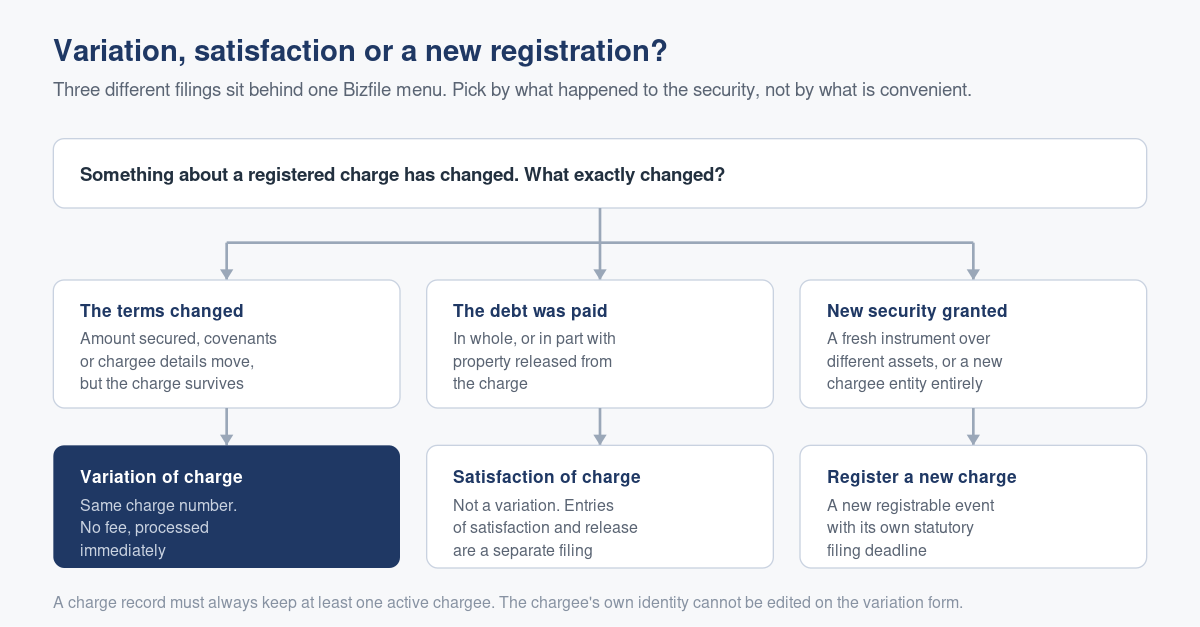
Variation, satisfaction or a new charge?
This is the decision that matters, and ACRA’s own guidance does not spell it out.
| What has happened | What you file | Why |
|---|---|---|
| The facility limit has been increased under the existing security | Variation of charge | Same charge, different amount secured |
| A supplemental deed changes the covenants or the secured obligations | Variation of charge | The charge survives, its terms change |
| The debt has been repaid in full | Satisfaction of charge | There is nothing left to secure |
| The debt has been repaid in part and the lender releases some property | Satisfaction of charge, partial | The Act deals with release of property separately from variation |
| A completely new security document is executed over different assets | New registration | A new charge is a new registrable event, with its own clock |
| The lender’s corporate name has changed but the entity has not | Variation of charge, chargee details | The party is the same, the name is not |
If the debt has been paid in whole or in part, the filing you want is a satisfaction, not a variation. Our note on satisfaction and release of a registered charge covers that route and the evidence the Registrar expects.
Who can file, and what you need in front of you
Only two categories of filer can lodge the variation: the chargor, which is the company that granted the security and owes the debt, and a corporate service provider appointed to act for it. The chargee, meaning the lender, does not file this. If your bank has told you it will “update ACRA”, push back and confirm, because in practice the obligation sits on your side of the table.
Before you open the eService, have these ready:
- The original charge number as it appears on ACRA’s register. Not your internal facility reference, not the deed date.
- The date the variation was made, which is the date of the varying instrument, not the date you noticed it.
- A description of the varying instrument, selected from the options the form offers.
- The new amount secured, if that is what changed, together with a description of that amount.
- The supporting documents, in a form you are content to have sitting on a public register.
There is no filing fee for a variation of charge and the transaction is processed immediately. You will see an on-screen acknowledgement and a confirmation notification will arrive in your Bizfile inbox.
The steps, in order
You will need Corppass access to the entity, or to be filing through a CSP profile. If Corppass is not yet sorted, that comes first, and our guide to logging in to Bizfile as a business user walks through it.
- Log in to Bizfile and choose Business User so that you are routed through Corppass.
- Check the entity name shown on the top menu bar and on the dashboard. If you hold positions in more than one company, confirm you are in the right one before you touch anything. Filing a variation against the wrong entity is a correction exercise nobody enjoys.
- If you are a corporate service provider acting for a client, switch to the Corporate Service Provider profile first and select the correct firm.
- From the top menu, open Manage, then Local company or Foreign company, then File variation/satisfaction of charges.
- Select Variation of charges and start the transaction.
- Under charge information, pick the relevant charge number. Charges that have been discharged, satisfied or removed from the register will not appear in this list, which is itself a useful check: if you cannot find the charge, it is not live.
- Enter the date of the variation and select the description of the varying instrument.
- Choose the type of change. The form separates changes to chargee details and amount secured from changes to the variation description.
- Complete the relevant fields, attach your supporting documents, and review.
- Tick the declaration and submit.
What the form will not let you do
Two constraints catch people out, and both are deliberate.
You cannot edit the chargee’s identity. Where you select the chargee details route, you can open an existing chargee and change whether the charge secures all monies owing, and if it does not, the amount secured and its description. The chargee’s own information is not editable in that screen. If the security has genuinely moved to a different lender, that is an assignment or a novation, and it is not something you fix by typing over a name.
You cannot leave the charge without a chargee. The record must always carry at least one active chargee. You can add chargees and you can change the ones that are there, but the system will not let you empty the field. In a syndicated or club facility this matters, because retiring one participant is not the same transaction as discharging the security.
What goes wrong in practice
The variation is agreed and never filed. This is by far the most common failure. The supplemental deed is signed, the facility is drawn, and the ACRA record continues to describe last year’s arrangement. Nobody notices until a due diligence exercise or a refinancing, at which point the buyer’s solicitors ask why the register and the deeds disagree, and the answer costs time you do not have.
The wrong filing is used. A partial repayment gets filed as a variation of the amount secured rather than as a satisfaction. The entry that results is not wrong on its face, but it is not the entry the Act contemplates for that event, and it can muddy the position on release of property.
Priority is assumed rather than checked. A variation does not re-date your charge or improve its ranking. Where more than one charge exists over the same assets, increasing the amount secured under an earlier charge can raise real questions about whether the additional sum enjoys the earlier priority. Those questions are fact-sensitive and they are fought. Our piece on priority disputes between registered charges sets out how the Singapore courts approach them, and negative pledge clauses covers the contractual overlay that often bites first.
The supporting document says more than it needed to. What you upload becomes part of a public record. Commercially sensitive schedules, pricing and covenant detail do not always need to travel with the filing. Consider what the variation actually has to evidence.
Frequently asked questions
Does filing a variation of charge cost anything?
No. ACRA does not charge a fee for filing a variation of charge, and the transaction is processed immediately rather than being queued for review. You will receive an acknowledgement on screen and a confirmation in your Bizfile inbox.
Can the bank file the variation instead of us?
No. The filer must be the chargor company or a corporate service provider appointed by it. Lenders frequently say they will handle the ACRA side, but the eService is not open to them in that capacity. Confirm who is filing before you assume it has been done.
We repaid part of the loan. Is that a variation?
No. Where the debt secured by a charge has been paid in whole or in part, the correct filing is a satisfaction of charge, not a variation. A variation is for changes to the terms of the charge itself, such as the amount secured going up or the covenants changing.
The lender has changed its name. What do we file?
Where the chargee entity is unchanged but its name is different, that is handled through the chargee details route on the variation form. Where the security has actually been transferred to a different entity, it is not a name change and you should take advice on the correct filing before lodging anything.
How quickly do we need to file a variation after signing?
The Act sets express deadlines for registering charges, and prudence says treat a variation the same way. File it as soon as the varying instrument is executed. A stale register is a problem you carry until someone forces you to fix it.
Keeping the register and the deeds in step
The register of charges is one of the few public records that a lender, an acquirer or a liquidator will treat as a starting point rather than a formality. Every variation you do not file is a small gap between what your company has agreed and what the world can see.
Raffles Corporate Services files charge registrations, variations and satisfactions for Singapore companies, and reconciles the ACRA record against the underlying security documents before financing events and year ends. If you are not certain that every registered charge on your company matches the current paperwork, that is a short review and usually a quick fix.
You can reach us through Raffles Corporate Services, read ACRA’s own overview of registering a new charge, or see more on Singapore corporate secretarial practice at Singapore Secretary Services.
— The Editorial Team, Raffles Corporate Services
Need help with corporate secretarial or compliance matters?
If you would like help with your company's corporate secretarial, governance or compliance requirements, email [email protected] or WhatsApp +65 8501 7133.
Our team can assist with corporate secretarial, accounting and tax matters. Where legal advice is needed, advisers from our associated law firms can assist.