

If your business incorporates companies for other people, provides them with a registered office address, supplies directors or nominee shareholders, or files transactions with ACRA on their behalf, you must be registered with ACRA as a corporate service provider. Providing those services unregistered is an offence carrying a fine of up to $50,000 on conviction.
Raffles Corporate Services works with a panel of experienced Singapore law firms who offer cost-effective and efficient legal service and advice. This article is general information only and is not legal advice.
That is a much wider net than the phrase “corporate service provider” suggests. It catches law firms, accounting firms, virtual office operators, bookkeepers who file on a client’s behalf, and a fair number of one-person consultancies who have never thought of themselves as being in a regulated industry at all.
Raffles Corporate Services is itself a registered CSP, so we have been through this from the inside. This article is the map: who the regime catches, what you have to have in place before you apply, what the application costs and how long it takes. The detail of each stage sits in the three articles linked below.
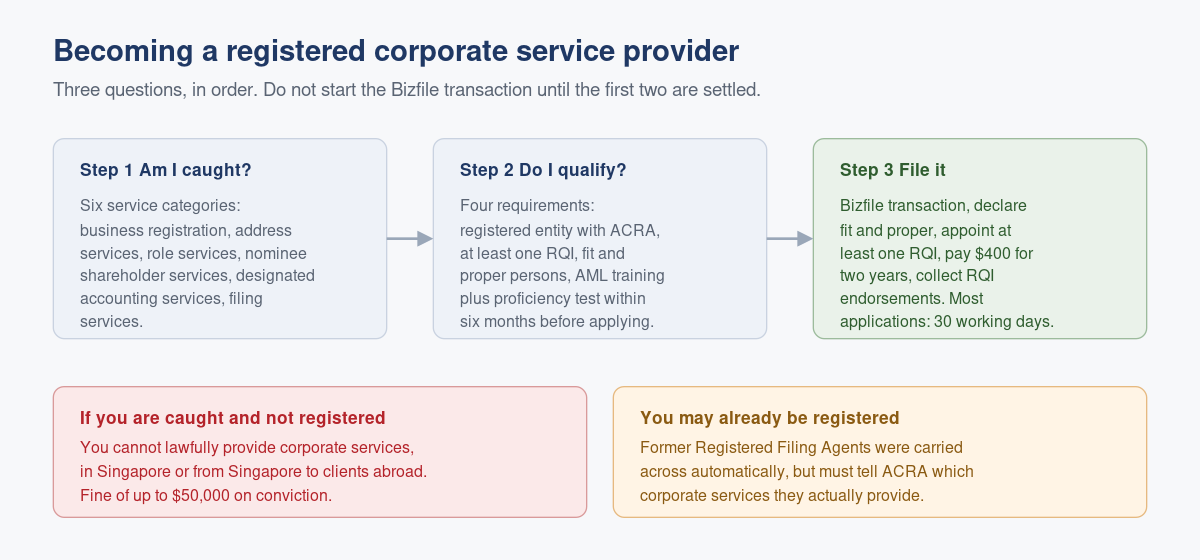
Where the regime came from, and why it is stricter than what preceded it
The Corporate Service Providers Act 2024 replaced the older Registered Filing Agent regime with something broader and considerably sharper. The old regime was essentially about who could press the buttons in ACRA’s filing system. The new one is about who may act as a gatekeeper to the Singapore corporate register at all.
The Act came into force on 9 June 2025, with a transition window that closed on 9 December 2025. If you were providing corporate services when the Act commenced and did not register by that date, you have been providing them unlawfully since.
The driver is anti-money laundering. Singapore’s exposure has never been in its own companies so much as in the ease with which a shell could be created by an intermediary who asked no questions. The CSP Act puts that intermediary under a registration, a training requirement, an AML obligation and a fit and proper test, and backs all of it with offences. Our CSP Act 2024 compliance FAQ deals with the ongoing obligations once you are in; this article deals with getting in.
Step 1: Are you actually caught?
Registration is triggered by activity, not by job title. You must register if you provide any of six categories of service to others:
- Business registration services. Setting up corporations or other legal entities for clients.
- Address services. Registered office addresses, business addresses without a fixed physical space, correspondence addresses where the customer is contactable but not present, and virtual office services.
- Role services. Acting as, or arranging for others to act as, a company director, company secretary, partner in a partnership or an equivalent role. Note the width of “arranging”. Handing a client a shortlist of candidate directors is caught. So is introducing a director and billing for the introduction.
- Nominee shareholder services. Acting as, or arranging for others to act as, a nominee shareholder.
- Designated accounting services. Carrying out transactions for customers while providing accounting services in connection with specified activities such as dealing in real estate, managing client money or assets, managing accounts, or forming and managing legal persons and arrangements.
- Filing services. Filing ACRA transactions for others, including for companies where you are the company secretary.
Some people are outside the regime. A landlord who leases a real, dedicated physical unit under a proper tenancy agreement is not providing an address service. An intermediary who only refers customers to registered CSPs is not caught. Nor are you caught for filing for your own entity, or for your holding company and related corporations as a group secretary or authorised employee.
The boundary cases are where the money is. Do I need to register as a CSP? works through the ones that actually come up, including public accounting entities and the position of former Registered Filing Agents.
Step 2: The four requirements
You cannot simply apply and see what happens. ACRA expects the four conditions below to be satisfied at the point of application.
| Requirement | What it means in practice |
|---|---|
| A registered entity | The applicant must itself be registered with ACRA as a business, company, LLP or LP. A person cannot register as a CSP in a personal capacity. |
| At least one registered qualified individual | You must be an RQI yourself, have a partner who is one, or employ or engage one. The RQI is the person who carries the professional competence for the firm. |
| Fit and proper | Every director, partner and person directly or indirectly involved in management must meet ACRA’s fit and proper requirements. |
| AML training and proficiency test | At least one director, owner or partner must complete the prescribed AML, counter proliferation financing and counter terrorism financing course and pass the proficiency test, within six months before applying. |
Two practical points that catch applicants out.
The six-month window runs backwards from the application, not forwards. If your director completed the training in January and you apply in October, the training is stale and you will have to do it again. Plan the training around the filing date, not the other way round.
The RQI is a separate registration with its own gate. You cannot appoint a person as your RQI unless they are themselves registered as one. If nobody in your firm holds that status, the RQI registration is the long pole in the tent and should be started first. The current costs and the shape of the training are set out in CSP registration requirements, and the individual registration in registering as a registered qualified individual.
There is also a cooling-off rule with real consequences. If ACRA has previously cancelled your CSP registration, you must wait two years before reapplying. That is not a discretionary bar you can argue your way past with good intentions.
Step 3: The Bizfile filing
The application itself is a Bizfile transaction, submitted by a representative of the firm, meaning a sole proprietor, partner or director. The sequence is fixed:
- Log in to Bizfile and open the CSP registration transaction.
- Enter the firm’s details, the types of corporate service you provide, and the nature of business.
- Declare that the relevant persons meet the fit and proper requirements.
- Appoint at least one RQI, identified by identification type and number.
- Submit the filing and pay the fee.
- Collect the endorsements. Every appointed RQI other than the one who submitted the application must separately log in and endorse their own appointment.
Fee and timing:
| Item | Amount |
|---|---|
| CSP registration | $400 for two years |
| Refundable if rejected, de-registered early or cancelled | No |
| Processing time | Most applications within 30 working days |
The endorsement step is where applications stall. Nothing happens until the last RQI endorses, and RQIs who are external engagements rather than employees are notoriously slow to log in. Chase them on the day you file. The screen-by-screen route is in using Bizfile to register as a CSP.
On approval you receive a unique CSP number. That is not the end of the setup. Before you can file for a client, you must log in through Corppass under the corporate service providers profile and add that client to your CSP account, which is a separate step and a separate consent exercise on the client’s side.
What ACRA is actually assessing
The 30 working days are not a queue. ACRA reviews the substance, and the published criteria tell you what to prepare for:
- Your conduct and compliance history as a CSP or RQI, including any previous regime
- Any professional misconduct, breach of fiduciary duty, or serious negligence bearing on your commercial integrity
- Whether you understand terrorist designation legislation and targeted financial sanctions
That last item is the one applicants underestimate. It is a competence ACRA expects the firm to hold, and the same competence that will be tested at inspection. Treat the AML training as training rather than as an entry fee and the rest of the regime becomes much easier to live with.
What goes wrong in practice
Thinking you are not a CSP because you do not call yourself one. The most exposed businesses are the ones providing a single service on the list as a sideline: an accountant who files the annual return “as a favour”, a serviced office that lets tenants use the address as a registered office without a real dedicated unit, a consultant who arranges a resident director. One service is enough to trigger registration.
Assuming a former Registered Filing Agent has nothing to do. RFAs were carried across into the CSP regime automatically, which sounds like good news and produces the worst kind of complacency. You still have to tell ACRA which of the six corporate services you actually provide, and every ongoing obligation under the new Act applies to you in full.
Leaving the RQI arrangement to the last minute. A firm can have every other requirement in place and still be unable to apply because its one qualified person has not completed their own registration. Build the timeline backwards from the RQI, then the training, then the filing.
Forgetting that the registration expires. A CSP registration runs for two years. It is not perpetual, the fee is non-refundable either way, and letting it lapse is not a paperwork problem but a “you can no longer lawfully do this work” problem. Diarise it the day you are approved.
Losing track of who inside the firm can file. Once registered, filing access for employees and the appointment or withdrawal of RQIs become live administrative obligations. Get them wrong and you have people filing who should not be, or nobody able to file at all. See appointing or withdrawing RQIs and managing employees’ filing access.
Frequently asked questions
Do I need to register as a CSP if I only file annual returns for two friends’ companies?
Yes. Filing ACRA transactions on behalf of others is one of the six services that trigger registration, and the Act does not set a volume threshold. Filing for your own entity, or for your holding company and related corporations, is outside the regime.
Is a law firm or an accounting firm exempt?
No. Law firms, accounting firms and corporate secretarial firms are all expressly within the regime if they provide any of the six services. A registered public accounting entity does not need separate CSP registration unless it files transactions on behalf of others, at which point it does.
How much does it cost in total to become a registered CSP?
The registration fee is $400 for two years and is non-refundable. On top of that sit the AML course fee, the proficiency test fee per attempt, and the cost of the RQI registration for the individual. The application fee is not the largest number in the exercise; the training and the RQI are.
How long does approval take?
ACRA processes most applications within 30 working days from a complete submission, and will tell you if more time is needed. The clock does not start until every appointed RQI has endorsed their appointment, so the real timeline depends on how quickly you collect those endorsements.
What happens if I provide corporate services without registering?
You cannot lawfully provide those services, whether to clients in Singapore or from Singapore to clients overseas, and you face a fine of up to $50,000 on conviction. A conviction also affects the fit and proper assessment if you later try to register properly.
Does my CSP registration cover my staff?
Not automatically. The firm holds the registration, individual RQIs hold their own, and employee filing access is administered separately within Bizfile. All three have to be kept current, and they are the parts most often found out of date at inspection.
If you are on the other side of this
Most readers of this page are working out whether they have to register. Some are working out whether they would rather not, and would prefer to hand the regulated work to a firm that already carries the registration, the RQIs and the AML framework. That is a sensible answer, and a lot of small accounting practices and law firms have reached it.
Raffles Corporate Services is a registered corporate service provider and handles incorporation, registered office, company secretarial and ACRA filing work for several hundred Singapore entities. If you would rather refer that work than build the compliance infrastructure for it, a referral arrangement keeps you outside the regime entirely.
The legislation is free to read on Singapore Statutes Online, and ACRA’s own registration material sits at acra.gov.sg. For more on Singapore corporate secretarial practice, see Singapore Secretary Services.
The Editorial Team, Raffles Corporate Services
Need help with corporate secretarial or compliance matters?
If you would like help with your company's corporate secretarial, governance or compliance requirements, email [email protected] or WhatsApp +65 8501 7133.
Our team can assist with corporate secretarial, accounting and tax matters. Where legal advice is needed, advisers from our associated law firms can assist.