

A VCC and each of its officers can be fined for a handful of recurring failures: holding the AGM late, filing the annual return late, not telling ACRA within 14 days about a change of officer or registered office, or not displaying the VCC’s name and registration number correctly. None of these require dishonesty. They are ordinary filing failures that happen because nobody diarised the date.
Raffles Corporate Services works with a panel of experienced Singapore law firms who offer cost-effective and efficient legal service and advice. This article is general information only and is not legal advice.
The Variable Capital Companies Act 2018 borrows its enforcement architecture from the Companies Act 1967: fines, default penalties, composition sums, court prosecution, and in repeated cases director disqualification. What is different about a VCC is who is watching. A private company’s compliance failures are usually a matter between the company, its secretary and ACRA. A VCC almost always sits inside a fund structure with a manager regulated by the Monetary Authority of Singapore, investors relying on the register being accurate, and an auditor who will ask about outstanding filings at the next audit. A missed deadline surfaces faster and to a wider audience.
This page is the map of what can go wrong and why. Each offence has its own dedicated guide covering the exact deadlines, fees and penalty figures; this one shows how the pieces fit together and where the two failure modes that do not have a home elsewhere, name display and the general officer’s duty, sit alongside them.
What counts as an “offence” for a VCC
An offence, in this context, is a failure to do something the VCC Act 2018 requires within a stated time. The Act does the modifying work that lets a VCC operate under a structure built for ordinary companies, adapting provisions of the Companies Act 1967 where the VCC Act itself is silent.
Two features of the framework matter in practice:
The VCC and its officers are both liable. Where the Act imposes a duty, both the entity and “every officer in default” can be fined. An officer in default is typically a director who knew about the failure, or ought to have known, and did nothing to prevent it. Being a nominee or a non-executive does not, by itself, remove that exposure.
A default penalty runs alongside the fine. Several of these offences carry not just a one-off fine but a default penalty that keeps accruing while the failure continues. The fine is not the end of the cost; the clock keeps running until the filing is actually made.
The four offences behind almost everything ACRA sees
| Offence | Deadline | Governing provision | Read the full detail |
|---|---|---|---|
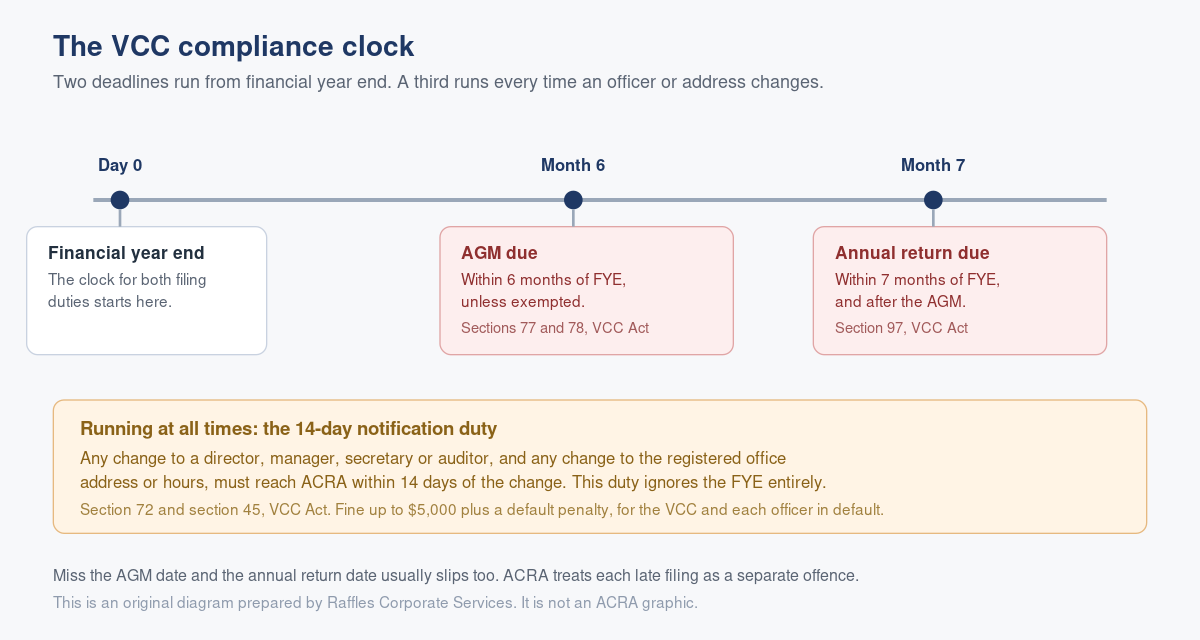
| Not holding the AGM on time | Within 6 months of financial year end, unless exempted | Sections 77 and 78, VCC Act 2018 | Legal obligations of a VCC director |
| Not filing the annual return on time | After the AGM, within 7 months of financial year end | Section 97, VCC Act 2018 | Penalties for late VCC annual return filing |
| Not notifying ACRA of a change to a director, manager, secretary or auditor | Within 14 days of the change | Section 72, VCC Act 2018; section 173A, Companies Act 1967 | Updating VCC information and officers |
| Not maintaining or reporting a change to the registered office | From incorporation; within 14 days of any change | Section 45, VCC Act 2018 | Updating VCC information and officers |
A late AGM and a late annual return are related but separate offences: the annual return cannot be filed until after the AGM (or after accounts reach members, where the AGM is dispensed with), so a VCC that is already behind on one is racing against a second clock at the same time, not buying itself extra room. Our guide to penalties for late VCC annual return filing sets out exactly how the automatic penalty, composition sum and court fine escalate if that clock is allowed to run.
The 14-day notification duty is the one most often missed, precisely because it is not tied to the financial year. A resignation, a new manager taking over, or an office relocation can happen at any point in the year, and the window is easy to let slip past while everyone is focused on the AGM and annual return instead. The exact fees, the faster one-working-day clock that applies to a sub-fund name change, and the registers that sit behind these filings are all covered in updating VCC information and officers.
Two offences that do not have their own page
Displaying the VCC’s name and registration number
Section 45 requires a VCC to display its name and registration number, in clear romanised letters, on business letters, statements of account, invoices, official notices and publications issued or signed by it or on its behalf. It is a small, mechanical requirement, and it is the one most often caught only when a bank or counterparty pushes back on a document that is missing it, rather than through any proactive check.
Unlike the filing duties above, this is not something VCC eServices reminds anyone about. It has to be built into whatever template a VCC, its manager or its administrator uses for correspondence, and checked whenever that template changes.
The general duty to act honestly and with diligence
Underneath the itemised deadlines sits a broader duty that does not come with a calendar entry. Section 63 of the VCC Act, headed “duty and liability of officers”, requires a VCC officer to act honestly and use reasonable diligence in the discharge of the role, and not to make improper use of information or position for personal advantage or to the detriment of the VCC or its sub-funds. Breach of this duty is a distinct offence from the filing failures above, and it is the one most likely to surface only once something has already gone wrong, such as a related-party arrangement with the manager that was never properly scrutinised. Our guide to the legal obligations of a VCC director covers what this duty requires in practice.
How ACRA enforces these offences
The shape of enforcement is broadly consistent across these offences, even though the exact figures differ from one to the next. ACRA typically offers a composition sum before considering prosecution, which lets the VCC and its officers settle the matter administratively rather than going to court. Where composition is not accepted, or ACRA decides against offering it, the matter proceeds by way of a court summons sent to the VCC’s registered office and to each relevant director’s residential address, and a representative or director must attend even while an appeal is being processed.
Repetition changes the stakes for an individual director. A director convicted of three or more filing offences under the VCC Act within five years faces automatic disqualification for five years, as does a director who has had three or more companies struck off within the same period. Separately, a director who fails to meet the key obligations expected of a VCC director can be debarred, which blocks any new appointment as a director or company secretary until the debarment is lifted. The precise composition amounts and court fine ceilings differ by offence; our guide to penalties for late VCC annual return filing sets these out in full for that specific offence, since it is the one ACRA’s own materials document most completely.
If you have just discovered a VCC is behind, do this first
The four offences above share the same triage sequence, regardless of which one has actually been missed.
- Identify exactly which duty is outstanding: the AGM, the annual return, an officer or registered office notification, or the name and registration display requirement. Each has its own deadline and its own dedicated guide linked above.
- Establish the actual trigger date: the financial year end for the AGM and annual return, or the date of the underlying change for a notification duty. ACRA measures every deadline from that date, not from the date you noticed the problem.
- File the outstanding item without waiting to bundle it with something else. A prompt late filing is treated very differently from one that only surfaces during an audit query months later.
- Check whether the same gap exists on any other VCC the same directors or manager are responsible for. A pattern across entities is what drives director disqualification, so a single missed filing is the moment to check for others, not to assume it was isolated.
- Put a named owner against each of the four deadlines going forward, rather than leaving them to whichever party happens to notice first.
What goes wrong in practice
Everyone assumes someone else owns the compliance calendar. In a fund structure, the manager, the fund administrator and the corporate secretary can each assume the others are tracking the AGM, the annual return, or a pending officer change. Nobody is wrong to assume it, and nobody actually does it.
A dormant-looking VCC still owes the annual return. Directors sometimes assume that a VCC with no sub-funds trading, or between fundraising rounds, has nothing to file. The AGM and annual return duties do not pause for that. Only formal exemption, dispensation, or eventual closure changes the position, and closure itself is a formal process, not something that happens by neglect. Our guide to closing a VCC sets out the routes if that is actually the intention.
The name and registration number requirement is only checked when a template changes badly. A VCC that has been using the same letterhead and invoice template for years may never have confirmed it actually complies with section 45, because nobody had a reason to look until a bank queried a document.
Three strikes arrives faster than people expect. A director who sits on several VCCs administered by the same group can rack up three filing offences within five years without any single VCC being badly managed. It is the accumulation across entities that triggers disqualification, not the severity of any one lapse.
Frequently asked questions
Can ACRA fine both the VCC and its directors for the same missed filing?
Yes. The VCC Act treats the VCC and each officer in default as separately liable for most filing and notification offences. A single late AGM or late annual return can therefore result in a fine against the VCC and a separate fine against one or more directors, not one fine shared between them.
Which of these offences is the most commonly missed?
The 14-day notification duty for officer and registered office changes, because unlike the AGM and annual return it is not anchored to the financial year end. It can be triggered at any point in the year, which makes it easy to overlook while attention is on the annual filing calendar.
Can a nominee director avoid liability by saying they were not involved day to day?
Not automatically. Liability attaches to an “officer in default”, which turns on what the director knew or ought reasonably to have known, not on their job title or how active they were. A nominee arrangement does not, on its own, remove exposure to these offences.
Does losing a fund manager count as one of these common offences?
It is a related but distinct problem. A VCC without a manager for longer than the period allowed under the VCC Act’s regulations faces the risk of being wound up, which is a more serious consequence than the fine-based offences covered here. It is worth treating a manager gap as urgent for that reason.
Is there a grace period before the 14-day notification clock starts?
No. The 14 days run from the date of the change itself, such as the date a resignation takes effect or the date the VCC starts operating from a new address, not from the date the paperwork is signed or the date someone remembers to file it.
Where do I find the exact fines and fees for each of these offences?
This page maps the offences and how they relate to each other. The exact deadlines, fees and penalty figures for the AGM and annual return sit in penalties for late VCC annual return filing and legal obligations of a VCC director, and the figures for officer and registered office changes sit in updating VCC information and officers.
Keeping a VCC off ACRA’s radar for the wrong reasons
Every offence on this page is avoidable with a calendar and a clear owner for each deadline. The pattern we see is not one VCC ignoring its obligations; it is several parties around one VCC, each assuming somebody else is tracking the date.
Raffles Corporate Services acts as corporate secretary to Singapore VCCs and umbrella structures, running the AGM and annual return calendar, filing officer and registered office changes inside the 14-day window, and flagging manager or governance gaps before they become grounds for winding up. If your VCC’s filing history has a gap in it, or you are not certain who currently owns these dates, that is worth sorting out before ACRA raises it for you.
For the source law, see the Variable Capital Companies Act 2018 and ACRA’s own page on common offences for VCCs. If your VCC needs to close rather than continue filing, our guides to closing a VCC and striking off a VCC cover the exit routes, and our note on MAS’s governance and management thematic review of Singapore’s VCCs covers the regulatory backdrop.
The Editorial Team, Raffles Corporate Services
Need help with corporate secretarial or compliance matters?
If you would like help with your company's corporate secretarial, governance or compliance requirements, email [email protected] or WhatsApp +65 8501 7133.
Our team can assist with corporate secretarial, accounting and tax matters. Where legal advice is needed, advisers from our associated law firms can assist.