

Striking off removes a VCC’s name from ACRA’s register, permanently and administratively, without a liquidator. It is only available if the VCC is not carrying on business, has no debts, and meets the criteria ACRA applies to every striking off application. Where any of that is untrue, winding up is the correct route instead.
Raffles Corporate Services works with a panel of experienced Singapore law firms who offer cost-effective and efficient legal service and advice. This article is general information only and is not legal advice.
Striking off is the cheapest way to close a VCC precisely because it assumes there is nothing left to do. No creditor to pay, no asset to realise, no investor whose capital has not already been returned. That assumption is tested by ACRA before the application is approved, and it can be tested again by anyone who objects once the process has started. Treat it as an administrative deletion for a vehicle that has already, in substance, wound down, not as a shortcut for one that has not.
Here is who qualifies, how the application actually runs, and what happens if something is still outstanding when it is filed.
What striking off actually does
Striking off is governed by section 130B of the Variable Capital Companies Act 2018, which applies the striking off provisions of the Companies Act 1967 to a VCC, together with the Variable Capital Companies (Dissolution of Sub-funds and Striking Off of VCCs’ Names) Regulations 2020, which set out the specific criteria ACRA applies.
The effect of a successful application is that the VCC’s name is removed from ACRA’s register and the VCC ceases to exist as a legal person. Unlike winding up, there is no liquidator, no formal claims process, and no distribution of assets, because striking off is only meant to apply where there was nothing to distribute in the first place.
Who qualifies
ACRA may approve a striking off application if it is satisfied the VCC:
- Is not carrying on business, and
- Meets the criteria set out in the VCC (Dissolution of Sub-funds and Striking Off of VCCs’ Names) Regulations 2020.
In practice, that means a VCC with unpaid creditors, unreturned investor capital, or assets still to be realised is not a candidate. Nor is an umbrella VCC that still has an active sub-fund on the register; the sub-fund has to be dissolved or wound up first. Our overview of closing a VCC sets out how striking off sits alongside winding up and sub-fund dissolution, and which one fits which situation.
Striking off compared with the alternative
| Striking off | Winding up | |
|---|---|---|
| Right for | A dormant VCC with no debts and nothing to realise | A VCC with debts, unrealised assets, or grounds for a court-ordered closure |
| Who runs it | ACRA, administratively | A liquidator |
| Formal claims process | No | Yes |
| Typical timeline | At least 3 months from approval | No fixed timeline; depends on the complexity of the estate |
| Governing provision | Section 130B, VCC Act 2018 | Section 130, VCC Act 2018 |
How to apply
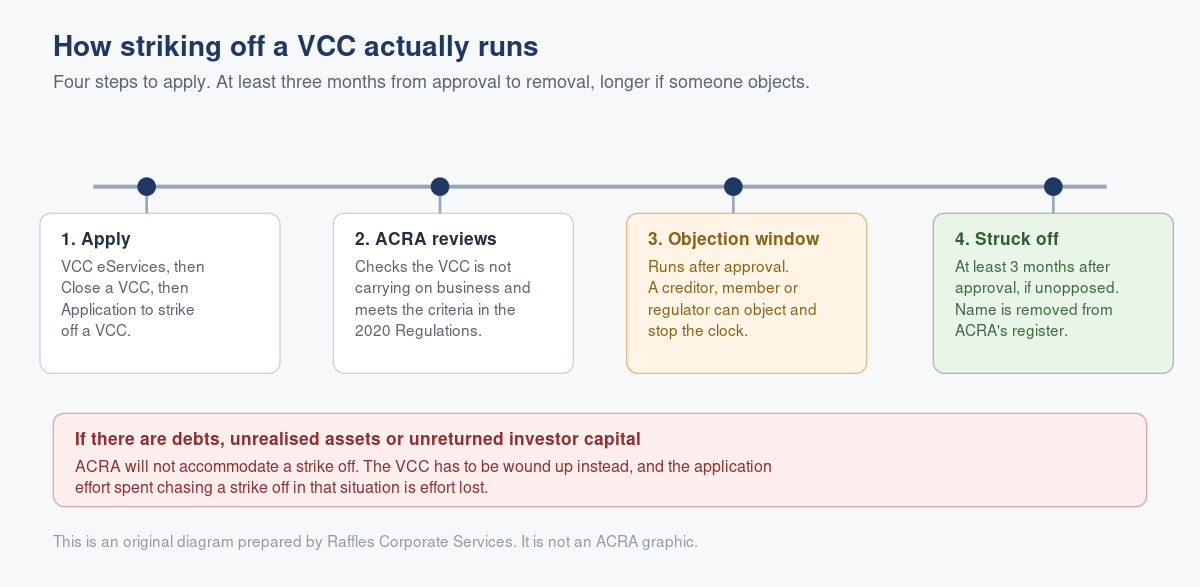
- Open VCC eServices and log in to your account.
- Click eServices, then select Close a VCC.
- Select Application to strike off a VCC.
- Submit the application, together with whatever supporting information ACRA requests to confirm the VCC is not carrying on business and meets the criteria.
The striking off process itself only begins once ACRA has approved the application. From that point, it takes at least three months to complete, and longer if anyone objects during that period. There is no way to compress that timeline once the clock has started; the minimum period exists to give creditors, members and other interested parties the chance to raise an objection before the VCC disappears from the register for good.
What can stop or reverse a striking off
An application can be refused before approval if ACRA is not satisfied the VCC meets the criteria. After approval, the process can still be stopped if someone objects during the statutory window, typically a creditor who was not paid, a member with an unresolved claim, or a regulator with an outstanding concern. If ACRA proceeds to strike the VCC off despite an unresolved liability that later comes to light, section 344 and related provisions of the Companies Act 1967, as applied to a VCC, allow an application to restore the VCC to the register in appropriate cases, though that is a separate and more expensive process than doing the striking off properly the first time.
What goes wrong in practice
The application is filed while a creditor is still owed money. This is the single most common reason a striking off application fails or is later challenged. A director’s belief that a debt is “small” or “not worth chasing” does not make the VCC debt-free for the purposes of the application.
A sub-fund is still open. Directors closing down an umbrella VCC sometimes file to strike off the whole entity while a sub-fund technically remains active on the register. ACRA will not process that application until the sub-fund itself has been dissolved or wound up.
Outstanding filing offences surface during ACRA’s review. A VCC that is behind on its AGM or annual return, or has an unreported officer change sitting past its 14-day window, is not “not carrying on business” in the way the criteria require until those filings are brought up to date. Our page on common offences for a Singapore VCC covers what tends to be outstanding at this point.
Nobody tells the fund’s investors before the application goes in. Even where the striking off itself is technically valid, investors who discover after the fact that their VCC has been struck off, without warning, tend to escalate the matter, which can turn into an objection during the statutory window even if the underlying position was sound.
The registered office stops responding before the process completes. Because striking off takes a minimum of three months, and any correspondence, including an objection notice, will go to the registered office on file, a VCC that lets its registered office arrangement lapse partway through the process risks missing something important.
Striking off is used to sidestep an unresolved manager or compliance issue. A VCC with a lapsed fund manager, or unresolved AML and CFT findings, is not “not carrying on business” in the sense the regulations require. Attempting to strike off in that situation is likely to be refused, and it can draw more regulatory attention than simply addressing the underlying issue directly.
Frequently asked questions
Is striking off free?
There is no liquidator to pay and no formal claims process, which makes striking off far cheaper than winding up. Whether ACRA charges a filing fee for the application itself is a matter to confirm with ACRA or VCC eServices at the time of applying, since fee schedules can change.
How long does striking off take from start to finish?
Once ACRA approves the application, the process takes at least three months before the VCC’s name is actually removed from the register. It takes longer if anyone objects during that window. The time ACRA takes to assess the application itself, before approval, is on top of that three-month period.
Can a creditor stop a VCC from being struck off?
Yes. A creditor who is owed money by the VCC can object during the statutory window after ACRA’s approval, which can stop the striking off from proceeding. This is one of the main reasons the underlying debt-free assumption needs to be genuinely true before applying.
What happens to the VCC’s registers and records once it is struck off?
The VCC ceases to exist as a legal person once striking off is complete, and its records with ACRA become historical rather than live. Directors and officers should keep their own copies of the VCC’s registers and key documents before the process completes, since access through the VCC’s own eServices account ends with the entity.
Can a struck-off VCC be restored to the register later?
In certain circumstances, yes, through an application to restore the VCC, generally where it later becomes apparent that a creditor, member or other interested party was prejudiced by the striking off. Restoration is a separate legal process and is more involved than the original striking off, so it should not be relied on as a safety net.
Does an umbrella VCC need to strike off all its sub-funds first?
Yes. Any sub-fund still active on the register has to be dissolved or wound up before the umbrella VCC itself can be struck off. Our guide to closing a VCC sets out the sequencing across all three exit routes.
Making sure striking off is actually the right call
The appeal of striking off is that it is quick and administrative, which is exactly why it gets reached for before anyone has properly checked the VCC is actually eligible. Getting that check wrong costs more time than doing it properly the first time, because a refused or objected-to application still has to be resolved before the VCC can close by any route.
Raffles Corporate Services reviews a VCC’s creditor position, sub-fund status and compliance history before recommending striking off, so the application goes in once and goes through. If you are weighing up whether a VCC is ready to strike off or actually needs winding up instead, that is a conversation worth having before the application is filed.
For the source law, see the Variable Capital Companies Act 2018, the VCC (Dissolution of Sub-funds and Striking Off of VCCs’ Names) Regulations 2020, and ACRA’s own page on striking off a VCC. If debts or unrealised assets rule striking off out, see our guide to winding up a VCC.
The Editorial Team, Raffles Corporate Services
Need help with corporate secretarial or compliance matters?
If you would like help with your company's corporate secretarial, governance or compliance requirements, email [email protected] or WhatsApp +65 8501 7133.
Our team can assist with corporate secretarial, accounting and tax matters. Where legal advice is needed, advisers from our associated law firms can assist.