

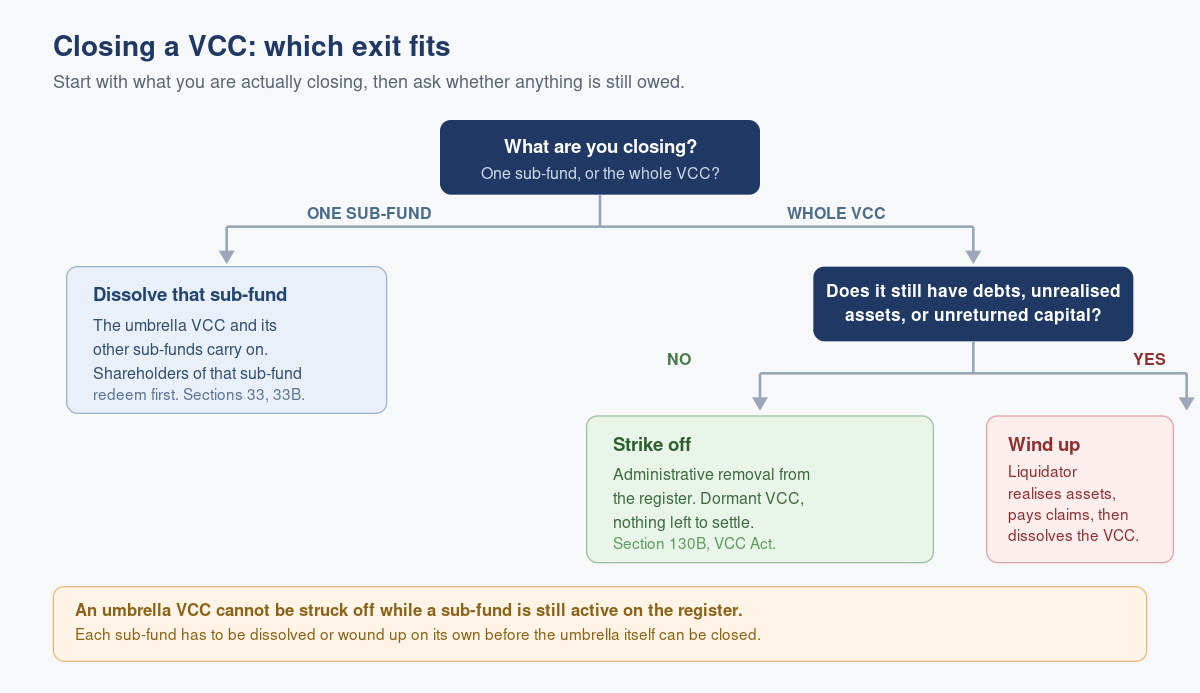
Closing a VCC means choosing one of three routes: striking it off if it is dormant and debt-free, winding it up if there are debts or assets still to deal with, or dissolving a single sub-fund while the rest of the umbrella continues. Picking the wrong one wastes months.
Raffles Corporate Services works with a panel of experienced Singapore law firms who offer cost-effective and efficient legal service and advice. This article is general information only and is not legal advice.
The Variable Capital Companies Act 2018 does not treat “closing a VCC” as one process with one form. It treats striking off, winding up and sub-fund dissolution as three genuinely different mechanisms, each with its own trigger, its own governing provisions, and its own timeline. A VCC that is between fundraising rounds is not automatically eligible for the cheap option, and an umbrella VCC cannot simply be deleted while a sub-fund inside it is still holding investor capital.
This article is the map. It sets out when each route applies and how they relate to each other. The mechanics of each route, including the statutory grounds, the steps and the things that go wrong, are covered in their own dedicated guides, linked below.
The three ways a VCC’s life can end
Every VCC eventually needs to close, either because the strategy has run its course, the investors have been repaid, or the vehicle never got off the ground. What differs is what is left inside it when that moment arrives.
| Exit route | When it fits | What it closes | Governing provision |
|---|---|---|---|
| Striking off | The VCC is not carrying on business, has no debts, and meets ACRA’s striking off criteria | The whole VCC | Section 130B of the VCC Act 2018, applying the striking off provisions of the Companies Act 1967 |
| Winding up | There are debts to settle, assets to realise, or grounds for a court-ordered closure | The whole VCC | Section 130 of the VCC Act 2018, applying the Insolvency, Restructuring and Dissolution Act 2018 for a winding up commencing on or after 1 April 2026 |
| Dissolving a sub-fund | One sub-fund of an umbrella VCC has reached the end of its life, while the umbrella and its other sub-funds continue | One sub-fund only | Sections 33 and 33B of the VCC Act 2018, and the VCC (Dissolution of Sub-funds and Striking Off of VCCs’ Names) Regulations 2020 |
Striking off: the administrative exit
Striking off removes the VCC’s name from ACRA’s register. It is the cheapest and quickest route, and it is only available where there is genuinely nothing left to do: no creditors, no unreturned investor capital, and nothing to realise.
ACRA will only approve a striking off application if it believes the VCC is not carrying on business and meets the criteria set out in the VCC (Dissolution of Sub-funds and Striking Off of VCCs’ Names) Regulations 2020. The application is made through VCC eServices, and once ACRA approves it, the process itself takes at least three months, longer if anyone objects.
Because the bar is “nothing left to do”, striking off is the wrong instrument the moment a creditor is owed money, an investor’s shares have not been redeemed, or the VCC is still holding an asset that has not been converted to cash. Our dedicated guide to striking off a VCC covers the eligibility criteria and the application steps in full.
Winding up: the route for a VCC with something to settle
Winding up puts a liquidator in charge of realising the VCC’s assets, adjudicating claims against it, paying out in statutory order, and then dissolving the vehicle. Section 130 of the VCC Act 2018 applies the Insolvency, Restructuring and Dissolution Act 2018 to a VCC’s winding up commencing on or after 1 April 2026, with modifications set out in the VCC Act itself; a winding up that commenced before that date instead followed the Companies Act 1967 as modified by the VCC Act.
There are three ways a VCC is wound up: members’ voluntary winding up, where the directors are satisfied all debts can be paid within twelve months; creditors’ voluntary winding up, where they cannot make that declaration; and compulsory winding up, ordered by the Court. Beyond the ordinary grounds that apply to any Singapore entity, a VCC can also be wound up on grounds specific to it, including the loss of its collective investment scheme authorisation, trading outside its permitted use, going without a licensed or registered manager for too long, or breaching its anti-money laundering obligations. Our full guide to winding up a VCC sets out all three routes, the VCC-specific grounds, and how receivership fits alongside winding up.
Dissolving a sub-fund: closing part of the structure, not all of it
An umbrella VCC can have one sub-fund reach the end of its life while the rest of the structure keeps trading. Section 29 of the VCC Act 2018 keeps each sub-fund’s assets and liabilities legally separate from the umbrella and from every other sub-fund, which is precisely what makes it possible to close one sub-fund without disturbing the others.
Where appropriate, shareholders of the closing sub-fund should redeem their shares first. The application to dissolve a sub-fund is made through VCC eServices, under Close a VCC, in the same way as a striking off application, but it is a distinct application: Application to Dissolve a Sub-Fund. Our guide to closing a VCC sub-fund walks through that application step by step, and our earlier note on winding up or dissolving a sub-fund of a Singapore VCC covers the underlying insolvency analysis in more depth.
Closing the whole umbrella when sub-funds are still open
This is the sequencing point that most often gets missed. An umbrella VCC cannot be struck off, and typically cannot be wound up cleanly, while a sub-fund inside it is still active. Each sub-fund has to be dealt with in its own right, either dissolved or wound up, before the umbrella itself can be closed.
That means closing an umbrella VCC with several sub-funds is rarely a single transaction. It is a sequence: close each sub-fund as it reaches the end of its life, and only bring the application for the umbrella itself once nothing remains inside it.
Choosing the right route, in order
- Identify what is actually being closed: a single sub-fund, or the whole VCC.
- If it is a single sub-fund, confirm whether shareholders of that sub-fund need to redeem first, then apply to dissolve the sub-fund.
- If it is the whole VCC, check whether any sub-fund is still active. If so, close each one first.
- Once nothing remains open, assess whether the VCC has any debts, unrealised assets or unreturned investor capital.
- If there is genuinely nothing left, apply to strike off.
- If there is something left to settle, or the directors cannot honestly declare solvency within twelve months, proceed to winding up instead, choosing between the members’ voluntary, creditors’ voluntary or compulsory route as the facts require.
What goes wrong in practice
An application to strike off is filed before anyone checks for creditors properly. Striking off looks like the fast, cheap option, and it is reached for too early. If ACRA or a creditor later shows the VCC was not in fact debt-free, the application fails and the time spent on it is lost.
A sub-fund is forgotten when planning to close the umbrella. Directors sometimes focus on the umbrella’s own balance sheet and overlook that a sub-fund, technically still on the register, blocks the whole exercise until it is dealt with.
Nobody checks which law applies to the winding up. Because the governing regime changed for windings up commencing on or after 1 April 2026, a VCC that started the process before that date and one starting after it can be subject to different statutory frameworks for what looks like the same kind of closure. Getting this wrong at the outset means redoing paperwork later.
The declaration of solvency for a members’ voluntary winding up is made on optimism rather than evidence. In a fund vehicle, that declaration usually rests on the carrying value of illiquid positions. If those positions do not realise what was expected, the winding up converts to a creditors’ voluntary winding up partway through, which is disruptive and can expose the directors personally.
Closure is treated as a way to avoid ongoing compliance rather than a formal process in its own right. A VCC that has simply stopped filing its AGM and annual return is not closed. It is a VCC racking up common offences under the Variable Capital Companies Act 2018 while everyone assumes it will quietly disappear. It will not, until one of the three routes above is actually completed.
Frequently asked questions
Can I choose striking off just because it is cheaper than winding up?
Only if the VCC genuinely has no debts, no unrealised assets and no unreturned investor capital. ACRA assesses the application against the striking off criteria in the 2020 Regulations, and the process will not proceed, or can later be challenged, if the VCC turns out not to qualify.
Does closing one sub-fund affect the other sub-funds in the umbrella?
No. Section 29 of the VCC Act 2018 keeps each sub-fund’s assets and liabilities separate from the umbrella and from every other sub-fund. Dissolving or winding up one sub-fund does not touch the assets or obligations of the others, which continue to operate as before.
How long does it take to close a VCC?
It depends on the route. Striking off takes at least three months from ACRA’s approval, longer if there is an objection. Winding up has no fixed timeline; it runs until the liquidator has realised the assets, settled the claims and completed the statutory steps to dissolution, which can take anywhere from months to years depending on complexity.
Can an umbrella VCC be struck off while it still has an active sub-fund?
No. An active sub-fund has to be dissolved or wound up first. ACRA will not process a striking off application for an umbrella VCC that still has a live sub-fund on the register.
What happens if we stop filing and just let the VCC go inactive?
It does not close itself. A VCC that stops filing its AGM and annual return continues to accrue offences and penalties under the VCC Act 2018 rather than being removed from the register. Closure only happens through striking off or winding up, both of which require a positive application.
Who decides whether a winding up is voluntary or ordered by the Court?
The directors decide whether to propose a voluntary winding up, and the members or creditors then vote on it depending on the type. A compulsory winding up is different: the Court orders it, on the application of the VCC itself, a director, a creditor, a contributory, the liquidator, the Minister, or in specific circumstances, the Monetary Authority of Singapore.
Getting the exit right the first time
Most VCC closures are not distressed. They are the ordinary end of a fund’s life: the strategy has run, investors have been repaid, and someone has to close the vehicle properly rather than leave it drifting on the register, quietly collecting offences under the VCC Act. The expensive version is the one where the wrong route was chosen at the outset, or a sub-fund was overlooked until it blocked everything else.
Raffles Corporate Services handles the corporate secretarial side of VCC closures: working out which of the three routes actually fits, sequencing sub-fund closures correctly, and making the filings that keep the process moving. If you are looking at a VCC that needs to be closed, that is worth a conversation before an application goes in, not after it is rejected.
For the source law, see the Variable Capital Companies Act 2018 and ACRA’s overview of closing a VCC. For the detail on each route, see our guides to striking off a VCC, winding up a VCC, and closing a VCC sub-fund. If your VCC also has outstanding filings to sort out first, see our page on common offences for a Singapore VCC.
The Editorial Team, Raffles Corporate Services
Need help with corporate secretarial or compliance matters?
If you would like help with your company's corporate secretarial, governance or compliance requirements, email [email protected] or WhatsApp +65 8501 7133.
Our team can assist with corporate secretarial, accounting and tax matters. Where legal advice is needed, advisers from our associated law firms can assist.