

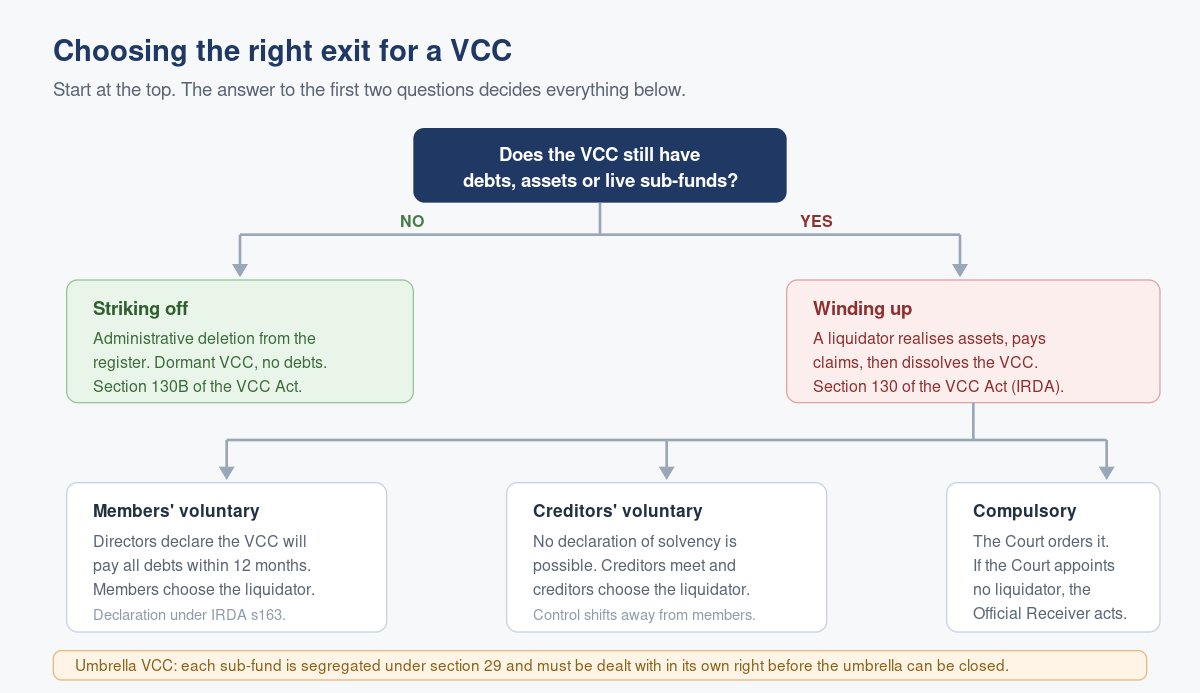
A VCC that has debts to settle is closed by winding up, not by striking off. There are three routes: members’ voluntary winding up where the directors can swear the VCC will pay everything within twelve months, creditors’ voluntary winding up where they cannot, and compulsory winding up ordered by the Court.
Raffles Corporate Services works with a panel of experienced Singapore law firms who offer cost-effective and efficient legal service and advice. This article is general information only and is not legal advice.
Which set of rules governs the process depends on when it starts. For a winding up commencing on or after 1 April 2026, the Insolvency, Restructuring and Dissolution Act 2018 applies to a VCC in substantially the same way it applies to an ordinary company limited by shares, adapted by the Variable Capital Companies Act 2018. Section 130 of the VCC Act does that work. Before that date, the position ran through the Companies Act 1967 instead.
The practical effect is that a VCC liquidation now looks a great deal like a company liquidation, with three important differences: sub-funds, the fund manager, and a longer list of grounds on which somebody else can put you into liquidation.
Winding up, striking off and dissolving a sub-fund are not the same thing
Three distinct exits sit under the heading of closing a VCC, and choosing the wrong one wastes months.
| Exit route | When it is the right one | What it closes | Governing provision |
|---|---|---|---|
| Striking off | The VCC is dormant, has no debts and nothing to realise | The whole VCC | Section 130B of the VCC Act, applying the striking off provisions of the Companies Act 1967 |
| Winding up | There are debts to settle, assets to realise, or a Court order | The whole VCC | Section 130 of the VCC Act, applying Parts 8 and 9 of the IRDA |
| Dissolving a sub-fund | One sub-fund inside an umbrella VCC has reached the end of its life | One sub-fund only | Sections 33 and 33B of the VCC Act |
Striking off is an administrative deletion from the register. It is cheap and quick, and it is available only where there is genuinely nothing left to do. The moment there are creditors, unrealised assets, or investors still holding shares whose capital has not been returned, striking off is the wrong instrument and the Registrar can be expected to say so.
Winding up is the real thing: a liquidator takes control, realises the assets, adjudicates the claims, pays out in statutory order and then dissolves the vehicle.
The three ways a VCC is wound up
Members’ voluntary winding up
This is the solvent route. It is available where the directors are prepared to make a formal declaration of solvency: that having made a full enquiry into the VCC’s affairs, they are satisfied it will be able to pay its debts in full within a period not exceeding twelve months from the commencement of the winding up. Section 163 of the IRDA carries that declaration, and section 33(3) of the VCC Act confirms the same mechanism applies at sub-fund level.
The declaration is not a formality. It is sworn, it is filed, and a director who makes it without reasonable grounds exposes himself personally. Our note on the declaration of solvency in a Singapore members’ voluntary liquidation sets out what “full enquiry” actually requires and what happens when the twelve months turn out to have been optimistic.
Members then pass a special resolution to wind up, appoint a liquidator, and the liquidator runs the process.
Creditors’ voluntary winding up
This is the route where the directors have concluded that the VCC cannot carry on its business by reason of its liabilities. No declaration of solvency is made or can be made. A meeting of creditors is summoned, the creditors see a statement of affairs, and the creditors have the decisive say on who is appointed liquidator.
Control shifts. In a members’ voluntary winding up the shareholders choose the liquidator; in a creditors’ voluntary winding up the creditors do. Directors who assume they will keep a friendly liquidator are frequently surprised.
Compulsory winding up by the Court
Here the Court makes an order. If the Court does not appoint a liquidator, the Official Receiver becomes liquidator automatically.
Section 130(5) of the VCC Act replaces the ordinary IRDA list of who may apply, and it is a wide list: the VCC itself, any director, any creditor including a contingent or prospective creditor, a contributory, the liquidator, the Minister, and the Monetary Authority of Singapore on one specific ground. That MAS standing is a feature of the VCC regime that has no equivalent for an ordinary private company.
The grounds that are specific to VCCs
Section 130(6) of the VCC Act replaces the ordinary list of grounds on which the Court may order a winding up. Most of it is familiar: inability to pay debts, no members, the VCC has suspended business for a whole year, oppression of members, just and equitable, an inspector’s report recommending it.
Four grounds are distinctly VCC grounds, and they matter because they can be invoked by the regulator rather than by a disgruntled creditor:
- The collective investment scheme authorisation is gone. Where MAS has revoked or withdrawn the authorisation of the collective investment scheme constituted as the VCC under section 288 of the Securities and Futures Act 2001, that is a standalone ground.
- The VCC has traded outside its sole object. Section 15 of the VCC Act confines the vehicle to use as a collective investment scheme. A VCC that has been doing something else has given the Minister a ground.
- The VCC has gone without a manager for too long. Section 46 requires a VCC to have a manager, and a contravention persisting for the period prescribed by regulations is a ground for winding up. Losing your fund manager is not merely an operational problem; left unfixed it is an existential one.
- AML and CFT breaches. Contravention of a direction issued under section 83(1) or 84(1), or of section 84(3) or the regulations made under those sections, is a ground on which MAS may apply. What those obligations require in practice is covered in our MAS AML and CFT for licensed entities FAQ.
There are also grounds around misuse for unlawful purposes, prejudice to national security or the national interest, and breach of the conditions imposed on a foreign corporate entity registered as a VCC by transfer of registration.
Receivership is a different animal
If a creditor holds a charge over the VCC’s assets, it may appoint a receiver before anyone reaches the question of winding up. The receiver’s job is not to close the VCC. It is to enforce the charge for the benefit of the debenture holders, which may mean selling the charged asset or running the business long enough to recover what is owed.
Part 10 of the VCC Act deals with receivers and managers and applies Part 6 of the IRDA. A receivership and a liquidation can run at the same time, over different assets, with different people in charge, which is exactly as awkward as it sounds. Our comparison of receivership and judicial management in Singapore explains how the two interact, and if the validity of the charge itself is in question, see challenging the validity of a Singapore fixed or floating charge.
Sub-funds change the arithmetic
For an umbrella VCC, the single most important rule in a liquidation is section 29 of the VCC Act. The assets of a sub-fund must not be used to discharge any liability of the VCC or of any other sub-fund, and any liability of a sub-fund must be discharged solely out of that sub-fund’s own assets. Section 29 says in terms that this holds in the winding up of the VCC and in the winding up of another sub-fund.
Section 29(2) then voids any provision of the constitution, or any agreement or contract, that is inconsistent with that rule, and voids any application of assets made in breach of it.
So a liquidator of an umbrella VCC is not liquidating one pool. He is liquidating the VCC’s own general assets plus a set of legally separate pools, each answerable only to its own creditors. A sub-fund can be wound up on its own under section 33 of the VCC Act, which applies Parts 8 and 9 of the IRDA to a sub-fund as if the sub-fund were a legal person, subject to the modifications in the First Schedule to the Act. The mechanics of closing an individual sub-fund are set out in our guide to winding up or dissolving a sub-fund of a Singapore VCC.
The sequencing point follows from all of this: an umbrella VCC cannot be tidied away while sub-funds remain live on the register. Each sub-fund has to be dealt with.
What goes wrong in practice
Somebody applies to strike off a VCC that has creditors. Striking off is the cheap option and it is reached for too early. Where there are unpaid liabilities, unreturned investor capital or assets still to realise, the application is the wrong one and the time spent on it is lost.
The declaration of solvency is made on a valuation nobody has tested. A members’ voluntary winding up turns on the directors’ honest belief that debts will be paid in full within twelve months. In a fund vehicle that belief usually rests on the carrying value of illiquid positions. If those positions do not realise anything like the carried value, the liquidation converts to a creditors’ winding up and the directors are left explaining the declaration. The MAS valuation and risk management papers and what they mean for VCC sub-funds is worth reading before anyone signs.
Cross-subsidisation is used to smooth a wind-down. Covering a shortfall in one sub-fund from the umbrella’s cash or from a healthier sub-fund is a breach of section 29, the transaction is void, and section 29(4) creates an offence for the VCC and every officer in default, with a materially higher maximum fine where the contravention was committed with intent to defraud.
The manager resigns and nobody replaces it. The moment a VCC is without a manager the clock starts on a statutory ground for winding up. A manager resigning mid wind-down is common, because the economics stop working, and it needs to be planned for rather than discovered.
The books disappear. A liquidator who cannot reconstruct the affairs of the VCC will use the statutory tools to find out, and those tools reach individuals. See public examination of company officers under the IRDA for what that looks like from the other side of the table.
A disputed debt is treated as a winding up threat. Not every demand supports an application. The standard for a genuinely disputed debt is covered in our note on disputed debts and winding up applications.
Frequently asked questions
Which law governs the winding up of a VCC?
For a winding up commencing on or after 1 April 2026, Parts 8 and 9 of the Insolvency, Restructuring and Dissolution Act 2018 apply, as applied to VCCs by section 130 of the Variable Capital Companies Act 2018 with the modifications set out there. Processes that began before that date were governed by the Companies Act 1967, as modified by the VCC Act.
Can I just strike off a VCC instead of winding it up?
Only if there is genuinely nothing to settle. Striking off is an administrative deletion for a dormant vehicle with no debts and no assets to distribute. Where creditors remain unpaid, investor capital has not been returned, or assets have still to be realised, winding up is the correct route and the Registrar will not accommodate a shortcut.
Who can apply to the Court to wind up a VCC?
Section 130(5) of the VCC Act sets out the list: the VCC itself, any director, any creditor including a contingent or prospective creditor, a contributory or the personal representative of one, the liquidator, and the Minister. MAS may also apply, on the ground relating to breaches of the VCC Act’s anti-money laundering and terrorism financing requirements.
What happens to the sub-funds when the umbrella VCC is wound up?
They stay segregated. Under section 29 of the VCC Act the assets of a sub-fund cannot be used to discharge any liability of the umbrella VCC or of another sub-fund, and that protection applies expressly in a winding up. Each sub-fund’s creditors look only to that sub-fund’s assets, and each sub-fund has to be dealt with in its own right.
Does losing the fund manager put a VCC at risk of being wound up?
Yes, if it is not fixed. Section 46 of the VCC Act requires a VCC to have a manager, and a contravention that persists for the period prescribed by regulations is a ground on which the Court may order the VCC wound up. Replacing a departing manager is therefore a compliance priority, not an administrative loose end.
Can a receiver be appointed instead of a liquidator?
A receiver can be appointed as well, not instead. A secured creditor holding a charge may appoint a receiver to enforce that charge over the charged assets, which is a different exercise from winding up the VCC as a whole. Both can be on foot at once, dealing with different assets under different authority.
Closing a fund vehicle properly
Most VCC wind-downs are not distressed. They are ordinary end of life decisions: the strategy has run, the investors have been repaid, and somebody has to close the vehicle without leaving a trail of unfinished filings behind it. The expensive version is the one where the route was chosen before anyone looked hard at the balance sheet, or where a sub-fund’s numbers turned out not to support the declaration that had already been sworn.
Raffles Corporate Services handles the corporate secretarial side of VCC closures: working out which of the three exits actually fits, keeping the sub-fund sequencing straight, preparing the resolutions and the statutory declarations, and making the filings on time so the liquidator is not starting from a mess. If you are looking at a VCC that needs to be closed, or one that has lost its manager, that is a conversation worth having early rather than late.
The statutory source is the Variable Capital Companies Act 2018 and the Insolvency, Restructuring and Dissolution Act 2018, and ACRA’s procedural guidance sits on its page for winding up a variable capital company. For the regulatory backdrop, see our Securities and Futures Act chapter explainers.
The Editorial Team, Raffles Corporate Services
Need help with corporate secretarial or compliance matters?
If you would like help with your company's corporate secretarial, governance or compliance requirements, email [email protected] or WhatsApp +65 8501 7133.
Our team can assist with corporate secretarial, accounting and tax matters. Where legal advice is needed, advisers from our associated law firms can assist.