
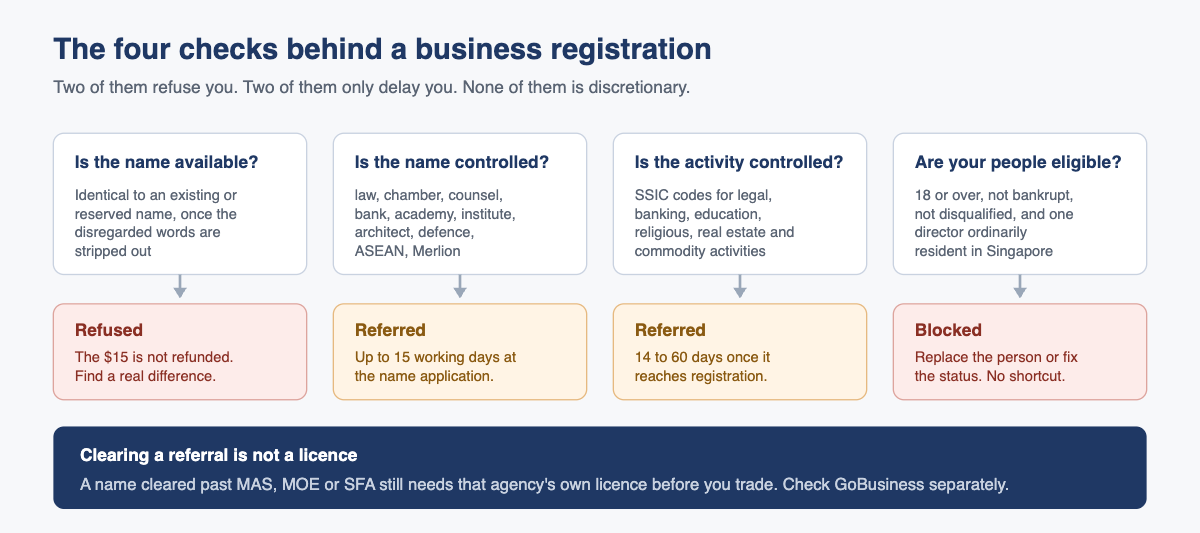
ACRA runs four checks: is the name available, is the name controlled, is the activity controlled, and is every person behind it allowed to be there. Fail the first and you are rejected. Fail the second or third and you are referred, which is slower but survivable.
Raffles Corporate Services works with a panel of experienced Singapore law firms who offer cost-effective and efficient legal service and advice. This article is general information only and is not legal advice.
Most founders never see any of this, because most registrations clear within minutes of payment. The ones that do not tend to fail for reasons that were entirely visible in advance, and the fees are not refundable.
This is part two of our series on registering a business in Singapore. Part one walks the process end to end. If your question is whether you personally are allowed to register, start with requirements and eligibility.
What is a referral authority?
A referral authority is another government agency that has to sign off on your registration before ACRA can approve it, because the name you have chosen or the activity you have declared falls inside that agency’s regulated territory. The Registrar does not make the judgment; it passes the file across and waits.
Referrals are triggered by two things only: a word in your proposed business name, or an SSIC code on your application. There is nothing subjective about it. If your name contains “chamber” you are going to the Ministry of Law, whether you are a law firm or a business selling chamber music recordings.
Referral is not rejection. It is delay. A referral at the name application stage can take up to 15 working days, and a registration that needs approval from a referral authority is quoted at 14 to 60 days.
Which words send your name to another ministry?
This is the list nobody reads until it is too late. Every entry below is a live trigger.
| Agency | Words in the name that trigger a referral |
|---|---|
| Ministry of Law, Legal Services Regulatory Authority | law, legal, counsel, chamber, advocate, solicitor, LLC |
| Monetary Authority of Singapore | bank, banking, banque, banco, finance, finance company, futures exchange, clearing house, securities exchange, stock exchange, clearing corporation, clearing organisation |
| Ministry of Education | academy, college, institute, university |
| Board of Architects | architect, or anything that suggests you are one |
| Professional Engineers Board | professional engineering, professional engineers, PE |
| Council for Estate Agencies | real estate agent, real estate agency |
| Ministry of Defence | military, defence |
| Ministry of Foreign Affairs | ASEAN, Association of Southeast Asian Nations |
| Ministry of Culture, Community and Youth (charities) | foundation, international, Singapore, where you are registering a charity |
| Singapore Tourism Board | Merlion, or the Merlion symbol |
Two of those deserve a second look.
MAS is narrower than founders assume. “Bank” is controlled. “Financial”, “financing”, “financial adviser”, “fund management”, “asset management”, “insurance”, “securities” and “stockbroker” are not, at least not for the purpose of triggering an ACRA referral. Do not assume a fintech name is blocked, and do not assume ACRA clearance means MAS has licensed you. It has not. Our note on MAS financial adviser licensing covers what that separate application involves.
“Institute”, “chamber” and “counsel” catch the innocent. Plenty of training and research businesses reach for “institute” because it sounds substantial; it sends you to the Ministry of Education, and pairing it with “national” or “Singapore” earns a rejection rather than a referral. “Chamber” and “counsel” belong to no one in ordinary English, but both sit on the Ministry of Law’s list, so a “Chamber” in a hospitality name will be referred.
Which SSIC codes trigger a referral?
The Singapore Standard Industrial Classification code you pick for your primary activity is checked independently of the name. Pick one of these and your file is going to a second agency regardless of what you called the business.
| Agency | SSIC codes |
|---|---|
| Board of Architects | 71111 architectural services |
| Council for Estate Agencies | 68201 real estate agencies and valuation, 68209 real estate activities on a fee or commission basis |
| Enterprise Singapore | 66124 commodity and futures brokers and dealers |
| Ministry of Home Affairs | 94911 churches, 94912 mosques, 94913 Buddhist or Taoist temples, 94914 Hindu or Sikh temples, 94919 other religious organisations |
| Ministry of Law | 69101 legal activities |
| Ministry of Education | 85310 secondary schools, 85331 junior colleges and centralised institutes, 85401 polytechnics, 85402 universities, 85403 teachers’ training institutes |
| SkillsFuture Singapore | 85320 technical and vocational education, 85340 international and foreign system schools, 85350 schools for special needs, 85404 commercial schools offering higher tertiary programmes |
| Monetary Authority of Singapore | 64120 full banks, 64130 wholesale banks, 64140 merchant banks, 64150 finance companies with deposit-taking functions, 64992 representative offices of foreign banks |
| Singapore Food Agency | 10611 rice milling, 10740 manufacture of macaroni, noodles and vermicelli |
Certain declared activities also trigger a referral without any code or word being involved: spot commodity trading and rubber trading go to Enterprise Singapore, promoting or teaching religion goes to the Ministry of Home Affairs, and operating a school, learning centre or training centre goes to the Ministry of Education or SkillsFuture Singapore. Non-academic training is out of scope. Beauty, cooking, dressmaking, sports, driving and recreation do not need education-sector approval.
The SSIC mismatch problem nobody warns you about
The referral list is the visible risk. The invisible one is picking a code that clears ACRA in seconds and then quietly misdescribes you for years.
The SSIC code on your ACRA record is not a private administrative detail. It travels. Banks read it during account opening and enhanced due diligence. Grant administrators read it when assessing sector eligibility. IRAS sees it. Licensing agencies see it. A childcare operator who registered under a generic education code, or a payments business that chose a software code to avoid attention, has created a mismatch that will surface at exactly the wrong moment, usually mid-way through a bank onboarding.
Two rules keep you out of trouble. Choose the code that genuinely describes your main revenue-generating activity, not the nearest code that avoids a referral. And if the honest code triggers a referral, take the referral: 15 working days is far cheaper than a bank declining your account eighteen months later. Sector compliance stacks on top of ACRA registration rather than replacing it, as our piece on childcare centre compliance across ACRA, ECDA and MOM illustrates.
What gets a name rejected outright
Referral is a delay. These are refusals.
- Identical to an existing or reserved name. Remember that ACRA disregards “The”, geographical words like Asia and Singapore and Worldwide, descriptors like Group, Holdings, International and Trading, entity suffixes like Pte Ltd and LLP, and domain suffixes like .com and .sg. If those are the only difference, the name is identical.
- Undesirable. Vulgar, obscene or offensive terms.
- Too close to a government body, or protected by legislation. Temasek is the standard example.
- Using “national” or “Singapore” alongside an education word. Normally rejected rather than referred.
- Using “SkillsFuture”. Normally rejected.
The $15 name application fee is non-refundable whether the name is unavailable or you withdraw the application yourself, so search properly before you pay. If you have a genuine reason for a refused name, there is a name review request route rather than simply paying again.
The people check: who ACRA will not let you appoint
The fourth check has nothing to do with the name. ACRA verifies that every person you have named is legally capable of holding the position.
Disqualified directors. A person is disqualified from acting as a director, or from taking part directly or indirectly in the management of a company, if they are an undischarged bankrupt under section 148 of the Companies Act 1967, have been convicted of an offence involving fraud or dishonesty carrying three months’ imprisonment or more under section 154, have been convicted of three or more ACRA filing offences under section 155, or have had three or more companies struck off by ACRA within a five-year period under section 155A. The last one catches ordinary people who let dormant companies lapse rather than closing them properly. It is automatic, it runs for five years from the date the last company was struck off, and ACRA is under no obligation to tell you it has happened. Acting as a director while disqualified, without the court’s permission, carries a fine of up to $10,000 or imprisonment of up to two years, or both.
Residency failures. A company must appoint at least one director who is ordinarily resident in Singapore at registration, under section 145 of the Companies Act 1967. A sole proprietorship or partnership owned entirely from overseas needs an authorised representative who meets the same test, and an LLP needs a local manager.
Pass-holder failures. A Foreign Identification Number holder must confirm with the pass issuer before accepting a position. An Employment Pass holder taking a directorship in another company needs a Letter of Consent from the Ministry of Manpower first, and a Dependant’s Pass holder running their own business needs one too. Our guide to the Letter of Consent for Dependant’s Pass holders sets out that process.
Medisave arrears. For sole proprietorships, partnerships and LPs, a self-employed person must be current on Medisave contributions, either paid in full or on an active GIRO arrangement, before they can reserve a business name or become an owner of an existing business. This one blocks the transaction rather than the approval, and it catches more people than every referral authority combined.
What goes wrong in practice
The pattern we see most often is not a rejected name. It is a founder who submits, gets referred, and then goes quiet for a month because nobody explained that a referral is normal and that ACRA is waiting on another agency rather than on them. Meanwhile the lease is signed, the first invoice is due, and there is no UEN to put on it.
The second is quieter and more expensive: a name that clears, an SSIC code that does not match the business, and a bank account application that stalls six months later while the compliance team asks why a “management consultancy” is receiving payment-processing volumes. That is a re-filing exercise and an awkward conversation, both avoidable at the name application stage.
The third is a disqualification nobody knew about. A founder brings in a co-director with a tidy CV and three quietly struck-off shelf companies behind them. Verifying the people is as much a part of the exercise as verifying the name, and it is one reason the Corporate Service Providers Act 2024 now puts formal due-diligence duties on the firms filing these applications.
Frequently asked questions
Why was my business name referred to another authority?
Because a word in the name or the SSIC code you selected falls inside another agency’s regulated area. Common triggers are law, legal, chamber, bank, academy, institute, architect and defence, plus regulated SSIC codes for legal, banking, education, religious and real estate activities. Referral means a wait, not a refusal.
How long does a referral to another agency take?
A name application sent to a referral authority can take up to 15 working days. A registration that needs approval from a referral authority is quoted at 14 to 60 days. Plan for the longer end. ACRA will tell you if more time is needed, but you cannot accelerate the other agency’s review.
Does ACRA approval mean I am licensed to operate?
No. ACRA registers the entity; it does not licence the activity. A name cleared past MAS still needs a MAS licence to carry on a regulated financial activity, and a food business still needs Singapore Food Agency approval. Check GoBusiness for the licences your activity requires before you start trading.
Can I be refused because of who my directors are?
Yes. Directors must be at least 18, of full legal capacity, and not disqualified. Disqualification arises from undischarged bankruptcy, conviction for fraud or dishonesty, three or more ACRA filing convictions, or three or more companies struck off within five years. At least one director must be ordinarily resident in Singapore.
What happens if I choose the wrong SSIC code?
Nothing immediately, which is the danger. The code appears on your public Business Profile and is used by banks, grant bodies and regulators. A mismatch between your code and your actual activity surfaces during bank onboarding or a grant application, and correcting it then is slower than getting it right at the name application stage.
Clearing the checks before you pay
None of these four checks is discretionary, and none of them is a secret. That is the useful part: a registration that is going to be referred or refused can almost always be identified before any money changes hands.
Raffles Corporate Services runs that pre-check as routine: name against the disregarded-word and controlled-word rules, SSIC code against both the referral list and the reality of your business model, and every proposed officer against the residency and disqualification tests. Where a referral is unavoidable we say so up front, so nobody signs a lease against a UEN that does not exist yet.
You can reach us through Raffles Corporate Services, or read more on Singapore corporate secretarial practice at Singapore Secretary Services.
The Editorial Team, Raffles Corporate Services
Need help with this?
Raffles Corporate Services can handle the ACRA filings, compliance documentation and records for you, and where court proceedings or legal advice are needed, we work with a panel of experienced Singapore law firms who offer cost-effective and efficient legal service and advice.
Email: [email protected]
Call, SMS or WhatsApp: +65 8501 7133