
You can go from decision to UEN in a single afternoon. Registration is only two Bizfile transactions: a name application, then the registration itself. The form is quick. The decisions in front of the form are what actually take the time.
Raffles Corporate Services works with a panel of experienced Singapore law firms who offer cost-effective and efficient legal service and advice. This article is general information only and is not legal advice.
Almost everything that delays a Singapore business registration happens before anyone touches Bizfile. People pick a structure they will regret, choose a name that gets referred to another ministry, or discover at the payment screen that a director’s Medisave is outstanding.
This article walks the whole path in order, with the real fees and the real timings. Part two of this series covers what ACRA actually checks before it approves you, and a companion piece covers who is eligible to register in the first place.
What does “registering a business” actually mean in Singapore?
Registering a business means entering your entity on the register kept by the Accounting and Corporate Regulatory Authority, and receiving a Unique Entity Number in return. The UEN is the identifier every other agency uses: IRAS for tax, CPF Board for contributions, the Ministry of Manpower for work passes, GoBusiness for licences.
Whether you need to register at all depends on one test: are you carrying on an activity for profit on a regular basis, under a name that is not simply your own full identity card name? If yes, you register, unless you fall inside one of the exemptions in section 4 of the Business Names Registration Act 2014. A home baker trading as “Flowers by Tan Mei Ling” registers. A freelance consultant invoicing under her own full name does not.
Registering is not the same as being licensed, and it is not the same as owning the name. A trade mark is a separate application to the Intellectual Property Office of Singapore, a domain is a separate purchase, and an industry licence is a separate application through GoBusiness. Assuming ACRA approval covers all three is a common and expensive mistake.
The five decisions you have to make before you open the form
Bizfile will not let you progress until each of these is settled. Settle them on paper first.
Decision 1: the structure
This is the only decision that is genuinely hard to reverse. A sole proprietorship is not a separate legal person, so your personal assets are exposed to every business debt. A private limited company is a separate legal person, so they are not. Everything else follows from that.
| Structure | Separate legal entity? | Owner liability | Set-up fee | Typical use |
|---|---|---|---|---|
| Sole proprietorship | No | Unlimited, personal | $115 for one year, $175 for three years | One owner, low risk, testing an idea |
| Partnership | No | Unlimited, personal, including for your partners’ acts | $115 for one year, $175 for three years | Two to 20 owners, low capital |
| Limited partnership (LP) | No | General partner unlimited, limited partner capped at contribution | Registration fee applies | Investment vehicles, passive money |
| Limited liability partnership (LLP) | Yes | Limited, except for your own wrongful acts | Registration fee applies | Professional practices |
| Private limited company | Yes | Limited to what shareholders paid in | $315 total | Anything with employees, external investors, real contracts or real risk |
Note the renewal trap on the unincorporated forms. Sole proprietorships and partnerships must be renewed every one or three years, and a self-employed owner with outstanding Medisave contributions can have the registration cancelled early. Companies and LLPs do not renew. They continue until formally wound up or struck off.
Decision 2: the name
Your name has to clear three hurdles: it must not be identical to an existing or reserved name, it must not be undesirable, and it must not be too close to a government body or a name protected by legislation.
The hurdle people misjudge is “identical”. ACRA disregards a long list of words when comparing names. Adding “The” at the front, adding a geographical word like Asia or Singapore or Worldwide, adding a descriptor like Group or Holdings or International, adding an entity suffix like Pte Ltd or LLP, or adding a domain suffix like .com or .sg does not make your name different. If the only thing separating you from an existing entity is one of those, expect a rejection, and the $15 is not coming back.
Decision 3: the SSIC code
You pick a Singapore Standard Industrial Classification code for your primary activity at the name application stage, and optionally a secondary one. It is not a formality. Certain SSIC codes automatically refer your application to another agency for approval, which is where multi-week delays come from. Part two of this series lists the codes and the agencies.
Decision 4: the people
For a company you need at least one director who is ordinarily resident in Singapore, appointed at registration. Section 145 of the Companies Act 1967 requires this from day one, and a director cannot later resign if doing so would leave the company with none. Directors must be natural persons aged 18 or over with full legal capacity.
You also need a company secretary, though that appointment can follow within six months. A sole director cannot also be the company secretary. For unincorporated structures run by foreigners, the equivalent is an authorised representative or a local manager who meets the residency test.
Decision 5: the housekeeping
Financial year end, registered office address, share capital and share classes, who gets how many shares, and whether you adopt ACRA’s model constitution or upload a customised one. The registered office must be a Singapore address open to the public during normal business hours, for at least three hours on each business day. That is a real requirement with a penalty attached, which is why a residential address with nobody home is a poor choice.
The steps, in order
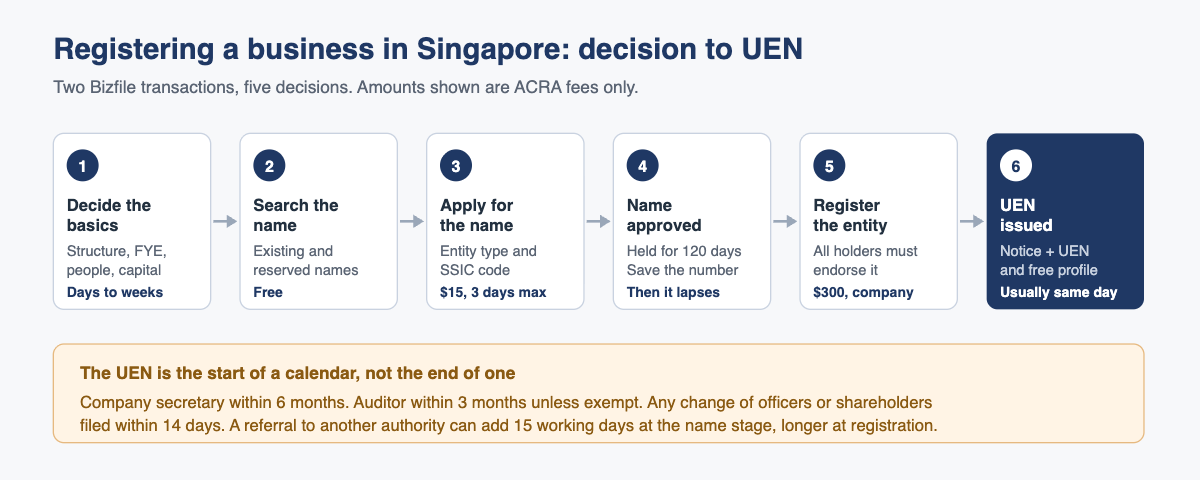
- Confirm you are eligible. Age, residency, bankruptcy status, Medisave standing for the unincorporated structures. Foreigners without local residency must engage a registered corporate service provider rather than filing directly.
- Choose the structure. See the table above.
- Search the name. Check existing entity names, reserved names, domain availability and trade marks before you spend anything.
- Apply for the name on Bizfile. $15, non-refundable. You need the entity type, the primary SSIC code, and a valid email address. Save the transaction number.
- Wait for the outcome. Straightforward names clear quickly. ACRA’s own review can take up to three working days. A referral to another authority takes longer.
- Register the entity within 120 days. The approved name is held for 120 days and then released. Only the person who applied for the name can file the registration, and for a company that person must be appointed as a director or secretary.
- Key in the entity details. FYE, registered office, office hours, company email, position holders, residential and contact addresses, nominator and controller declarations, share capital, share allotment, constitution.
- Collect endorsements. Where a corporate service provider did not file for you, every other position holder must endorse the registration through their own Bizfile inbox within 60 days. Nothing proceeds to payment until they all do.
- Pay. $300 for a company. You can buy a special UEN at this point if you want a memorable number.
- Check your Bizfile inbox. Approval brings the notice of incorporation, the UEN, and a link to download a free Business Profile.
How long does it really take?
| Stage | Straightforward case | Complicated case |
|---|---|---|
| Name application decision | Soon after payment | Up to 3 working days for ACRA’s own review |
| Name referred to another authority | Not applicable | Up to 15 working days |
| Entity registration decision | Soon after payment | Up to 15 working days |
| Registration referred to another authority | Not applicable | 14 to 60 days |
| Endorsement by other position holders | Same day, if everyone is responsive | Up to 60 days allowed |
Two honest caveats. ACRA quotes referral timelines in working days at the name stage and calendar days at the registration stage, so treat any referral as a month of exposure rather than a fortnight. And the single biggest source of delay in practice is not ACRA. It is a co-founder who does not open their Bizfile inbox.
What goes wrong, and what it costs
Paying twice for the same name. The $15 is not refundable if the name is unavailable, and it is not refundable if you withdraw. Two or three rejected attempts is a small sum of money and a large amount of lost momentum. Search properly before you pay once.
Letting the 120 days lapse. An approved name is reserved for 120 days. Miss that window, and the name goes back into the pool for anyone to take. Founders waiting on funding or on a co-founder’s relocation are the usual casualties.
Registering the wrong entity type. You must register the same entity type you nominated when you reserved the name. Deciding halfway through that the partnership should really be a company means starting the name application again.
Appointing the wrong person as the local director. A company that carries on business for more than six months without a director ordinarily resident in Singapore exposes its knowing members to personal liability for the debts contracted in that period, under section 145(10) of the Companies Act 1967. If you are relying on a nominee, understand what you are buying: our note on the sentencing framework for nominee directors sets out how seriously the courts now treat the arrangement.
Treating registration as the finish line. It is the start of a calendar. A company must appoint a company secretary within six months and an auditor within three months unless exempt, must file any change in officers or shareholders within 14 days, and must then hold annual general meetings and file annual returns. Our Companies Act 1967 deep-dive FAQ is the plain-language version.
Not registering at all. Under section 35 of the Business Names Registration Act 2014, carrying on business without registering when you should attracts a fine of up to $10,000 or imprisonment for up to two years. The quieter cost is commercial: an unregistered business struggles to enforce its own contracts.
Frequently asked questions
How much does it cost to register a company in Singapore?
$315 in total to ACRA: $15 for the name application and $300 for the incorporation. A sole proprietorship or partnership is $115 for a one-year registration or $175 for three years, inclusive of the same $15 name fee. Professional fees, if you use a corporate service provider, are separate.
How long is an approved business name held for?
120 days from approval. You must complete the entity registration inside that window. After 120 days the name is released and anyone else may apply for it. There is no automatic extension, so do not reserve a name until your co-founders and capital are actually ready.
Can I register a Singapore business if I live overseas?
Yes, but not by yourself. A foreigner without Singapore residency must engage a registered corporate service provider to file the name application and the registration, and the entity still needs at least one locally resident director, authorised representative or manager, depending on the structure.
Do I need an office before I can register?
You need a registered office address in Singapore, which is where ACRA and the courts will send documents and where your registers are kept. It must be accessible to the public during normal business hours. It does not have to be where you actually trade, so a Raffles Place registered office with a Tuas workshop is perfectly normal.
What is the difference between a UEN and a business name?
The UEN is the permanent number the government uses to identify your entity, issued on registration. The business name is the trading identity on the register. You can change the name later by filing with ACRA; the UEN stays with the entity for life.
Getting it right the first time
Registration is cheap. Getting it wrong is not, because the cost is rarely the fee. It is the six weeks you lose to a referral you did not anticipate, or the year you spend as a sole proprietor before realising the structure cannot carry the contract you have just been offered.
Raffles Corporate Services registers Singapore entities every week, and the part that earns its fee is the half hour before the form opens: pressure-testing the structure against what you intend to do, checking the name against the disregarded-word rules, and confirming the SSIC code will not send you to another ministry.
You can reach us through Raffles Corporate Services, or read more on Singapore corporate secretarial practice at Singapore Secretary Services.
The Editorial Team, Raffles Corporate Services
Need help with this?
Raffles Corporate Services can handle the ACRA filings, compliance documentation and records for you, and where court proceedings or legal advice are needed, we work with a panel of experienced Singapore law firms who offer cost-effective and efficient legal service and advice.
Email: [email protected]
Call, SMS or WhatsApp: +65 8501 7133