
Filing a cessation notice in Bizfile ends your registration. It does not end your liability. The filing is free, it takes minutes, and it cannot be reversed once ACRA processes it. The law also gives you only 14 days from the day you stop trading to lodge it.
Raffles Corporate Services works with a panel of experienced Singapore law firms who offer cost-effective and efficient legal service and advice. This article is general information only and is not legal advice.
Most owners treat closing a sole proprietorship as an administrative full stop. It is not. A sole proprietorship has never been a separate legal person, so there is nothing to dissolve and nothing to liquidate. What you are closing is a registration of a name, and every debt, contract, tax obligation and claim that attached to you personally while you traded remains attached to you afterwards.
Understanding that distinction is the difference between closing a business properly and simply switching off the ACRA entry and hoping.
If you want the click-by-click route through the eService, our guide on how to close a sole proprietorship or partnership covers it. This article is about what the filing actually achieves.
The 14-day rule that applies to you too
Directors of companies know about the 14-day filing window. Sole proprietors rarely realise they have one.
Section 22(1) of the Business Names Registration Act 2014 requires a registered person who stops carrying on business under a registered business name to lodge notice with the Registrar within 14 days after stopping. Not within a reasonable time, and not at the next renewal. Fourteen days.
Section 22(3) makes failure an offence, punishable on conviction by a fine of up to $5,000.
Section 22(2) gives you the other half of the picture. The Registrar may allow you to lodge notice in advance, specifying the date on which you intend to stop. That is the provision behind the future-dated cessation option in Bizfile, and it is the sensible way to file if you already know your last trading day.
On receipt of the notice, or on the future date you specified, section 22(4) operates: the registration of the person and the business name ceases. That is the entirety of the legal effect.
What ends, and what follows you
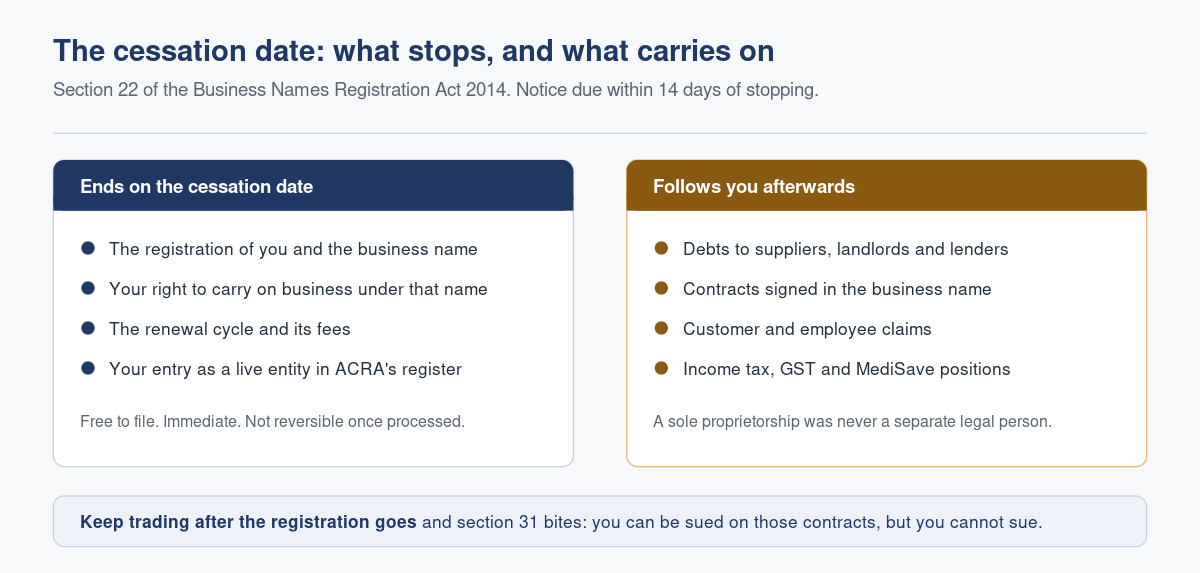
| Item | Does cessation end it? | Why |
|---|---|---|
| Your registration and business name | Yes, on the cessation date | Section 22(4) of the BNRA 2014 |
| Your right to trade under that name | Yes | Section 5(1) requires registration before carrying on business |
| The annual renewal obligation | Yes | There is no longer a live registration to renew |
| Debts owed to suppliers, landlords and lenders | No | A sole proprietorship is not a separate legal person, so the debts were always yours |
| Contracts you signed in the business name | No | You were the contracting party throughout |
| Claims by customers or employees | No | They lie against you personally |
| Income tax on the profits you earned | No | Trade income is assessed on you as an individual |
| GST registration, if you had one | No, it is cancelled separately with IRAS | GST registration is an IRAS matter, not an ACRA one |
| Self-employed MediSave liability | No | It attaches to net trade income already earned |
The right-hand column is the whole message. Closing the registration removes your ability to trade under the name. It removes nothing else.
Partnerships are the same, only multiplied
A general partnership registered under the BNRA 2014 is not a body corporate either. Partners remain jointly liable for the firm’s obligations after the registration ceases, in the same way a sole proprietor does.
If you want the liability to actually stop at the entity’s edge, you needed a different structure before you stopped trading, not after. Our note on converting a sole proprietorship to a private limited company covers that route, and a limited liability partnership is the analogous answer for a two-partner firm.
You cannot close a registration that has already expired
This trips people up constantly, and the logic is not obvious until you see it.
A business registration under the BNRA 2014 runs for a fixed period and must be renewed. If yours has lapsed, there is no live registration for a cessation notice to operate on. You have to renew it first, pay for a period you have no intention of trading in, and only then file the cessation.
Owners who drift for a year after their last invoice therefore pay twice: once to bring the registration back into good standing, and again in time and irritation. Renewal opens 60 days before expiry, and the practical obstacle is usually outstanding MediSave rather than the fee itself, which we cover in renewing a sole proprietorship or partnership registration.
File the cessation while the registration is still live. It is the cheapest decision in this entire article.
The order to do things in
Work through this before you touch the eService, because the filing itself is immediate and irreversible.
- Fix your cessation date. This is the date you stopped or will stop carrying on business. Bizfile accepts a past, current or future date.
- Finish or assign your contracts. Ongoing obligations do not lapse because the registration did.
- Deal with anything registered in the business name. Vehicles, licences, leases, hire purchase agreements and grant conditions all need transferring, terminating or disclosing.
- Cancel your GST registration with IRAS if you were registered, through IRAS’s GST deregistration process/gst-registration-deregistration/cancelling-gst-registration). ACRA does not do this for you.
- Renew the ACRA registration if it has expired, so there is something live to cease.
- Log in to Bizfile as a business user through Corppass and file the cessation of the business entity, entering the cessation date and the reason.
- Keep your records. Your tax position for the final year of assessment is still open, and you will need the books to support it.
What goes wrong, and what it costs
Trading on after the registration has gone. This is the expensive one. Section 31 of the BNRA 2014 imposes a disability on a defaulter who carries on business under a business name after the registration has been cancelled or has ceased: that person may not enforce, by action or other legal proceeding, rights arising under contracts made during the period of default. In plain terms, you can be sued but you cannot sue. A customer who does not pay a $40,000 invoice raised after your registration ceased knows exactly what that is worth.
Filing cessation and then taking one more job. Same problem, smaller scale, and entirely avoidable. Once the cessation date passes you are not registered.
Assuming ACRA tells IRAS everything. Closing the ACRA registration does not close your GST account, settle your income tax, or clear MediSave. Those are separate agencies with separate processes.
Choosing the wrong cessation date to save tax. The date is a statement of fact about when the business stopped, and it is used by other agencies. Backdating it to something convenient is a poor idea for the same reason as any other inaccurate filing.
Letting the registration lapse instead of closing it. Cancellation for failure to renew leaves an untidy trail, and it does nothing about the liabilities. Cessation is the clean exit.
If you closed it and should not have
There is a way back, and it is time limited.
Section 24 of the BNRA 2014 allows a person whose registration has ceased under section 22, or been cancelled, to apply to the Registrar to restore it. The application must be made within 12 months after the date the registration ceased or was cancelled, or within such longer time as the Registrar may allow in special circumstances.
If restoration is granted, section 24(4) treats the registration as if it had never ceased. Note section 24(5) though: restoration does not stop you being prosecuted for having carried on business while unregistered. The restoration repairs the register, not the offence.
Twelve months sounds generous until you remember that the usual trigger for noticing is a client asking for your UEN.
Frequently asked questions
How much does it cost to close a sole proprietorship in Singapore?
Nothing. Filing the cessation of a sole proprietorship or partnership in Bizfile is free and processed immediately. The costs that arise are indirect: renewing a lapsed registration before you can close it, cancelling GST registration with IRAS, and settling outstanding tax or MediSave.
Can I reverse a cessation after filing it?
Not by undoing the filing. Once ACRA processes the cessation the registration is gone. Your route back is an application to restore the registration under section 24 of the Business Names Registration Act 2014, made within 12 months of the cessation date, or later if the Registrar accepts special circumstances.
Do I still owe my suppliers after I close the business?
Yes. A sole proprietorship is not a separate legal person, so its debts were always your personal debts. The same is true of a general partnership, where the partners remain liable. Closing the ACRA registration changes nothing about who a creditor can pursue.
What happens if I just stop trading and never file anything?
Two things. You commit an offence under section 22(1) of the Business Names Registration Act 2014, punishable by a fine of up to $5,000. And your registration eventually lapses for non-renewal, which leaves a cancelled rather than a ceased entry against your name in ACRA’s records.
Can I close the business if my registration has expired?
No. You must renew the registration first, because a cessation notice needs a live registration to operate on. This is the most common reason a straightforward closure turns into a two-step exercise with an unexpected fee attached.
Does closing the business close my GST registration too?
No. GST registration is administered by IRAS and must be cancelled separately through IRAS. Businesses that forget continue to receive filing obligations for a registration they believe no longer exists, and late GST returns attract their own penalties.
Closing properly, once
Closing a business well is mostly a sequencing problem. The Bizfile filing is the last step, not the first, and doing it out of order is what turns a free transaction into an expensive month.
Raffles Corporate Services handles cessations, restorations and the conversions that people wish they had done earlier, for sole proprietors, partnerships and companies. If you are winding down and are not certain what has to happen before the filing, that is a short conversation and usually a short list.
You can reach us through Raffles Corporate Services, or read more on Singapore corporate secretarial practice at Singapore Secretary Services.
— The Editorial Team, Raffles Corporate Services
Need help with this?
Raffles Corporate Services can handle the ACRA filings, compliance documentation and records for you, and where court proceedings or legal advice are needed, we work with a panel of experienced Singapore law firms who offer cost-effective and efficient legal service and advice.
Email: [email protected]
Call, SMS or WhatsApp: +65 8501 7133