

Every individual who holds a position in a Singapore entity must give ACRA a contact address. That is the address the public sees when they buy a Business Profile. Your residential address stays with the Registrar, excluded from public access, for as long as the contact address actually works.
Raffles Corporate Services works with a panel of experienced Singapore law firms who offer cost-effective and efficient legal service and advice. This article is general information only and is not legal advice.
The regime exists for one reason. Company officers used to appear in public records at their home address, which is a real safety and nuisance problem for anyone whose company attracts creditors, disgruntled customers or worse. The contact address is the fix, and it replaced the older “alternate address” arrangement.
What most directors do not realise is that the protection is conditional and can be withdrawn, that you get one contact address across every entity, and that if you never actively provided one your home address may be on the public record right now.
What a contact address actually is
Section 4 of the Companies Act 1967 defines a contact address, in relation to an individual, as an address meeting all three of the following conditions:
- it is a physical address at which the individual can be physically found or contacted by post;
- it is not a post office box number; and
- it is located in the same jurisdiction as the individual’s residential address.
Each limb is doing work. “Physically found or contacted by post” rules out an address you have permission to use but never attend. The post office box exclusion rules out the obvious workaround. The same-jurisdiction requirement is the one people trip over: a director living in Kuala Lumpur cannot give a Singapore contact address.
Section 173(3)(ba) then requires the Registrar’s register of directors to contain each director’s contact address alongside the residential address, and sections 173(5)(ba) and 173(6)(ba) do the same for chief executive officers and secretaries. The contact address is therefore not an optional privacy product. It is a compulsory field in a statutory register.
Section 4 also defines the residential address it protects. For a person registered under the National Registration Act 1965 it is the place of residence registered under that Act, which is the address on the NRIC record. For everyone else it is their usual residential address.
Who has to provide one
The requirement attaches to individuals holding positions, not to entities and not to corporate shareholders.
| Entity type | Who needs a contact address |
|---|---|
| Company | Directors, chief executive officers, company secretaries |
| Limited liability partnership | Managers and partners who are individuals |
| Limited partnership | General partners who are individuals, and the local manager where required |
| Sole proprietorship or partnership | The sole proprietor, the partners, and any authorised representative |
| Any entity | Corporate shareholders: not required, because the rule applies to individuals |
Individual shareholders of a private company are in a different position. Section 12E(1)(b) requires the Registrar to exclude their residential address, held in the electronic register of members, from public access.
The rules that catch people
One contact address per person, not per company
You cannot hold three directorships and use three different contact addresses. The address attaches to you, not to the appointment. Section 12F(9) reflects this from the Registrar’s side: where an individual provides a new contact address, the Registrar must replace the contact address in each register kept under section 12(1) with the new one.
The effect is useful and occasionally unwelcome. Change it once and it changes everywhere, across every entity and across the ACRA administered Acts. You cannot compartmentalise: the address given for a company you would rather not discuss is the one showing against the company you are proud of.
Several people can share one address, if they are really there
All the position holders of an entity can use the same business address, provided each of them can actually be located there. Directors who work from the office, partners in a firm and officers based at the corporate service provider’s premises all satisfy that.
The limit is presence, not permission. A foreign position holder who is not physically present at the entity’s Singapore address cannot use it, which follows from the same-jurisdiction limb of the definition and from the requirement that the individual can be found there.
Your corporate service provider can file it once
If a corporate service provider acts for you, they can file the contact address once and it flows through to every entity where you hold a position. Expect to be asked for documentary proof of the address. That is not officiousness: a CSP that files an address you cannot be found at has a problem of its own, as our Corporate Service Providers Act 2024 compliance FAQ explains.
What it costs
Nothing. ACRA does not charge a fee to register a contact address, and there is no charge for updating it either. That is a change from the older alternate address arrangement, where the application was a chargeable transaction.
Since the filing is free, no director has a financial reason to be sitting on the public record at their home address. The only reasons it still happens are inattention and not knowing the option exists.
Where your residential address is still visible, and still used
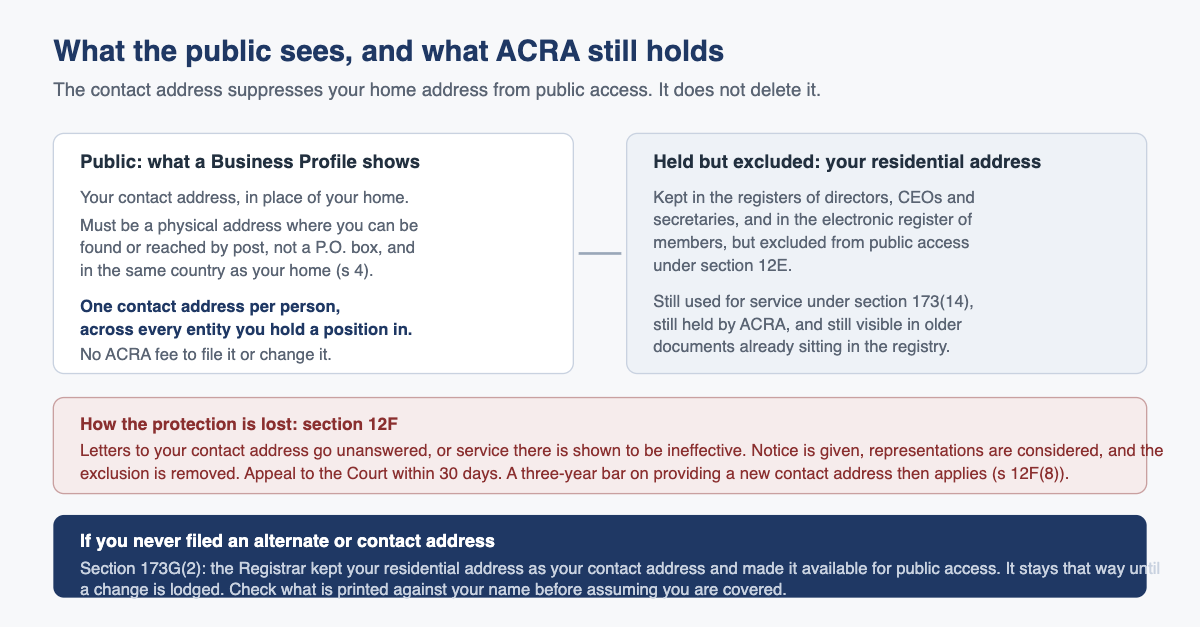
This is the part that gets oversold elsewhere, so it is worth being precise. A contact address does not delete your residential address from ACRA. It suppresses it from public access, in defined places only.
| What | Status |
|---|---|
| Residential address in the register of directors, CEOs and secretaries | Held by the Registrar, excluded from public access under section 12E(1)(a) |
| Residential address of an individual member of a private company, in the electronic register of members | Held by the Registrar, excluded from public access under section 12E(1)(b) |
| Residential address entered on a form submitted electronically on or after the commencement of section 30 of the ACRA (Registry and Regulatory Enhancements) Act 2024 | Excluded from public access for that document under section 12E(4) |
| Older documents already in the registry | Not automatically covered by section 12E(4). A buyer of historical documents may see what was filed at the time |
| Service of documents on you | Section 173(14) allows service at either the residential or the contact address |
| ACRA and other public agencies | Continue to hold and use the residential address |
The middle rows are the practical limit of the protection. Suppression applies to the register going forward and to forms filed electronically from the relevant commencement date. It does not rewrite a decade of documents already in the registry, and a determined searcher buying historical filings is a different problem from a casual Business Profile purchase.
How the protection gets taken away
Section 12F is the provision nobody reads until it is being used against them.
The Registrar may cause your residential address to stop being excluded from public access on either of two grounds in section 12F(1): that communications sent to your contact address requiring a response within a specified period have gone unanswered, or that there is evidence that service of documents at your contact address is not effective in bringing them to your notice. There is a process before it happens:
- The Registrar gives notice to you, to every company of which the Registrar has been notified that you are a director, chief executive officer or secretary, and to every private company of which you are a member (section 12F(2)).
- That notice states the grounds relied on and specifies a period for representations (section 12F(3)), which the Registrar must consider (section 12F(4)).
- If the Registrar decides to proceed, notice of the decision goes to you and to those companies before it takes effect (section 12F(5)), sent to your residential address unless service there may be ineffective (section 12F(6)).
- You may appeal to the Court within 30 days after receiving that notice, and the Court may confirm or reverse the decision (section 12F(7)).
Then the sting. Under section 12F(8), you are not allowed to provide a contact address for three years after the Registrar removes the exclusion, unless the Registrar is satisfied there is good cause in a particular case. Three years of your home address on the public record, because post sent to your nominated address went unanswered.
Section 12E(3) is the way back where it has not gone that far: the exclusion resumes if notice of a change in your contact address is lodged, subject to that three-year bar, or if the Court so directs on an appeal.
The transitional trap
Section 173G deals with the addresses already in the system when the contact address regime commenced, and it produces an outcome that surprises directors.
Where an individual had an alternate address recorded, the Registrar keeps that as their contact address until a change is lodged. Sensible, and invisible to the person concerned. Where an individual had no alternate address but their residential address was in the register, the Registrar keeps that residential address as their contact address, in addition to keeping it as the residential address, and makes it available for public access.
Read that twice if you have never filed an alternate or contact address. Your home address is very likely doing duty as your public contact address today, and will continue to until a change is lodged. The regime did not put a curtain up for everybody automatically. It put one up for the people who had already asked.
What goes wrong in practice
Nobody ever files one, and the home address is public by default. Section 173G(2) is the reason. The filing is free, so this is a five-minute fix most directors have simply never been told about.
The contact address is an office the director left two years ago. Post goes unanswered and section 12F(1)(a) is satisfied on its face. This is the most common route to losing the protection, and the three-year bar in section 12F(8) makes it expensive.
Moving house and updating only one entity. The one address per person propagates, but only when it is actually filed. Where the officer is a Singapore citizen or permanent resident, changes of residential address flow through from ICA, which is not the same thing as updating the contact address: see changing an officer’s particulars with ACRA.
Confusing it with the registered office. The registered office is the company’s address for service under sections 142 and 143 of the Companies Act 1967: see registered office requirements. The contact address belongs to an individual, and it does not affect what ACRA and other public agencies hold, nor the separate register of registrable controllers.
Frequently asked questions
What is a contact address in ACRA’s records?
It is the address of a position holder that appears on the public record in place of their residential address. Section 4 of the Companies Act 1967 requires it to be a physical address where the individual can be found or contacted by post, not a post office box, and in the same jurisdiction as their residential address.
Does a contact address cost anything?
No. ACRA does not charge a fee to register or change a contact address. The cost of not having one is that your residential address may be the address shown publicly against every entity where you hold a position, which is what happens by default where no alternate or contact address was ever filed.
Can a foreign director use the company’s Singapore office as a contact address?
Only if they can actually be found there. The statutory definition requires the address to be in the same jurisdiction as the individual’s residential address, so a director living overseas must give a contact address in their own country rather than the Singapore entity’s address.
Can ACRA put my home address back on the public record?
Yes. Under section 12F, if communications sent to your contact address go unanswered or service there is shown to be ineffective, the Registrar may remove the exclusion after giving notice and considering representations. You may appeal to the Court within 30 days, and a three-year bar on providing a new contact address then applies.
A five-minute job worth doing today
Pull your own People Profile or a Business Profile of one of your companies and look at the address printed against your name. If it is your home, you have a free filing to make. If it is an office you no longer use, you have a more urgent one, because the clock on section 12F starts with the first letter you do not answer.
Raffles Corporate Services files contact addresses for the officers of the companies we act for and checks them as part of the annual compliance review. If you are not certain what address ACRA is showing for you, we can tell you in a few minutes.
You can reach us through Raffles Corporate Services, or read more on Singapore corporate secretarial practice at Singapore Secretary Services.
— The Editorial Team, Raffles Corporate Services
Need help with corporate secretarial or compliance matters?
If you would like help with your company's corporate secretarial, governance or compliance requirements, email [email protected] or WhatsApp +65 8501 7133.
Our team can assist with corporate secretarial, accounting and tax matters. Where legal advice is needed, advisers from our associated law firms can assist.