

If you are a director or chief executive officer of a Singapore company and you are interested, directly or indirectly, in a transaction the company is doing, section 156 of the Companies Act 1967 requires you to declare it as soon as practicable after the facts come to your knowledge. Failing to do so is an offence carrying a fine of up to $5,000 or imprisonment of up to 12 months.
Raffles Corporate Services works with a panel of experienced Singapore law firms who offer cost-effective and efficient legal service and advice. This article is general information only and is not legal advice.
The declaration is not a formality, and it is not satisfied by everybody already knowing. In a two-director family company where one director is also the landlord, the interest is obvious to both of them and still has to be declared and minuted.
Below is what counts as an interest, when the clock runs, the separate rules on lending company money to directors, and the board process that makes all of it survivable.
What counts as an interest
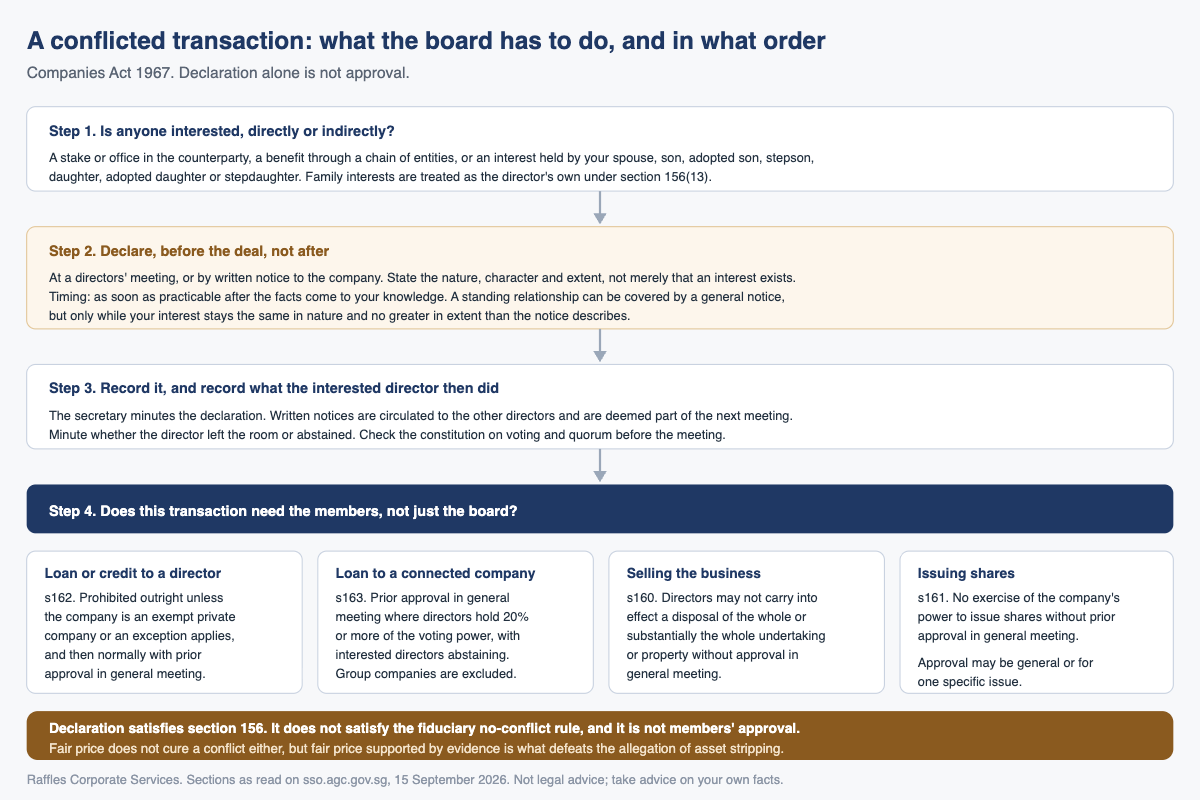
Section 156(1) catches any director or chief executive officer who is “in any way, whether directly or indirectly” interested in a transaction or proposed transaction with the company. Three features of that wording catch people out.
Family interests are your interests. Section 156(13) treats an interest held by a member of your family as your own, and defines family to include your spouse, son, adopted son, stepson, daughter, adopted daughter and stepdaughter. If your company rents premises from a company your spouse owns, that is yours to declare.
Indirect means indirect. A stake in the counterparty, an office in it, or a benefit through a chain of entities all count. Our note on what makes a company a related corporation sets out how far those chains reach.
Proposed transactions count. The duty bites before the deal is signed. Declaring at the point of payment is late.
There are two relief valves. Section 156(3) disapplies the duty where your only interest is being a member or creditor of a corporation involved in the transaction, and that interest is properly immaterial. Section 156(4) says you are not treated as interested merely because you guaranteed a loan to the company, or because you hold office in a corporation deemed related to it under section 6. Both are narrower than they look.
How and when to declare
| Situation | What section 156 requires | Timing |
|---|---|---|
| Interest in a transaction or proposed transaction | Declare its nature at a directors’ meeting, or send the company a written notice giving the nature, character and extent | As soon as practicable after the facts come to your knowledge |
| New director or CEO with an existing interest | The same, by declaration or written notice | As soon as practicable after the date of appointment |
| A standing relationship with a named company, firm or LLP | A general notice stating that you are an officer, member or partner of that entity and are to be regarded as interested in any future transaction with it | Given at a meeting, or brought up and read at the next meeting |
| An office or property creating a conflicting duty or interest | Declare the fact and the nature, character and extent of the conflict | At the first directors’ meeting after appointment, or after you acquire it |
A general notice under section 156(5) is the sensible mechanism for recurring relationships, but only if it does what the subsection asks. It must specify the nature and extent of your interest in that entity, and it stops covering the transaction once your interest becomes different in nature or greater in extent than the notice describes. A general notice given years ago for a 10 per cent shareholding does not cover today’s transaction with a company you now control.
Written notices do not disappear into a file. Section 156(9) requires the company to copy the other directors, and section 156(10) deems the declaration part of the proceedings of the next directors’ meeting, with the section 188 minute requirements applying as if it had been made there. Section 156(11) puts the recording duty on the company secretary, alongside the wider obligation to keep company information and registers current. The register of directors’ interests under section 164 is the parallel obligation on shareholdings, and disclosure of directors’ interests works through the mechanics.
Lending company money to a director, and to companies they control
This is a separate regime with a much heavier penalty, and it is the one small company directors breach most often without realising there is a rule at all.
Section 162: restricted transactions with directors
A company, other than an exempt private company, must not make a “restricted transaction”: a loan or quasi-loan to a director of the company or of a related company, a guarantee or security for such a loan made by someone else, a credit transaction for a director’s benefit, or an arrangement structured to achieve the same result indirectly. Section 162(8) extends “director” to the same family list as section 156.
Section 162(3) carves out four situations, of which two matter in practice: funds to meet expenditure the director incurs for the company’s purposes, and a housing loan to a director in the company’s full-time employment, with only one such transaction outstanding at any time. Even then, section 162(4) requires prior approval at a general meeting at which the purpose and amount are disclosed, failing which the amount must be repaid within six months after the next annual general meeting. The directors who authorised it are jointly and severally liable to indemnify the company for any loss if that condition is missed.
A director who authorises a restricted transaction in breach commits an offence carrying a fine of up to $20,000 or imprisonment of up to 2 years.
Section 163: lending to companies your directors control
Section 163 extends the same discipline outward. A company, other than an exempt private company, must not lend to, guarantee borrowing by, or extend credit to another company, an LLP or a VCC in which its directors together hold 20 per cent or more of the total voting power, unless the company approves in general meeting beforehand with the interested directors and their family members abstaining. That abstention requirement falls away only where every shareholder has voted to approve.
Section 163(4) excludes the company’s own subsidiary, holding company or fellow subsidiary, which is what makes ordinary intra-group funding workable. It is also why the first question on any director loan is whether the counterparty is genuinely inside the group or merely owned by the same people. The penalty mirrors section 162: a fine of up to $20,000 or imprisonment of up to 2 years.
The exempt private company point
Both sections open with “other than an exempt private company”, which is why many owner-managed Singapore companies never meet them. That is a relief from sections 162 and 163 only. It is not a relief from section 156, from the fiduciary no-conflict rule, from the tax treatment of a director’s current account, or from the accounting disclosure: see related party transactions and transfer pricing for SMEs.
Big-ticket transactions that need the members, not just the board
Two provisions take the decision away from the board entirely, whatever the constitution says. Section 160 stops directors carrying into effect a disposal of the whole or substantially the whole of the company’s undertaking or property without approval in general meeting, and any member can apply to the Court to restrain a breach. Section 161 stops them exercising the company’s power to issue shares without prior approval in general meeting.
Singapore has no standalone “substantial property transaction” rule for private companies of the kind some other jurisdictions use. The discipline on a director buying an asset from the company, or selling one to it, comes from section 156, the fiduciary no-conflict rule, and section 160 where the asset is substantial enough. That is strong enough, but only if the paperwork exists.
Listed companies carry a further overlay: the SGX listing rules on interested person transactions, which sit outside the Companies Act and do not touch private companies. What does reach private companies is the accounting disclosure of related party transactions and key management personnel compensation under FRS 24, which is how most of these arrangements become visible to a reader of the accounts.
The board process that keeps you safe
Six steps, in order. None of them takes long.
- Identify the interest before the item is tabled. The chair should ask.
- Declare the nature, character and extent, not just the existence. “I have an interest in the landlord” is weaker than “I hold 60 per cent of the landlord and I am its sole director”.
- Minute it in the director’s own words. Section 188 requires minutes within one month; write them the same week.
- Leave the room, or at minimum abstain, and record which it was. Check the constitution on voting and quorum beforehand.
- Check whether members’ approval is needed. Sections 160, 161, 162 and 163 all move the decision to a general meeting.
- Record the commercial justification and file it with the resolution. Market rent evidence, two comparable quotes, an independent valuation. A fair price does not cure a conflict, but a fair price supported by evidence defeats the allegation that the company was stripped.
Where the company has a single director, section 157B allows a declaration required under the Act to be made by recording it and signing the record, which satisfies any requirement that it be made at a meeting. That is also the situation in which the file is the only evidence you will ever have: see our note on the sole director company.
What goes wrong: “everyone already knew”
The recurring failure is not concealment. It is a two or three person board, usually family or co-founders, where every director already knows who owns the landlord, who the supplier’s shareholder is, and whose spouse is on the payroll. Nobody declares anything because there is nothing anyone does not know.
Then something changes. A shareholder falls out with the others, an investor does diligence, or a liquidator starts pulling the minute book. At that point the question is not what the directors knew at the time. It is what the company can prove was disclosed, and the answer is nothing.
The consequences stack. A transaction in breach of the fiduciary no-conflict rule is voidable at the company’s option, and the director may have to account for profits. Section 156(15) supplies the criminal offence. Section 157(2) separately bars an officer from making improper use of the position or of information acquired through it, with liability under section 157(3) for profits made or damage caused. A shareholder who is shut out can bring a derivative action under section 216A, and a liquidator can pursue misfeasance claims.
The wider set of duties sits in our companion guides to statutory duties under the Companies Act, fiduciary duties and how the courts apply them, and a director’s personal liability.
Frequently asked questions
Do I have to declare an interest if all the other directors already know about it?
Yes. Section 156 requires a declaration regardless of what the other directors happen to know. Actual knowledge is not a substitute for a declaration made at a meeting or by written notice and recorded in the minutes. The point of the requirement is the record, which is what you will need years later.
Can a Singapore company lend money to its director?
It depends on the company. Section 162 prohibits loans, quasi-loans, credit transactions and related guarantees in favour of directors, but the prohibition does not apply to an exempt private company. Where it does apply, only narrow exceptions exist and most require prior approval in general meeting. The penalty for the authorising director is a fine of up to $20,000 or imprisonment of up to 2 years.
Does declaring an interest mean the transaction is allowed?
Not by itself. Declaration satisfies section 156. It does not satisfy the fiduciary no-conflict rule, which generally requires informed consent from the company, nor does it substitute for a members’ approval required by sections 160, 161, 162 or 163. Declare, then check whether anyone other than the board must approve.
Does my spouse’s shareholding count as my interest?
Yes, for these purposes. Section 156(13) treats an interest held by a member of your family as yours, and the definition covers your spouse, son, adopted son, stepson, daughter, adopted daughter and stepdaughter. Sections 162 and 163 use the same family list, so a loan to your spouse can be a restricted transaction.
What is an interested person transaction, and does it apply to my private company?
Interested person transactions are an SGX listing rules concept requiring listed issuers to announce, and sometimes obtain shareholder approval for, transactions with interested persons. It does not apply to private companies. Private companies are instead caught by section 156, the fiduciary duties, and related party disclosure in the financial statements.
Getting the paperwork to exist
Nothing in this article is difficult. It is a declaration, a minute and a resolution, and it takes a fraction of the time that reconstructing it later takes. The reason it does not happen is that related party dealings in owner-managed companies feel like housekeeping rather than transactions.
Raffles Corporate Services prepares the declarations, writes the minutes while the facts are still current, and flags the transactions that need a members’ resolution before they are signed. If your company deals with entities its directors own, and the minute book does not say so anywhere, that is worth a conversation now.
You can reach us through Raffles Corporate Services, or read more on Singapore corporate secretarial practice at Singapore Secretary Services.
— The Editorial Team, Raffles Corporate Services
Need help with corporate secretarial or compliance matters?
If you would like help with your company's corporate secretarial, governance or compliance requirements, email [email protected] or WhatsApp +65 8501 7133.
Our team can assist with corporate secretarial, accounting and tax matters. Where legal advice is needed, advisers from our associated law firms can assist.