

A Singapore director owes five fiduciary and common law duties: to act in good faith in the company’s interests, to exercise powers for a proper purpose, not to fetter his or her discretion, to avoid conflicts and secret profits, and to act with reasonable care, skill and diligence. None of them appears as a list in the Companies Act 1967.
Raffles Corporate Services works with a panel of experienced Singapore law firms who offer cost-effective and efficient legal service and advice. This article is general information only and is not legal advice.
They come from equity and the common law, and the Act says so. Section 157(4) of the Companies Act 1967 states that the statutory duty to act honestly and use reasonable diligence is in addition to, and not in derogation of, any other written law or rule of law about the duties of directors. Section 156(14) says something similar about disclosure of interests.
So the statutory duties tell you what to file. The fiduciary duties tell you how to decide. The second set is where directors get sued, and it is the set most private company directors have never had explained to them.
Why these duties exist at all
A director is a fiduciary because the company has handed control of its assets and its decisions to someone who is not the owner. Equity’s answer is strict: where you hold power over someone else’s property, you exercise it for them and not for yourself, and you do not put yourself where your interest might compete with theirs.
That is why the fiduciary duties feel harsher than commercial instinct suggests. They are not asking whether the deal was good. They are asking whose deal it was.
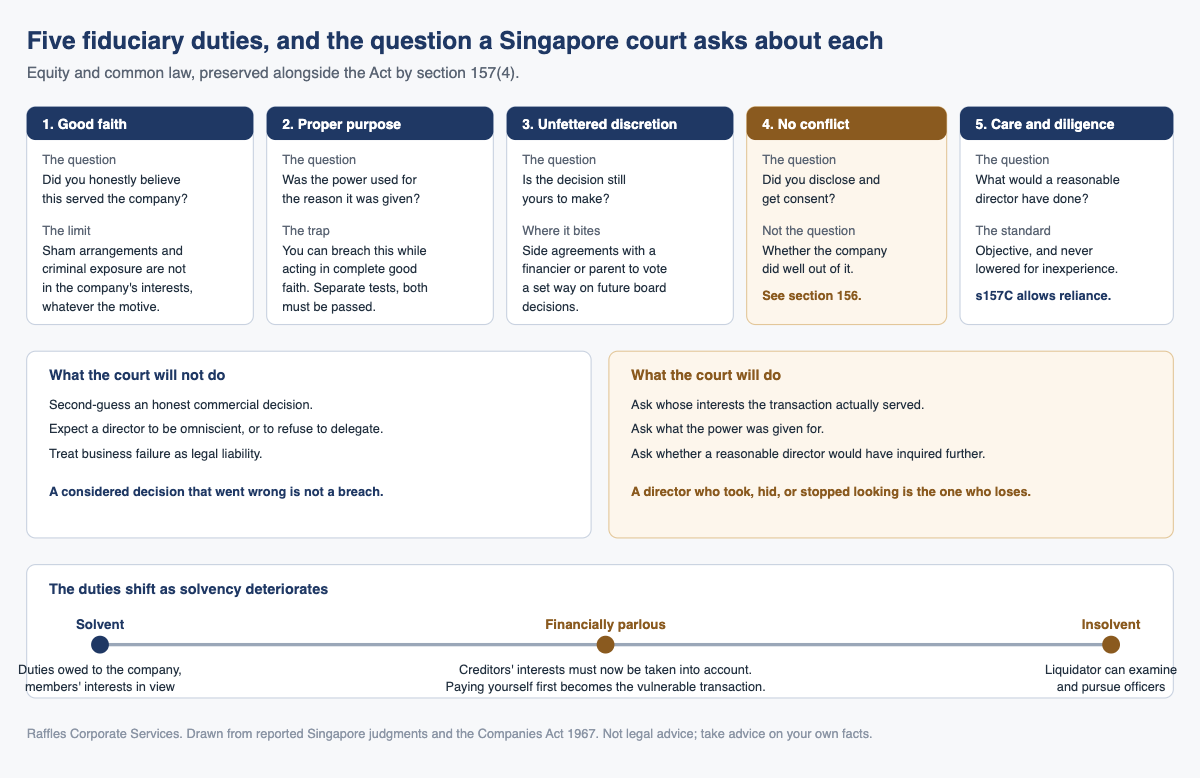
The five duties, and the question a court asks about each
| Duty | The question the court asks | What a breach looks like in a private company |
|---|---|---|
| Good faith in the company’s interests | Did you honestly believe this was in the company’s interests, and could a reasonable director have held that belief? | Paying a third party under an invented consulting agreement to win work, then recording it as a genuine expense |
| Proper purpose | Was the power exercised for the purpose it was given for? | Issuing shares to dilute a shareholder you are in dispute with rather than to raise capital the company needs |
| Unfettered discretion | Did you keep the decision yours, or did you promise it away in advance? | Agreeing with a financier or a parent company to vote a particular way on future board decisions |
| No conflict, no secret profit | Did you profit from the position, or sit on both sides of the deal, without full disclosure and consent? | Buying company assets through a company your spouse owns, at a price you set |
| Care, skill and diligence | Did you do what a reasonable director in your position would have done? | Signing whatever is put in front of you, never reading the management accounts, never asking why cash is short |
Good faith is tested honestly, but not blindly
Singapore courts start with what the director actually believed. If the belief was genuine, the court will usually not interfere.
That deference has limits, and the Court of Appeal in Ho Kang Peng v Scintronix Corp Ltd [2014] SGCA 22 drew them clearly. A director who caused a company to make unauthorised and irregular payments to a third party could not defend the conduct on the basis that the payments were meant to win business. Creating sham arrangements, misstating the accounts, or exposing the company to criminal risk is not acting in the company’s interests, whatever the commercial motive.
The practical test is uncomfortable but useful. If the transaction only works when nobody outside the room knows about it, the good faith defence is already in trouble.
Proper purpose is about the power, not the outcome
Every board power exists for a reason. The power to issue shares exists to raise capital. The power to refuse a share transfer exists to protect the company’s shareholder base, not to punish a family member. The classic statement is the Privy Council’s in Howard Smith Ltd v Ampol Petroleum Ltd [1974] AC 821: shares issued primarily to shift voting control rather than to raise needed capital are issued for an improper purpose, even if the directors sincerely believed the resulting control was better for the company.
A director can therefore breach this duty while acting in complete good faith. The two duties are separate tests, and both have to be passed.
Care, skill and diligence is measured objectively
The standard is not “what you personally were capable of”. In Lim Weng Kee v Public Prosecutor [2002] SGHC 193, the High Court held that a director is judged against the standard of a reasonable director in the same position, and that the standard will not be lowered to accommodate an individual’s inexperience. It is a continuum rather than a fixed line: the more a director held himself out as bringing particular skill, and the larger and more complex the company, the higher the bar rises.
There is a floor, though, and it applies to everyone. A director must acquire and maintain enough knowledge of the company’s business to be able to discharge the role. “I did not know” is the admission, not the defence.
Section 157C gives directors a real, bounded protection here. A director may rely on reports, financial data and expert advice from employees, professional advisers and other directors or board committees, provided he or she acts in good faith, makes proper inquiry where the circumstances indicate one is needed, and has no knowledge that the reliance is unwarranted. Relying on your accountant is legitimate. Relying on your accountant after three months of unanswered questions about the bank balance is not.
What the courts will not do
Singapore courts do not run the business. The High Court in Vita Health Laboratories Pte Ltd v Pang Seng Meng [2004] SGHC 158 put it plainly: it is the market’s role, not the court’s, to punish directors who have in good faith made incorrect commercial decisions, and undue legal interference would stifle the appetite for commercial risk. The same judgment accepted that delegation is unavoidable, and that the larger the business the greater the need for it.
That protection is real and wide. A director who considered the question, took advice where sensible, made the call and got it wrong is not liable for the loss.
The line runs between judgment and abdication, and between an honest decision and a self-interested one. The cases where directors lose are almost never about a bad commercial bet. They are about a director who took something, hid something, or stopped looking.
The duty that changes when the company is in trouble
Directors owe their duties to the company, not to shareholders individually and not to creditors. That shifts as solvency deteriorates.
In Foo Kian Beng v OP3 International Pte Ltd (in liquidation) [2024] SGCA 10, the Court of Appeal held that the duty to consider creditors’ interests is engaged once a company is in a financially parlous state, a threshold that sits below actual insolvency or the verge of it. The director in that case had authorised dividends and loan repayments to himself while litigation that could sink the company was on foot. The Singapore Courts’ published case brief sets out the reasoning, and our longer note on directors’ duties when a company is financially parlous works through what it means in practice.
The point for an ordinary private company director is narrow and important: once the company’s solvency is genuinely in question, paying yourself back before the trade creditors is the transaction most likely to be unwound.
What happens when a duty is breached
A breach of fiduciary duty is not one remedy but a menu, and the company chooses.
- Account of profits. You hand over what you made, whether or not the company lost anything.
- Equitable compensation. You make good the loss caused by the breach.
- Rescission. The transaction is unwound, where that is still possible.
- Statutory liability. Section 157(3) makes an officer in breach liable to the company for profits made or damage suffered, and guilty of an offence carrying a fine of up to $5,000 or imprisonment of up to 12 months.
Who brings the claim is the practical problem, because the company is controlled by the board the claim is against. A member can apply under section 216A to bring a derivative action in the company’s name. After a winding up, a liquidator can examine officers publicly and pursue misfeasance claims. Our companion guide to a director’s personal liability covers where the exposure actually lands.
What goes wrong: “but it was good for the company”
This is the single most common thing a director says when the claim arrives, and it is usually true. The payment did win the contract. The share issue did keep the business stable. The loan did keep the lights on.
It does not help, for three reasons.
First, good faith and proper purpose are separate tests, so an honest motive does not cure a power exercised for the wrong reason. Second, the no-conflict rule does not ask whether the company did well out of the deal; it asks whether you disclosed and obtained consent, which is why the discipline in our note on conflicts of interest and related party transactions matters so much. Third, none of it is available to a director who cannot show contemporaneous evidence that the decision was actually made.
That third point is where most private companies lose. There is no board minute, no declaration of interest, no note of the advice taken. Three years later, the only record of the director’s reasoning is the director’s memory, and the court is being asked to prefer it over a bank statement. The fix costs nothing: minute the decision, record the reason, and file the advice. Section 188 requires minutes of directors’ meetings to be entered within one month anyway, as set out in our guide to statutory duties under the Companies Act.
Frequently asked questions
Are fiduciary duties written into the Companies Act 1967?
Only partly. Section 157(1) requires a director to act honestly and use reasonable diligence, which restates the core of the duties in statutory form. Section 157(4) confirms the section adds to, and does not replace, the general law. The fuller content of the duties, including proper purpose and the no-conflict rule, comes from case law.
Can a director be liable for a decision that simply turned out badly?
Generally no. Singapore courts have repeatedly declined to second-guess honest commercial judgment, on the basis that business failure should not automatically mean legal liability. Liability follows dishonesty, self-interest, improper purpose or a failure to engage with the role at all, not a reasonable decision that did not work.
Does a nominee director owe the same duties as everyone else?
Yes, and to the company that appointed him or her, not to whoever nominated the appointment. A nominee who follows instructions without independent consideration is exposed on both good faith and diligence. Singapore’s sentencing approach for nominee directors who treat the role as passive has hardened considerably.
What is the duty to creditors, and when does it start?
It is not a duty owed to creditors directly. It is a requirement to take creditors’ interests into account when exercising your duties to the company, and it is engaged once the company is in a financially parlous state, which is a lower threshold than insolvency. Once engaged, transactions favouring shareholders or directors become vulnerable.
Can the company release a director from these duties in advance?
Not generally. A company can approve a specific conflicted transaction after full disclosure, and the constitution can regulate some procedural aspects. A blanket advance waiver of fiduciary duties is a different thing, and the Act restricts how far a company may indemnify its officers against liability to the company itself.
The cheapest protection available to a board
Almost every fiduciary claim we see against a private company director could have been made much harder to bring by ten minutes of paperwork at the time. A minute that records the decision, who was interested in it, who abstained, what was disclosed, and what advice was taken is worth more three years later than any amount of recollection.
Raffles Corporate Services sits in that gap: board minutes written while the facts are fresh, declarations of interest captured and recorded properly, and registers that match what the board actually decided. If your company’s minute book stops shortly after incorporation, that is worth fixing before anyone needs it.
You can reach us through Raffles Corporate Services, or read more on Singapore corporate secretarial practice at Singapore Secretary Services.
— The Editorial Team, Raffles Corporate Services
Need help with corporate secretarial or compliance matters?
If you would like help with your company's corporate secretarial, governance or compliance requirements, email [email protected] or WhatsApp +65 8501 7133.
Our team can assist with corporate secretarial, accounting and tax matters. Where legal advice is needed, advisers from our associated law firms can assist.