

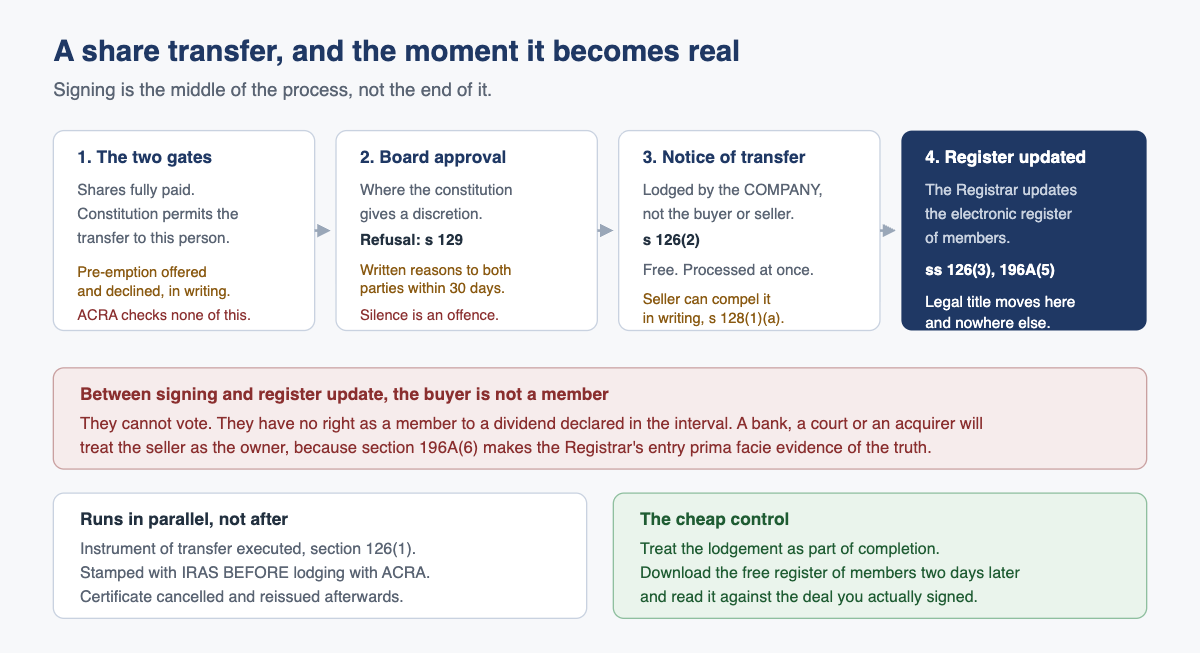
A transfer of shares in a Singapore private company does not take effect when the parties sign, when the money is paid, or when a certificate is handed over. It takes effect when the Registrar updates the electronic register of members. That is section 126(3) of the Companies Act 1967, and it is not a technicality.
Raffles Corporate Services works with a panel of experienced Singapore law firms who offer cost-effective and efficient legal service and advice. This article is general information only and is not legal advice.
Everything else in a share sale is preparation for that single moment. The filing that triggers it is a notice of transfer of shares, lodged through Bizfile by the company, and it costs nothing.
This article covers the ACRA side: who approves the transfer, who files it, and the ways companies lose control of the process. The instrument of transfer, the stamp duty payable to IRAS and the share certificates are dealt with in the companion piece on stamp duty and share certificates on a Singapore share transfer.
What is a notice of transfer of shares?
A notice of transfer is the prescribed Bizfile filing by which a private company tells ACRA that shares held by one person are now held by another. Section 126(2) puts the obligation on the company: where there has been a transfer of shares, a private company must lodge notice of that transfer with the Registrar in the prescribed form.
It is worth sitting with the word “company” there. Not the seller, not the buyer, not the buyer’s lawyer. That single point resolves most of the arguments that arise when a transfer stalls.
The filing updates both parties’ shareholdings at once, the fee is nil, and processing is effectively immediate.
Can the shares be transferred at all?
Two gates sit in front of the filing, and neither is an ACRA gate.
The shares must be fully paid
ACRA’s position is that a shareholder can transfer shares provided they are fully paid and the transfer complies with the constitution. Partly paid shares carry an outstanding liability to the company, and moving that liability is not something you do through the ordinary transfer route. If your register shows an unpaid amount against the shares, deal with that first.
The constitution must permit it
Private company shares are by definition subject to restrictions on transfer. Most constitutions give the directors a discretion to refuse registration, and give existing members a right of first refusal before shares go to an outsider. Many companies add a third layer in a shareholders’ agreement, with drag-along, tag-along or transfer-lock provisions.
None of this is visible to ACRA. Bizfile will accept a transfer that breaches a pre-emption clause exactly as readily as one that complies with it. These restrictions bite in a dispute between shareholders months or years later, where the remedy sought is usually rectification of the register or damages. Read the constitution first, every time; our note on the company constitution in Singapore sets out where the transfer clauses normally sit.
Does the board have to approve a share transfer?
Where the constitution gives the directors a discretion over registration, yes: the board must consider the transfer and resolve on it, and the resolution should be minuted. Approval is not automatic and is not a formality.
What the Act regulates is refusal. Section 129(1) says that if a private company refuses to lodge a notice of transfer of any share, it must send notice of the refusal to both the transferor and the transferee within 30 days after the date the transfer was lodged with it. Section 129(3) goes further: where an application is made to the company to lodge a notice of transfer for shares transferred or transmitted by act of parties or by operation of law, the company must not refuse in reliance on a constitutional discretion unless it has served the applicant, within 30 days beginning with the day of the application, a written notice stating the facts considered to justify the refusal.
A board that wants to block a transfer therefore has to say why, in writing, and quickly. Section 129(4) makes default an offence for the company and every officer in default, carrying a fine not exceeding $1,000 and a default penalty. Silence is not a strategy: a board that sits on a transfer it dislikes accumulates an offence while achieving nothing.
Who actually files it, and what if the company will not?
| Role | What they do | What they cannot do |
|---|---|---|
| The company (through an officer or a CSP) | Lodges the notice of transfer in Bizfile | Refuse indefinitely without giving written reasons under section 129 |
| The board | Approves or refuses registration where the constitution gives a discretion | Approve a transfer the constitution prohibits |
| The transferor (seller) | Signs the instrument of transfer; may compel the company to lodge under section 128(1)(a) | Lodge the notice directly with ACRA |
| The transferee (buyer) | Signs the instrument; pays the stamp duty in the usual case | Lodge the notice directly with ACRA |
| ACRA | Processes the notice and updates the electronic register of members | Check the constitution, pre-emption rights or the price |
The line that matters in a difficult transfer is section 128(1)(a). On the written request of the transferor of any share in a private company, the company must lodge with the Registrar a notice of transfer in the prescribed form. A seller who has done everything required of them, and is being stonewalled by a company controlled by the other shareholders, is not without a remedy: they make that request in writing, and the company’s obligation follows.
Section 128(3) gives a corresponding tool for the paperwork. On the transferor’s written request, the company must by written notice require whoever has possession, custody or control of the share certificate and the instrument of transfer to produce them at the company’s office within a stated period of not less than 7 and not more than 28 days, so the certificate can be cancelled or rectified. If that notice is ignored, sections 128(4) and 128(5) allow an application to a judge for a summons, and the court can order delivery.
These provisions exist because share transfers in private companies go wrong between people who used to be friends.
The steps, in order
- Check the constitution and any shareholders’ agreement for restrictions, pre-emption rights and the directors’ power to refuse. Confirm the shares are fully paid.
- Run the pre-emption process if one applies, and keep the evidence that it was offered and declined.
- Execute the instrument of transfer and stamp it. Both are covered in part 2. The stamping must be done before the transfer is lodged with ACRA.
- Pass the board resolution approving registration of the transfer, and minute it.
- Log in to Bizfile as a business user through Corppass, confirm the correct entity, and open the shares eService.
- Add the transferee if they are not already a shareholder: category, identification type and number, nationality, and a contact address in the same jurisdiction as their residential address.
- Enter the transfer details: transferor, transferee, currency, share class, number of shares and paid-up share capital. Each transfer between the same two people must be entered separately, even for the same class and currency, so two sales in the same year are two entries rather than one line.
- Review and submit. Read the resulting shareholding on the confirmation screen before you submit, not after.
- Download the register of members a day or two later and confirm ACRA’s version matches what you intended.
- Issue the new certificate, cancel the old one, and update the company’s own records, including the register of registrable controllers if anyone crosses the controller threshold.
When does the transfer actually become legal?
On update of the electronic register of members, and not before. Section 126(3) says a transfer of any share in a private company on or after 3 January 2016 does not take effect until the electronic register of members is updated by the Registrar under section 196A(5). Section 128(2) repeats the rule for transfers lodged at the transferor’s request.
Between signing and register update, the buyer is in a genuinely uncomfortable position:
- they are not a member, so they cannot vote at a general meeting
- they have no right as a member to a dividend declared in the interval
- they are not the person a bank, a court or an acquirer will treat as the owner
- the seller remains on the register with all of a member’s rights, including the right to vote against the buyer’s interests
Section 196A(6) adds that an entry in the register kept by the Registrar is prima facie evidence of the truth of the matters entered in it. That is what makes ACRA’s version the one that counts, and why a certificate in the drawer proves very little on its own.
The gap between signing and registration should be measured in days. Where it is measured in years, the company has a real problem rather than an administrative one.
What goes wrong
The transfer that was never filed. The dominant failure. The parties treat signing as completion, the person who would have lodged the notice was not in the room, and nothing reaches ACRA. Everyone behaves as though the shares moved: the buyer attends meetings, receives distributions, describes themselves as a shareholder on bank forms. Legally, nothing happened. It surfaces when an acquirer pulls the register of members and it does not match the cap table, and by then the seller may be uncontactable, bankrupt, in dispute, or dead.
The wrong number, filed and accepted. Bizfile validates against the transferor’s holdings, so it will stop you transferring more shares than the seller has. It will not stop you transferring the wrong class, the wrong quantity within range, or shares from the wrong shareholder group. Where the error cannot be resolved by a Notice of Error, the remaining route is a court order to amend the record. The only defence is a second reader on the review screen.
The refusal with no reasons, or the stall used as leverage. Directors who dislike the incoming shareholder decline to act and say nothing. Section 129 gives them 30 days to state the facts justifying a refusal, and default is an offence. If the transfer is genuinely objectionable, refuse it properly and in writing; if it is not, register it. Where a shareholder is being kept off the register to suppress their rights, the oppression remedy under section 216 is also in play.
Filing before stamping. IRAS is explicit that the instrument should be stamped before it is lodged with ACRA. Doing it the other way round is how companies pay a late stamping penalty on an otherwise clean transaction.
Frequently asked questions
Who files a share transfer with ACRA in Singapore?
The company does. Section 126(2) of the Companies Act 1967 requires a private company to lodge a notice of transfer with the Registrar in the prescribed form. Neither the buyer nor the seller can file it directly. A company officer files through Bizfile using Corppass, or the company authorises a corporate service provider to file on its behalf.
When does a share transfer take legal effect in Singapore?
When the Registrar updates the electronic register of members, under section 126(3) of the Companies Act 1967. Signing the instrument of transfer, paying the price and receiving a share certificate do not move legal title. Until the register is updated, the seller remains the member and the buyer cannot vote or claim a dividend as of right.
Can directors refuse to register a share transfer?
Only where the constitution gives them that discretion, and only if they act properly. Under section 129 of the Companies Act 1967 the company must notify the transferor and transferee of a refusal within 30 days, and must state the facts justifying it where the applicant asked the company to lodge the notice. Default is an offence for the company and every officer in default.
What can a seller do if the company will not file the transfer?
Make a written request under section 128(1)(a) of the Companies Act 1967. On the written request of the transferor of a share in a private company, the company must lodge a notice of transfer with the Registrar. Sections 128(3) to 128(5) also allow the company to compel production of the share certificate, with a court summons if it is withheld.
The part that is worth outsourcing
The Bizfile screens are not the hard part. The hard part is knowing, before anything is signed, whether the constitution allows this transfer to this person on these terms, and then making sure the lodgement happens on the day of completion rather than whenever someone remembers.
Raffles Corporate Services runs share transfers from constitution review through to register reconciliation: checking pre-emption and transfer restrictions, drafting the board resolution, coordinating the stamping step with IRAS, lodging the notice, and confirming that ACRA’s register matches the deal actually done. If you have a transfer completing, or one from a previous year you suspect was never filed, both are worth a short conversation.
You can reach us through Raffles Corporate Services, or read more on Singapore corporate secretarial practice at Singapore Secretary Services. ACRA’s page on filing a transfer of shares sets out the Bizfile screens, and the provisions are in the Companies Act 1967.
— The Editorial Team, Raffles Corporate Services
Need help with corporate secretarial or compliance matters?
If you would like help with your company's corporate secretarial, governance or compliance requirements, email [email protected] or WhatsApp +65 8501 7133.
Our team can assist with corporate secretarial, accounting and tax matters. Where legal advice is needed, advisers from our associated law firms can assist.