

Stamp duty on a Singapore share transfer is 0.2% of the purchase price or the value of the shares transferred, whichever is higher, rounded down to the nearest dollar, minimum $1. The buyer normally pays it, and the document must be stamped within 14 days of being signed in Singapore.
Raffles Corporate Services works with a panel of experienced Singapore law firms who offer cost-effective and efficient legal service and advice. This article is general information only and is not legal advice.
That is the headline. The detail underneath it is where money is lost, because the “value” of shares in a private company is rarely the price the parties agreed, and the penalty for stamping late can be four times the duty.
Part 1 of this pair covers filing the share transfer with ACRA: who lodges the notice, board approval, and the fact that the transfer takes legal effect only when the Registrar updates the electronic register of members. This article covers everything around that filing.
What is a proper instrument of transfer?
An instrument of transfer is the signed document by which the seller transfers legal title to specified shares to the buyer. It identifies the company, the transferor, the transferee, the class and number of shares and the consideration, and both parties sign it.
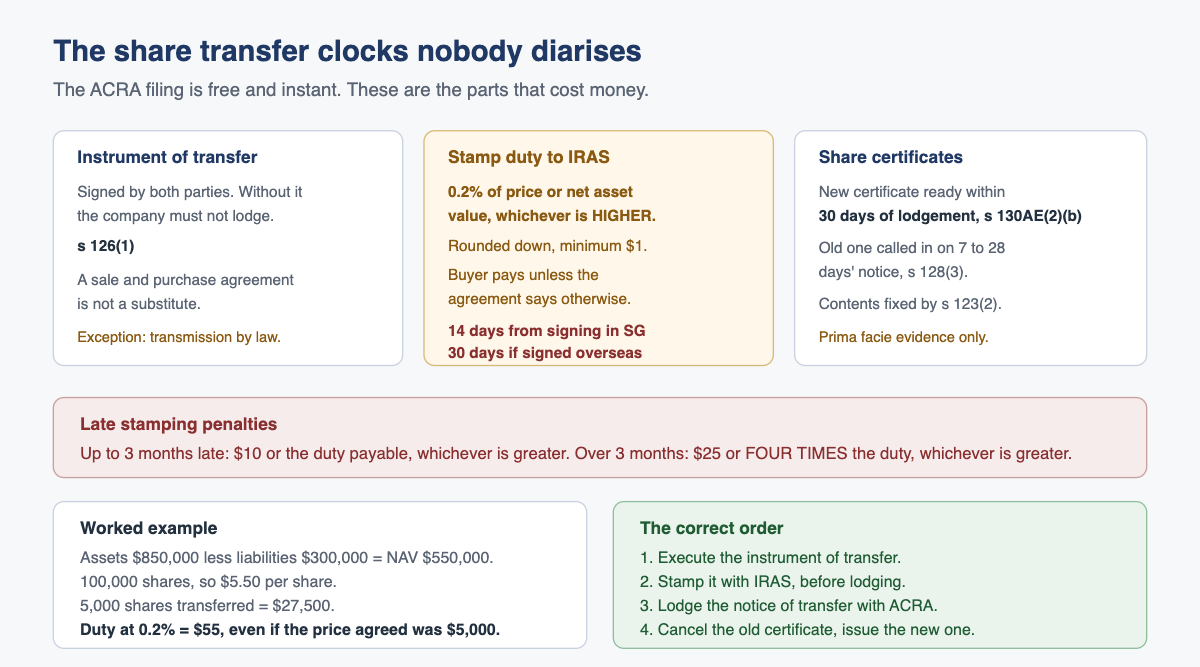
Section 126(1) of the Companies Act 1967 is categorical: despite anything in its constitution, a private company must not lodge a transfer of shares unless a proper instrument of transfer has been delivered to the company. The one carve-out is transmission by operation of law, where the right to shares passes on death or bankruptcy.
So no instrument means no lawful lodgement, no register update and no transfer. A sale and purchase agreement is not a substitute: it records the bargain, the instrument moves the shares.
How much stamp duty is payable on a share transfer?
Stamp duty is charged on the document signed when shares are bought or acquired, at 0.2% of the purchase price or the value of the shares transferred, whichever is higher, rounded down to the nearest dollar, minimum $1.
Acquisition covers more than a sale. IRAS treats duty as payable on shares acquired by purchase, by gift (including a voluntary declaration of trust or settlement), by distribution as a dividend in specie or in specie on a winding up, and by a distribution from a deceased estate that does not follow the will, the Intestate Succession Act or Muslim law of inheritance.
Working out the value, which is the part people get wrong
For a private company, value means net asset value or allotment price, depending on how long the company has existed.
Incorporated more than 18 months. Value is the net asset value of the shares transferred, computed from the latest statement of accounts, which must be dated within 24 months before the date of transfer. Where the company owns property, including leasehold property held as a non-current asset, market value at the date of the document replaces book value if book value is not reflective.
Incorporated 18 months or less. Value is the total allotment price of the shares transferred, provided the company owns no property. If it does, certified management accounts reflecting the property’s market value must be prepared.
Where there is more than one class of share, net asset value per share follows the rights attaching to each class, so preference shares with a priority return of capital and no share of surplus are valued differently from the ordinary shares beneath them.
A worked example
A company with 100,000 fully paid ordinary shares of $1 each, transferring 5,000 of them:
| Step | Figure |
|---|---|
| Total assets | $850,000 |
| Total liabilities | $300,000 |
| Net asset value | $550,000 |
| Net asset value per share | $5.50 |
| Value of 5,000 shares transferred | $27,500 |
| Stamp duty at 0.2% | $55 |
Now notice what that does to a transfer at par. If the parties agree $1 a share because that is what the founders paid, the price is $5,000 but the net asset value is $27,500, and duty is charged on the higher figure. Pricing a transfer without checking the balance sheet is how a company ends up with an assessment it did not budget for.
Who pays the stamp duty, and by when?
The party liable is usually stated in the agreement, and the parties are free to allocate it. Where the document is silent, liability follows the Third Schedule to the Stamp Duties Act: for a purchase or acquisition of shares, that is the buyer.
The deadlines are short:
- 14 days after signing, if the document is signed in Singapore
- 30 days after the document is received in Singapore, if it was signed overseas
Strictly, you stamp a document before you sign it; stamping within those windows afterwards simply avoids a penalty. It is done online through IRAS e-Stamping on myTax Portal.
Two practical points. “Date signed” generally means the date the document is first signed, so counterparts start the clock at the earliest signature. And electronic documents count: emails, an electronic signature or a click in an online platform can be an executed instrument, treated as executed where and when the signature is applied. A deal concluded over WhatsApp is still a dutiable document.
What late stamping costs
| Delay in payment | Penalty |
|---|---|
| Not exceeding 3 months | $10 or an amount equal to the duty payable, whichever is greater |
| Exceeding 3 months | $25 or 4 times the duty payable, whichever is greater |
Beyond the penalty, IRAS can appoint agents such as your bank, employer or tenant to recover the duty, issue a Travel Restriction Order preventing you from leaving Singapore until duty and penalties are paid in full, and take legal action. Where a bank is appointed, access to the account is affected until payment is made.
A reduced penalty of 5% of the late payment for each year of non-compliance, calculated daily, may apply where the matter qualifies under IRAS’s Voluntary Disclosure Programme. Disclosing an old unstamped transfer beats waiting for it to be found.
The correct order
- Execute the instrument of transfer.
- Work out the value, and e-Stamp the instrument with IRAS.
- Lodge the notice of transfer with ACRA through Bizfile.
- Cancel the old certificate and issue the new one within 30 days.
IRAS states that the instrument should be stamped before it is lodged with ACRA. A transfer sitting in ACRA’s register with an unstamped instrument behind it will surface in the next due diligence exercise, and the penalty runs from the signing date, not from the date anyone noticed.
What happens to the share certificates?
A share certificate is evidence of title, not title itself. Section 123(1) makes a certificate under the common or official seal of a company, specifying shares held by a member, prima facie evidence of that member’s title. Prima facie, not conclusive: the register governs.
Section 123(2) requires every certificate to be under the company’s common seal and to state, as at the date of issue, the name of the company and the authority under which it is constituted, the address of the registered office in Singapore, and the class of the shares, whether fully or partly paid and the amount unpaid. Non-compliance does not affect the holder’s rights under section 123(3), but under section 123(4) the company and every officer in default commits an offence.
The 30-day certificate deadline
This is the deadline people do not know exists. Under section 130AE(2)(b), a private company must, within 30 days after a notice of transfer is lodged with the Registrar under section 126(2) or 128(1)(a), complete and have ready for delivery all the appropriate certificates for the transfer. Section 130AE(2)(a) gives 60 days after an allotment.
Section 130AE(3) makes default an offence for the company and every officer in default, carrying a fine not exceeding $1,000 and a default penalty. Under section 130AE(4), a company served with a notice to make good the default that fails to do so within 10 days can be ordered by the court to comply.
Calling in the old certificate
The seller’s certificate has to be cancelled, and section 128(3) gives the company the tool. On the transferor’s written request, the company must by written notice require whoever has possession, custody or control of the certificate and the instrument of transfer to produce them at the company’s office within a stated period of not less than 7 and not more than 28 days, so the certificate can be cancelled or rectified. If that notice is ignored, sections 128(4) and 128(5) allow an application to a judge for delivery.
Where the certificate has been lost rather than withheld, section 125 governs the duplicate: a statutory declaration of the loss and an undertaking to return it if found.
Updating the company’s own records
ACRA holds the register of members. The company holds everything else, and all of it should agree.
| Record | What changes | Why it matters |
|---|---|---|
| Share certificates | Old cancelled, new issued within 30 days of lodgement | Section 130AE(2)(b); default is an offence |
| Minute book | Board resolution approving registration | Evidence the constitution was complied with |
| Instrument of transfer | Executed original, stamped, retained | Section 126(1); no instrument, no lodgement |
| Stamp certificate | Retrieved from myTax Portal, filed with the instrument | Proof of payment, wanted in due diligence |
| Register of registrable controllers | Updated if anyone crosses the controller threshold | A separate obligation with its own penalties |
| Cap table and register copy | Reconciled against ACRA’s electronic register | The mismatch nobody notices until an acquirer does |
| Shareholders’ agreement | New holder may need to accede | Otherwise they sit outside the contract binding the rest |
That last row deserves emphasis. A buyer on ACRA’s register who never signed up to the shareholders’ agreement is a member without any of the transfer restrictions, drag-along obligations or information rights the others accepted.
What goes wrong
Duty calculated on the price rather than the value. The parties transfer at par, or at a nominal figure between family members, forgetting that net asset value governs where it is higher. The assessment arrives later, with a penalty attached if the 14 days have gone.
Accounts too old to support the valuation. The latest statement of accounts must be dated within 24 months before the transfer. A company that has not finalised accounts for two years cannot support its own valuation, which turns a simple transfer into a scramble for certified management accounts. Our note on selling or restructuring a business covers the wider problem.
Certificates never issued or never cancelled. The 30-day deadline passes unnoticed, the seller keeps a certificate for shares they no longer hold, and the buyer has nothing. Both are offences, and both look careless in a data room.
Stamped but never filed, or filed but never stamped. Two halves of one process run by two people who each assume the other finished.
Frequently asked questions
How much is stamp duty on a share transfer in Singapore?
0.2% of the purchase price or the value of the shares transferred, whichever is higher, rounded down to the nearest dollar, with a minimum of $1. For a private company, value generally means net asset value computed from the latest statement of accounts dated within 24 months before the transfer, with property taken at market value where book value is not reflective.
Who pays stamp duty on a share transfer, and how long do I have?
Usually the buyer: the agreement can allocate liability, and where it is silent the Third Schedule to the Stamp Duties Act makes the transferee liable. Stamping is due within 14 days of signing in Singapore, or 30 days after the document is received in Singapore if signed overseas. It is done online through IRAS e-Stamping on myTax Portal, before the transfer is lodged with ACRA.
What is the penalty for late stamping of a share transfer?
For a delay not exceeding 3 months, $10 or an amount equal to the duty payable, whichever is greater. For a delay exceeding 3 months, $25 or 4 times the duty payable, whichever is greater. IRAS can also appoint your bank as agent to recover the duty and issue a Travel Restriction Order.
When must a company issue a new share certificate after a transfer?
Within 30 days after the notice of transfer is lodged with the Registrar, under section 130AE(2)(b) of the Companies Act 1967. Default is an offence for the company and every officer in default, carrying a fine not exceeding $1,000 and a default penalty. A certificate is only prima facie evidence of title: where it and the register disagree, the register governs.
The half of a share transfer nobody diarises
Filing the transfer with ACRA is free and takes minutes. The parts around it, the instrument, the valuation, the stamping window and the certificate deadline, carry the real cost, and are routinely left to whoever seems least busy.
Raffles Corporate Services handles the whole transaction: drafting the instrument, working the net asset value so the duty is right first time, coordinating the e-Stamping before lodgement, filing the notice with ACRA, reissuing certificates inside the 30-day window, and reconciling every register the company keeps. If you have a transfer completing, or an old one where nobody is certain the stamping was done, both are worth a short conversation.
You can reach us through Raffles Corporate Services, or read more at Singapore Secretary Services. IRAS sets out the rules on stamp duty for shares, ACRA’s page on filing a transfer of shares sets out the Bizfile screens, and the company law provisions are in the Companies Act 1967.
— The Editorial Team, Raffles Corporate Services
Would you like tax advice?
If you would like tax advice or help with your company's tax obligations, email [email protected] or WhatsApp +65 8501 7133.
Our accounting and tax advisers can assist. Where legal advice is needed, advisers from our associated law firms can also assist.