

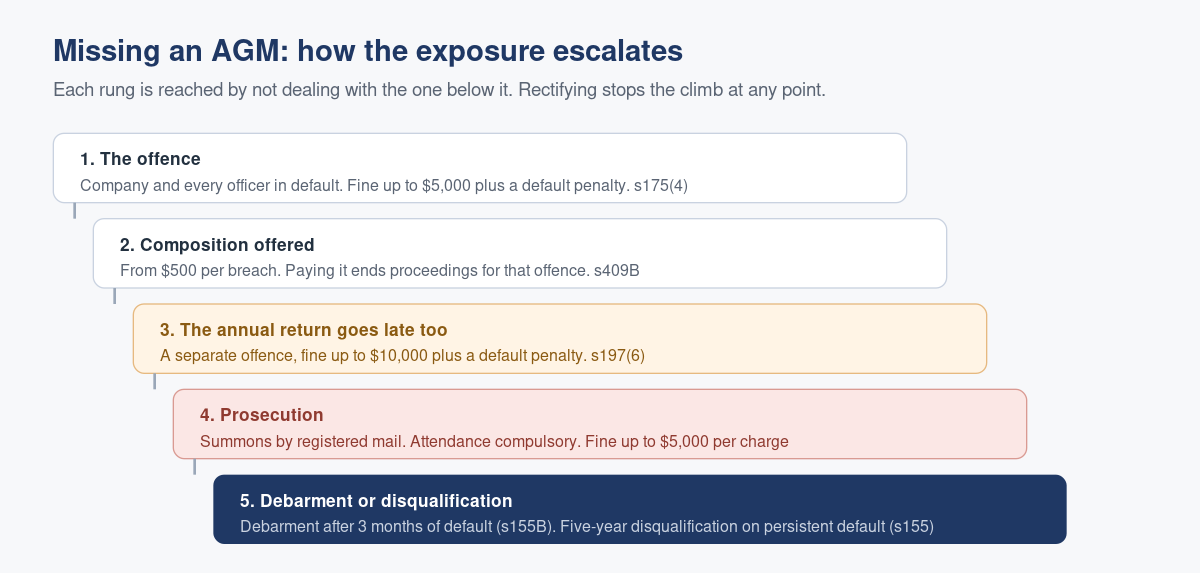
Failing to hold your AGM on time is an offence committed by the company and by every officer of the company who is in default. Section 175(4) of the Companies Act 1967 carries a fine of up to $5,000 on conviction, plus a default penalty that keeps accruing while the breach continues. In practice ACRA will usually offer a composition sum first, and the minimum is $500 for each breach.
Raffles Corporate Services works with a panel of experienced Singapore law firms who offer cost-effective and efficient legal service and advice. This article is general information only and is not legal advice.
The number that matters, though, is rarely the composition sum. It is what the missed AGM drags behind it. A late AGM almost always produces a late annual return, and each late annual return is a separate offence with its own penalty. Let that pattern repeat and the exposure stops being a fine and starts being your ability to sit as a director at all.
The offence itself
Section 175(1) requires an AGM within four months after financial year end for a listed public company and six months for every other company. Section 175(4) deals with failure: the company and every officer in default is guilty of an offence and liable on conviction to a fine not exceeding $5,000 and also to a default penalty. The same subsection lets the court, on the application of any member, order a general meeting to be called.
Two features of that wording deserve attention.
“Every officer who is in default” is personal. Section 408(3) defines an officer in default as one who knowingly and wilfully is guilty of the offence, or who authorises or permits it. The charge is not against the company alone. It follows the directors.
The default penalty continues. Where a section provides for a default penalty without specifying an amount, section 408(1) sets it at not more than $200 for each day the offence continues after conviction or after the matter has been dealt with by composition. Section 408(2) makes clear that the offence keeps running for as long as the thing required to be done remains undone. Holding the meeting late stops the clock. Ignoring it does not.
Composition: the outcome most companies get
Rather than prosecute, ACRA may offer the company the option of paying a composition sum. Paying it settles the matter without a court appearance, and under section 409B(3) no further proceedings may be taken in respect of that offence once the sum is paid.
ACRA’s stated minimum composition sum is $500 for each breach. The statutory ceiling is set by section 409B(1), which caps composition at the lower of half the maximum fine for the offence or $20,000. For a section 175 offence with a $5,000 maximum fine, that means composition cannot exceed $2,500.
The word to focus on is each. One company with three financial years of missed AGMs is not one breach. Add the annual returns that went unfiled alongside them and the arithmetic moves quickly in an unwelcome direction.
| What you are exposed to | Amount | Source |
|---|---|---|
| Composition sum, per breach | From $500 | ACRA’s published enforcement position |
| Composition ceiling for a section 175 offence | $2,500, being half the $5,000 maximum fine | Section 409B(1) |
| Fine on conviction, per charge | Up to $5,000 | Section 175(4) |
| Default penalty while the breach continues | Up to $200 per day | Section 408(1) |
| Fine for failing to lodge the annual return | Up to $10,000, plus a default penalty | Section 197(6) |
Court prosecution, and what the day actually looks like
ACRA may prosecute the company and its directors where composition is not accepted, where there are multiple or repeated breaches, or where ACRA decides not to offer composition at all. It may also decline to offer composition after a summons has already been issued.
The mechanics are worth knowing before you are in them.
The summons arrives by registered mail, sent to the company’s registered office or to the director’s residential address. It states the court, the date and the time. This is one of several reasons why an out-of-date registered office address is a genuinely dangerous piece of housekeeping to neglect.
Somebody must attend. A director must appear, or a representative carrying a letter of authority. That obligation holds even where an appeal is being processed. If the company sends nobody, the court may hear the matter in the company’s absence. If a director simply does not turn up, a warrant may be issued for their arrest.
In court there are three doors. Accept composition, if ACRA offers it after the summons. Plead guilty. Or claim trial and dispute the charges. If convicted, the fine can reach $5,000 per charge, and the director may also be liable to a default penalty.
The part that outlasts the fine: disqualification and debarment
This is where a missed AGM stops being an accounting inconvenience.
Disqualification for persistent default
Section 155 disqualifies a person who has been persistently in default in relation to requirements to file, deliver or send documents or notices to the Registrar. Persistent default may be conclusively proved by showing three or more convictions, or three or more orders under section 13 or section 399, within a period of five years.
The consequence: for five years after the last such conviction or order, that person must not, without the permission of the court, be a director or promoter of a company or take part directly or indirectly in its management. Breaching the disqualification is itself an offence carrying a fine of up to $10,000 or imprisonment of up to two years, or both.
Note the trigger carefully. Section 155 attaches to filing defaults rather than to the AGM itself. The wider set of director obligations that sit behind this is set out in our Companies Act 1967 deep-dive FAQ. That is precisely why the annual return consequence of a missed AGM matters more than the AGM charge does. Three years of unfiled annual returns is exactly the fact pattern the section was written for.
Debarment
Section 155B lets the Registrar make a debarment order against a person who is a director or secretary of a company at the time the order is made, where the company is in default of a relevant requirement of the Act, meaning the same class of filing obligations.
A debarred person must not act as a director or secretary of any other company. They remain in place at companies where they already held the office immediately before the order. The order runs from the date it is made until the Registrar cancels or suspends it, typically on rectification of the default.
There are two safeguards. The default must have persisted for a continuous period of three months or more, with the person as director or secretary during that period, and the Registrar must give at least 14 days’ notice of the intention to debar, specifying the default and inviting the person to show cause. The Registrar must consider any representations made. If you receive a show-cause notice, that 14 days is the most valuable window you will get. Rectify the filings and respond.
What goes wrong in practice
The company treats the AGM as a formality and the annual return as the real deadline. It is the wrong way round. The annual return declaration asks about your AGM position, and a company that never held the meeting and never validly dispensed with it cannot honestly complete that part of the form. Our guide to how to file your annual return on Bizfile shows where that declaration sits.
Breaches accumulate quietly across years. Nobody writes, so nobody acts. The correspondence that eventually arrives covers three years at once, and by then the exposure is three composition sums for the AGMs, three for the annual returns, and a director who is inside the section 155 pattern.
A resigned or absent director assumes it is not their problem. Liability attaches to the officers who were in default at the time, and a resignation does not retrospectively cure a breach that occurred while you were in office. Directors leaving a company with outstanding filings should deal with them before they go, not after. The related difficulty of extracting yourself cleanly is covered in our note on the trapped nominee director’s exit.
Nobody applies for an extension while one is still available. The 60-day extension of time closes at the due date. After that the only conversation left is about enforcement. If your date is still ahead of you, read applying for an extension of time to hold your AGM today rather than next month. If you are not sure when your date is, start with your AGM due date.
Frequently asked questions
What is the penalty for not holding an AGM in Singapore?
The company and every officer in default commits an offence under section 175(4) of the Companies Act 1967, punishable on conviction by a fine of up to $5,000 plus a default penalty. ACRA will usually first offer a composition sum, with a published minimum of $500 for each breach.
Can I still fix it after the deadline has passed?
Yes, and you should. The offence continues for as long as the meeting remains unheld, so holding it stops further accrual and demonstrates rectification. You cannot apply for an extension of time after the due date, so the remaining task is to hold the meeting, file the annual return and respond to ACRA promptly.
Can a director be personally fined for the company’s missed AGM?
Yes. The offence is committed by the company and by every officer who knowingly and wilfully is guilty of it or who authorises or permits it. That means directors are charged personally, not merely through the company, and a court fine on conviction can reach $5,000 per charge.
What is the difference between disqualification and debarment?
Disqualification under section 155 follows persistent filing default, typically three or more convictions or court orders within five years, and bars the person from directorship or management for five years without the court’s permission. Debarment is an administrative order by the Registrar barring the person from acting as director or secretary of any other company until it is lifted.
Does paying the composition sum leave a record?
Payment ends the prosecution for that offence, and section 409B(3) prevents further proceedings in respect of it. It is not a conviction. It is, however, part of the compliance history ACRA holds, and repeated compositions across years are exactly what pushes a company from composition towards prosecution.
We have three years of missed AGMs. What now?
Deal with all of them together rather than one at a time. Get the accounts for each year completed, hold the meetings or confirm a valid dispensation, file the outstanding annual returns, and expect a composition offer covering multiple breaches. Take advice before responding, because the sequence you file in affects the outcome.
If the letter has already arrived
Enforcement correspondence is not the moment to start reconstructing three years of records on your own. It is the moment to get the filings straight, in the right order, and to answer ACRA with something better than an apology.
Raffles Corporate Services brings companies back into good standing with ACRA: reconstructing the statutory position, completing the outstanding accounts and returns, and handling the correspondence. We also keep several hundred companies from ever needing that, by tracking the dates and raising them while there is still time to act.
You can reach us through Raffles Corporate Services, or read more on Singapore corporate secretarial practice at Singapore Secretary Services. The provisions cited here are on Singapore Statutes Online, ACRA sets out its own enforcement position on penalties for not holding an AGM, and the separate schedule of late lodgement penalties applies to the filings that follow.
— The Editorial Team, Raffles Corporate Services
Need help with corporate secretarial or compliance matters?
If you would like help with your company's corporate secretarial, governance or compliance requirements, email [email protected] or WhatsApp +65 8501 7133.
Our team can assist with corporate secretarial, accounting and tax matters. Where legal advice is needed, advisers from our associated law firms can assist.