

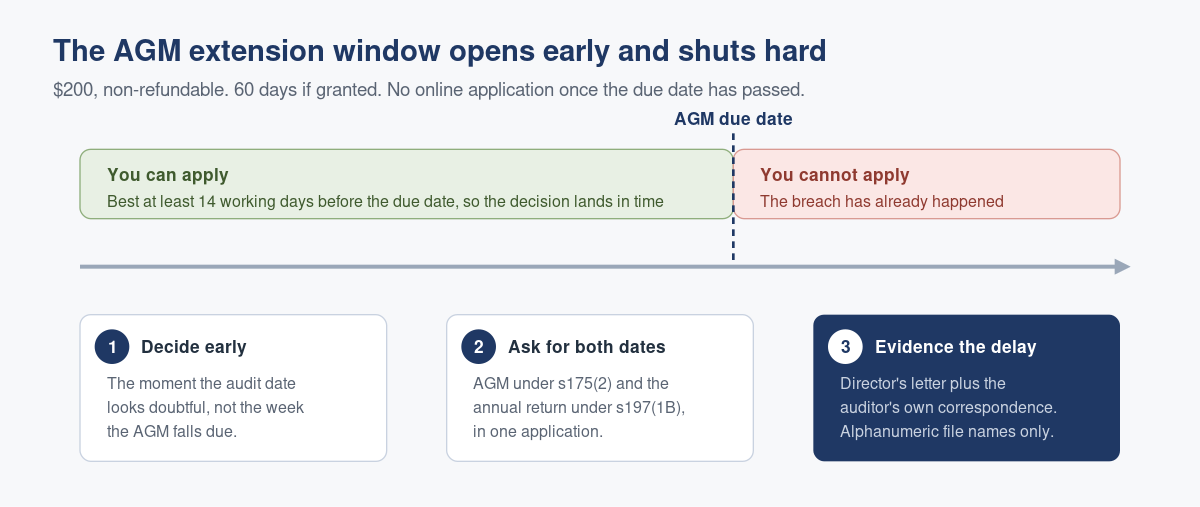
If your company cannot hold its AGM by the due date, you can apply to ACRA for a 60-day extension. The application is made through Bizfile, the fee is $200 and it is not refundable, and you must apply before the due date passes. Once the date has gone, the online application closes and the extension is no longer available to you.
Raffles Corporate Services works with a panel of experienced Singapore law firms who offer cost-effective and efficient legal service and advice. This article is general information only and is not legal advice.
That last point is the whole article in one sentence. The extension is not a remedy for a missed deadline. It is a decision you have to make while the deadline is still ahead of you, at a point when you probably still believe the audit will come in on time.
Here is when to apply, what ACRA wants to see, and what happens if you leave it too late.
Where the power to extend comes from
Section 175(1) of the Companies Act 1967 fixes the AGM deadline at four months after financial year end for a listed public company and six months for everyone else. Section 175(2) lets the Registrar extend that period, either on an application by the company where the Registrar thinks there are special reasons to do so, or in respect of a prescribed class of companies.
Two things follow from the wording. First, the extension is discretionary. The Registrar decides, and “we were busy” is not a special reason. Second, there is a parallel power in section 197(1B) covering the annual return deadline, which is why the Bizfile application lets you ask for an extension of the AGM date, the annual return date, or both.
Most companies that need one need both. If the AGM moves, the annual return that follows it moves too, and an extension that fixes only half the problem leaves you in breach of the other half.
The timing rule that actually matters
ACRA’s guidance is to apply at least 14 working days before your due date, and applications cannot be submitted online once the due date has passed.
Read those two together and the practical deadline is not your AGM date. It is roughly three working weeks before it.
| What you are planning | The date to work to |
|---|---|
| Holding the AGM itself | Six months after FYE for a non-listed company, four months if listed |
| Submitting the EOT application | At least 14 working days before that due date |
| Receiving the outcome | ACRA indicates up to 14 working days, sometimes longer |
| The hard cut-off for applying online | The due date itself. After that the application cannot be submitted |
The 14 working days is a processing estimate, not a guarantee, and busy periods run longer. Complex applications take longer still. If you submit five days before your due date and the decision comes back after it, you have paid $200 and you are still in breach, because the breach crystallises when the deadline passes rather than when ACRA replies.
What it costs
The fee is $200 per application. It is non-refundable in every case, including where the application is withdrawn, rejected or appealed. A further extension application after the first one also costs $200, on the same non-refundable basis.
That is worth weighing against the alternative. A composition sum for failing to hold an AGM starts at $500 per breach, and a late annual return carries its own separate penalty on top. The extension is usually the cheaper outcome, provided you apply in time for it to do any good.
Who can apply, and what to prepare
A director or the company secretary may file the application. You can also engage a corporate service provider to file it on the company’s behalf, which is the usual arrangement where the corporate secretarial function is outsourced. Only companies that are actually required to hold an AGM can apply, which means a company that has validly dispensed with AGMs has nothing to extend.
Whoever files needs Corppass access to the entity with the right e-Service authorisation. If that has never been set up, sort it out first, because it is not a same-day exercise. Our guides to setting up Corppass for a new company and who should have Bizfile access cover that ground.
Have the following ready before you start:
- The company’s UEN.
- The financial year end date. If the FYE itself needs to change, change it first. Applying for an extension against the wrong FYE creates a mess that is tedious to unwind. See changing your company’s financial year end.
- The reason for the extension, stated plainly.
- Supporting documents in PDF. Typically a director’s letter requesting the extension and explaining the delay, correspondence from the auditor explaining the delay and estimating completion, a director’s letter explaining any auditor change between the FYE date and the annual return due date, and, for listed entities, any comments from the exchange.
One small operational trap: file names must use alphanumeric characters only. No spaces, no full stops beyond the file extension, no symbols such as @, #, $, % or &, and no foreign language characters. A file named ABC Pte Ltd - auditor letter (final).pdf will be rejected by the upload. Rename it to something like auditorletter2026.pdf before you start.
The steps, in order
- Log in to Bizfile as a Business User through Corppass. The login route itself is covered in logging in to Bizfile as a business user.
- Confirm the entity shown on the top menu bar and dashboard is the right one. If you hold positions in several companies, switch profile before you go further.
- Open Manage, then Apply for extension of time.
- Start the transaction and confirm you are applying for the correct company.
- Select the extension of time application that covers AGM and annual return deadlines, then state whether the company is listed on the exchange.
- Under type of extension, choose whether the extension is for holding the AGM, for filing the annual return, or for both. Choose both if both dates are at risk.
- Upload the supporting documents, check every field, then submit and pay.
- Download the receipt from the acknowledgement screen.
- Watch your Bizfile inbox. You will get a notification confirming the application was submitted, and a second notification once the outcome is decided.
The outcome arrives by email and in the Bizfile inbox rather than by post, so make sure the email address on the entity record is one somebody actually reads.
Asking for a second extension
You can apply again if the first 60 days is not enough. ACRA is unlikely to grant a further extension unless the supporting reasons are strong, and the same conditions apply: $200, non-refundable, and the application must be submitted before your current due date, which by then is the extended one.
A second application that rests on the same explanation as the first is a weak application. If the auditor was the reason the first time and nothing has changed, the sensible reading is that the company did not manage the problem after it was given more time. Where you genuinely need a second extension, make the letter specific: what changed, what has been done since, and a defensible completion date.
What goes wrong in practice
The application goes in too late. This is the most common failure by a wide margin. The audit is “nearly done” at month five, the company holds off applying because it expects to make the date, and by the time it accepts it will not, the window has closed. Apply the moment the date looks doubtful. A $200 fee spent on an extension you did not end up needing is cheaper than a composition sum.
Only the AGM date is extended. The company gets its 60 days for the meeting, holds it, and then discovers the annual return deadline never moved. Two deadlines, two extensions, one application if you tick both.
The supporting letter says nothing. “The accounts are not ready” is not a special reason, it is a restatement of the problem. The letter that works explains what caused the delay, what the company has done about it, and when the audit will finish, ideally corroborated by the auditor’s own correspondence.
Nobody checks the Bizfile inbox. The outcome sits unread, the company assumes the extension was granted, and acts on an approval that never came. Check the inbox, and keep the notification with the statutory records. Our note on the first fifteen minutes in Bizfile covers where those notifications live.
If the date has already passed, the extension route is closed and the question becomes one of exposure rather than prevention. That is covered in what happens if you miss your AGM.
Frequently asked questions
How long an extension will ACRA give for an AGM?
Sixty days. The application is for a 60-day extension of the deadline set by section 175 of the Companies Act 1967. If 60 days is not enough you may apply again before the extended deadline, but ACRA is unlikely to grant a second extension without strong supporting reasons.
Can I apply after my AGM due date has passed?
No. The online application cannot be submitted once the due date has gone. At that point the company is already in breach, and the matter moves from an extension question to an enforcement question. Apply at least 14 working days before the due date.
How much does an AGM extension cost?
$200 per application. The fee is non-refundable in all circumstances, including where the application is withdrawn, rejected or appealed. A further extension application costs another $200 on the same terms.
Does an AGM extension also extend my annual return deadline?
Only if you ask for it. The Bizfile application lets you select an extension for the AGM, for the annual return, or for both. Most companies that need one need both, because the annual return deadline sits one month after the AGM deadline.
Who can file the application?
A director or the company secretary, or a corporate service provider engaged to file on the company’s behalf. Whoever files needs Corppass access to the entity with the appropriate e-Service authorisation, so check that before the deadline approaches rather than on the day.
Getting ahead of the date instead
An extension application is a sign that something upstream slipped. Usually it is the audit, and usually the slip was visible two months before anyone acted on it.
Raffles Corporate Services tracks AGM and annual return deadlines for several hundred Singapore companies, flags at-risk dates while an extension is still available, and files the application with supporting documents that actually address the Registrar’s test. If your AGM date is close and your accounts are not, talk to us now rather than after the date.
You can reach us through Raffles Corporate Services, or read more on Singapore corporate secretarial practice at Singapore Secretary Services. The statutory power to extend is at section 175(2) on Singapore Statutes Online, and ACRA’s own page on applying for an extension of time sets out the current fee and processing position.
— The Editorial Team, Raffles Corporate Services
Need help with corporate secretarial or compliance matters?
If you would like help with your company's corporate secretarial, governance or compliance requirements, email [email protected] or WhatsApp +65 8501 7133.
Our team can assist with corporate secretarial, accounting and tax matters. Where legal advice is needed, advisers from our associated law firms can assist.