

Your private RORC is a real register that you keep yourself, either at your registered office or at your corporate service provider’s office, and it is separate from anything you file with ACRA. If an ACRA officer asked to see it this afternoon, you would have to produce it.
Raffles Corporate Services works with a panel of experienced Singapore law firms who offer cost-effective and efficient legal service and advice. This article is general information only and is not legal advice.
Filing your controller information through Bizfile does not discharge the obligation to keep the register. Section 386AF of the Companies Act 1967 requires the entity to keep a register of its registrable controllers in the prescribed form and at the prescribed place, and section 386AM gives the Registrar the power to turn up and inspect it.
This article is about that register: what it contains, where it must sit, who does not have to keep one, and the housekeeping that keeps it defensible. For the deadlines and notice cycle, see how to file your RORC and keep it current. For what ACRA holds centrally, see the central RORC and who can see it.
What the private RORC actually is
A register of registrable controllers is a private record of the people and entities that beneficially own or control your business, whether or not their names appear on the public record. It has been a requirement since 31 March 2017.
Three entity types must keep one: companies, whether private or public, foreign companies registered in Singapore, and limited liability partnerships. The obligation does not pause because the entity is dormant, and it does not pause because the entity is being struck off, wound up, placed in receivership or put under judicial management. It runs until the entity itself is gone.
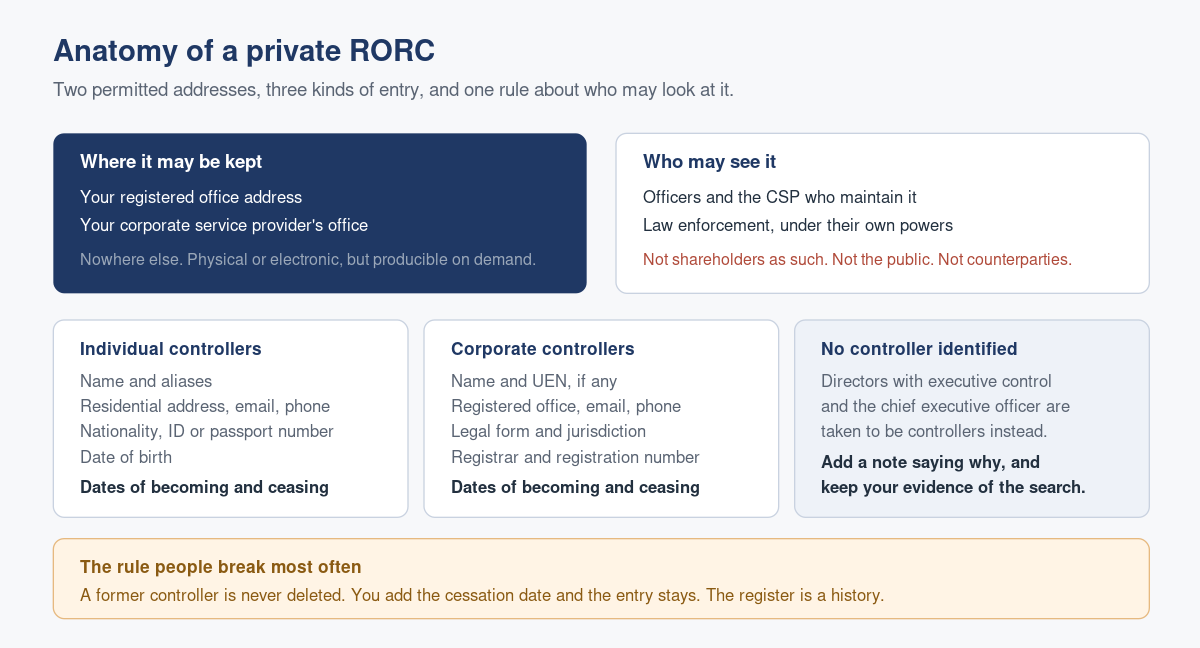
The register is private in a strict sense. Under section 386AF(11) you must not disclose it or make it available for inspection to any member of the public, and that expressly includes your own members acting as members. A shareholder who is not also an officer has no right to see it.
When you have to set it up
The set-up deadline depends on when the entity came into existence.
| Your situation | When the register must exist |
|---|---|
| Incorporated or registered from 16 June 2025 | On the day of incorporation or registration |
| Incorporated between 31 March 2017 and 15 June 2025 | Within 30 days of incorporation or registration |
| Incorporated before 31 March 2017 | Within 60 days of 31 March 2017 |
| Previously exempt, exemption has now ended | Within 60 days of the obligation applying |
The last row is the one that catches people. A company listed on an approved exchange in Singapore is exempt. Delist it, and a 60-day clock starts on a register the company has never had to keep. The same applies to any entity that loses its exempt characteristic.
For entities registered from 16 June 2025, the controller details are collected as part of the registration itself, so the register and the first central filing happen on day one.
Who does not have to keep one
Exemption is a function of what the entity is, not how small or quiet it is. The categories sit in the Fourteenth and Fifteenth Schedules to the Companies Act 1967 and the Sixth Schedule to the Limited Liability Partnerships Act 2005.
Local companies
A Singapore company is exempt if it is a public company listed on an approved exchange in Singapore, a Singapore financial institution, wholly owned by the Singapore government or by a statutory body established for a public purpose, or a wholly owned subsidiary of any of those. A company listed on a securities exchange outside Singapore can also be exempt where that exchange imposes regulatory disclosure and adequate beneficial ownership transparency requirements by rule, law or other enforceable means.
Foreign companies and LLPs
A registered foreign company is exempt if it is a Singapore financial institution, a wholly owned subsidiary of a foreign company that is a Singapore financial institution, listed on a qualifying overseas securities exchange, or primary listed on an approved exchange in Singapore.
An LLP is exempt if it is a Singapore financial institution, or if every partner is itself an exempt company or exempt foreign company.
Exempt is not the same as ignored
If you are exempt you still have two things to do. You must inform ACRA of your exemption status through the RORC eService, and you must declare the exemption when you file your annual return or annual declaration. An exempt entity that has never told ACRA it is exempt looks identical, in ACRA’s data, to a non-exempt entity that has never filed.
What goes into the register
Three categories of entry, depending on what you were able to establish.
Individual controllers. Full name, any aliases, residential address, email address, contact number, nationality, identity card or passport number, date of birth, the date they became a controller, and the date they ceased to be one where that applies.
Corporate controllers. Name, unique entity number where there is one, registered office address, email, contact number, legal form, the jurisdiction and law under which it was formed, the registrar concerned, its registration number where one was issued, and the dates of becoming and ceasing to be a controller. Where a foreign corporate controller was never issued a registration number at home, record that as not applicable rather than leaving the field blank.
Individuals with executive control. Where you have taken reasonable steps and still cannot identify a controller, or you have concluded there is none, section 386AFA makes each director with executive control and each chief executive officer a deemed controller. Record the same personal particulars as for an individual controller, plus a note explaining why the section applies, and keep the evidence of the steps you took. ACRA can ask you to show the search was genuine.
Where it lives and what form it takes
The register may be kept physically or electronically. A spreadsheet is acceptable. What matters is that it is complete, dated, and capable of being produced on demand.
It must be kept at one of two addresses: your registered office, or the office of your corporate service provider. Nowhere else. A register living on a director’s personal laptop in another country is not kept at either address, and that is a real risk for founder-run companies with an outsourced registered office.
Where it is held electronically, the Registrar’s inspection power extends to requiring a legible copy and requiring whoever is on the premises to help retrieve it. “It is on a system we cannot access today” is not an answer that holds.
The housekeeping that keeps it defensible
Never delete a former controller. When someone ceases to be a controller you add the cessation date. The entry stays. The register is a history of who controlled the entity and when, and a deleted entry destroys exactly the trail the regime exists to create.
Note the unconfirmed entries. Where a controller has not confirmed their particulars, the entry goes in anyway with a note saying it is unconfirmed. That is the statutory answer to silence, and it is a compliant register.
Keep the notices with the register. The sent notices and the replies are your evidence that the annual cycle ran. ACRA encourages you to attach them when you file centrally, which reduces the chance of being asked for them later.
Reconcile against the register of members once a year. A transfer that took someone from 20% to 30% has made them a controller, and nobody will send you a memo about it. Pulling the register of members at the same time each year is the cheapest control you can run.
Handle the CSP handover deliberately. When you change corporate service provider, the register moves with the engagement. Get it in a readable format, with the notice history, before the old provider’s access ends. Rebuilding an RORC from scratch is unpleasant, as anyone who has been through a register reconstruction will tell you.
What goes wrong in practice
The commonest failure is a register that exists but has not been touched since incorporation. The second is a register kept perfectly and never filed centrally, or filed centrally and never kept. The third is a company that assumed dormancy or an imminent strike off made the whole thing moot.
The consequence is consistent across all three. Section 386AF(12) makes the failure an offence by the company and by every officer in default, each liable on conviction to a fine of up to $25,000. Providing false or misleading information to the Registrar in response to an inspection carries the same exposure under section 386AM.
Nominee arrangements add a further layer, because a nominee shareholder’s register entry tells you nothing about who is behind the shares. If that describes your structure, read our piece on nominee shareholder arrangements and beneficial ownership disclosure alongside this one, and the Corporate Service Providers Act 2024 compliance FAQ for the obligations your CSP carries.
Frequently asked questions
Where must I keep my company’s RORC?
At your registered office address, or at the office of your corporate service provider. Those are the only two permitted locations. The register may be physical or electronic, but it must be capable of being produced to the Registrar on request, in legible form, from one of those addresses.
Can my shareholders ask to see the RORC?
No. A shareholder acting in that capacity is treated as a member of the public for this purpose, and the register must not be disclosed or made available to them. Access is limited to the officers and corporate service providers responsible for maintaining it, and to law enforcement agencies acting under their own powers.
My company is dormant. Do I still need an RORC?
Yes. Dormancy does not exempt an entity, and neither does being in the process of striking off, winding up, receivership or judicial management. The obligation to keep and update the register continues until the entity ceases to exist.
What if I cannot identify any registrable controller?
Take reasonable steps first and document them. If you still cannot identify one, each director with executive control and the chief executive officer are taken to be controllers. Record their particulars with a note explaining why, file the same with ACRA, and retain your evidence of the search.
Do I need to keep a register if my company is exempt?
No, but you must tell ACRA you are exempt through the RORC eService and declare the exemption in your annual return or annual declaration. If your exempt status later ends, you have 60 days from that point to set the register up.
Is a spreadsheet good enough?
Yes, provided it holds every prescribed particular, records the dates of becoming and ceasing to be a controller, carries any unconfirmed notes, and sits at your registered office or your CSP’s office. Format matters far less than completeness and availability.
Keeping it boring
A well-kept RORC is the least interesting document in your company’s file, and that is exactly the objective. It should be complete, current, and retrievable in under a minute.
Raffles Corporate Services maintains statutory registers for several hundred Singapore entities, holds the RORC at our office where clients use our registered address, and reconciles it against the register of members annually. If you are not sure where your register physically is right now, that is the question to start with.
Further reading: the Companies Act 1967 deep-dive FAQ and our guide to what Bizfile can and cannot do. The statutory text sits in Part XIA of the Companies Act 1967. More on Singapore corporate secretarial practice at Singapore Secretary Services.
— The Editorial Team, Raffles Corporate Services
Need help with corporate secretarial or compliance matters?
If you would like help with your company's corporate secretarial, governance or compliance requirements, email [email protected] or WhatsApp +65 8501 7133.
Our team can assist with corporate secretarial, accounting and tax matters. Where legal advice is needed, advisers from our associated law firms can assist.