

Two clocks run on every RORC change. You have seven days to update your company’s own register once a controller tells you something has changed, and two business days after that to file the same change with ACRA. Miss either and the offence carries a fine of up to $25,000.
Raffles Corporate Services works with a panel of experienced Singapore law firms who offer cost-effective and efficient legal service and advice. This article is general information only and is not legal advice.
Most companies get the first RORC right at incorporation and then never touch it again. That is the failure mode. The Register of Registrable Controllers is not a one-off form, it is a standing obligation with an annual verification cycle built into it, and the obligation sits on the company and on every officer in default personally.
This article covers the process end to end: how you find out something has changed, the notice you have to send, what you do when nobody replies, and exactly when each filing is due. If you are still working out what the register is, start with what the Register of Registrable Controllers actually is. If you are working out who belongs in it, read who counts as a registrable controller first.
The cycle in one view
RORC compliance is a loop, not a task. It has four moving parts: identify, notify, record, file.
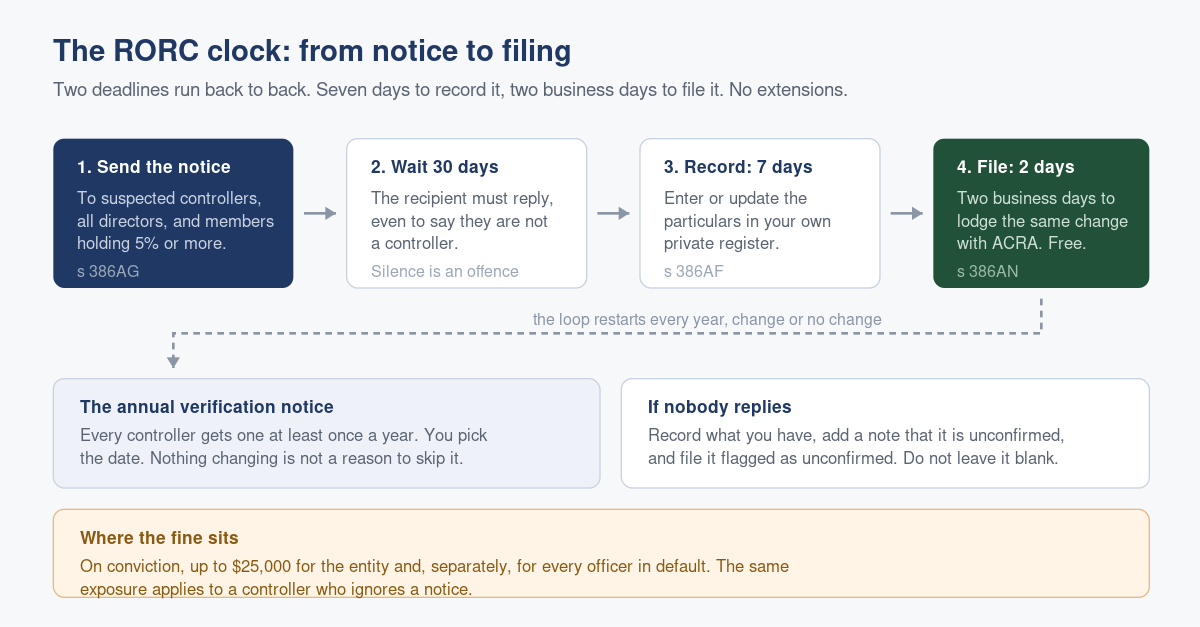
Three things trigger the loop: a change in your controllers, your own discovery that the register is wrong, and the calendar, once a year, whether anything has changed or not.
Step one: the duty to go and look
Section 386AG of the Companies Act 1967 requires a company to take reasonable steps to find out and identify its registrable controllers. That is an active duty, not a passive one. You cannot wait to be told.
Where you know, or have reasonable grounds to believe, that someone is a registrable controller, you must send that person a notice. You must also send a notice to anyone you believe knows the identity of a controller, even if that person is not a controller themselves. In practice, that means writing to all your directors and to every member holding at least 5% of the voting shares. For a limited liability partnership, it means all managers and all partners.
You do not need to send notices at incorporation. You collected the controller information when you registered the entity, so there is nothing to confirm.
What the notice has to ask
A notice under section 386AG must ask the recipient to state whether they are a registrable controller, and to say whether they know of anyone else who is or is likely to be one. It must state the deadline for compliance. ACRA publishes form of notice templates, and there is no reason to draft your own from scratch. Our guide to the five RORC notices explains which one fits which situation.
Thirty days is the response window. The person named in the notice must respond even if the answer is “no, I am not a controller”. Failing to respond is itself an offence, and the fine is up to $25,000 for the recipient, not just for the company.
Step two: the annual verification notice
This is the part companies miss.
Section 386AIA requires you to send a notice to each registrable controller already in your register, at the prescribed frequency, asking them to confirm two things: whether a relevant change has occurred, and whether the particulars you hold are still correct. In practice that is once a year for every controller on the register.
There is no fixed date. You choose it. The only requirement is that each controller receives a notice annually and gets 30 days from the date of the notice to respond. Pick a date you will remember, such as the month of your financial year end.
You still send the annual notice when nothing has changed. And you still send it even if the controller already appears on your Business Profile as a shareholder. The Business Profile is not verification.
If you do not send the annual notices, the company and every officer in default can each be fined up to $25,000. If the controller does not respond, they face the same exposure.
Step three: what happens if nobody answers
Silence does not pause the obligation. If the 30 days run out with no response, you must still update the register, and you must do it within seven days of the end of that 30-day window.
What you record is:
- The most recent particulars you hold for that controller.
- A note stating that the particulars have not been confirmed by the controller.
- The same information filed with ACRA, with the particulars flagged as unconfirmed.
Section 386AF(9) is explicit about this. Where confirmation has not been received, you enter the particulars with a note. An unconfirmed entry is a compliant entry. An empty register is not.
And if you genuinely cannot identify any controller
Section 386AFA covers the case where a company believes it has no registrable controller, or has one but cannot identify them after taking reasonable steps. Each director with executive control and each chief executive officer is then taken to be a registrable controller. You record their particulars, plus a note explaining why the section applies, and you file the same with ACRA.
Keep the evidence of the steps you took. ACRA can ask you to demonstrate that the search was real.
The deadlines, in one table
| Event | Update your own register | File with ACRA’s Central RORC |
|---|---|---|
| Entity incorporated or registered from 16 June 2025 | On the day of incorporation or registration | Same day, as part of the registration filing |
| Entity previously exempt, exemption ends | Within 60 days of the obligation starting | Within two business days of setting up the register |
| Controller notifies you of a change | Within seven days of being told | Within two business days of updating your register |
| Controller does not respond to a notice | Within seven days of the 30-day window closing | Within two business days of updating your register |
| Annual verification confirms no change | No entry required | No filing required |
| You discover an error in the register | On confirmation of the correct particulars | Within two business days |
There is no extension of time for RORC filings. You cannot apply for one. That single fact is why the two-business-day window catches so many companies out: a change notified on a Thursday before a public holiday weekend is still due on the Monday.
Filing with the Central RORC is free and processes immediately, so the cost of compliance is entirely a cost of attention.
What goes wrong in practice
Nobody sends the annual notices. This is the single most common RORC failure we see. The register was set up correctly at incorporation, the shareholding never changed, and everyone reasonably concluded there was nothing to do. But section 386AIA does not condition the notice on a change having occurred. The omission is an offence in its own right, and it surfaces at the worst possible moment, usually when a bank, an acquirer or ACRA asks for the file.
The register is updated and the filing is forgotten. The private register and the Central RORC are two separate obligations under two separate sections. Updating your own register is not filing. A company secretary who amends the register and closes the file has completed half of the requirement.
A director change is filed and the RORC is not. RORC information is held independently of position holder information. If your controller is also a director and changes their residential address, you have two separate filings to make through two separate eServices. Updating one does not update the other.
Past controllers are deleted. When someone ceases to be a controller you record the cessation date, you do not remove the entry. The register is a history, not a snapshot. Deleting the person destroys the audit trail ACRA and law enforcement rely on.
The company is dormant, so nobody bothers. Dormancy is not an exemption. Neither is being in the middle of a striking off, a winding up, a receivership or judicial management. The obligation runs until the entity is gone.
For the practical side of keeping the register itself in order, see our note on setting up and maintaining the private RORC. For what ACRA does with the information once you file it, see the central RORC and who can see it.
Frequently asked questions
How long do I have to file an RORC change with ACRA?
Two business days after you update your private register. The private register itself must be updated within seven days of the controller informing you of the change. Both deadlines are separate obligations and both carry a fine of up to $25,000 on conviction for the entity and for officers in default.
Do I have to send annual notices if nothing has changed?
Yes. The annual verification notice is required regardless of whether anything changed during the year. Each registrable controller must receive one at least once a year and must be given 30 days to respond. Failing to send them is an offence for the company and for every officer in default.
What do I do if a controller ignores my notice?
Update the register anyway, within seven days of the 30-day response window closing. Enter the most recent particulars you hold, add a note recording that they are unconfirmed, and file with ACRA marking the particulars as unconfirmed. Keep a copy of the notice you sent.
Can I get an extension of time for an RORC filing?
No. ACRA does not grant extensions for RORC filings. Late filing exposes the entity and its officers to prosecution and a fine of up to $25,000. Since the filing itself is free and processed immediately, there is nothing to gain by waiting.
Does my corporate service provider file this for me?
A registered corporate service provider can file with the Central RORC on your behalf, as can a director, company secretary, LLP partner or manager, or a group secretary. Delegating the filing does not move the legal obligation: it stays with the entity and its officers.
Is a dormant company exempt from RORC requirements?
No. The requirement applies to dormant entities and to entities in winding up, striking off, receivership or judicial management. Exemption depends on the type of entity, not on its activity level, and exempt entities still have to declare their exemption status to ACRA.
Making the cycle somebody’s job
The RORC is not difficult. It is just easy to forget, and the penalty for forgetting is disproportionate to the effort of remembering. Seven days, two business days, one annual notice per controller: that is the whole discipline.
Raffles Corporate Services runs the notice cycle for the companies we act for, diarises the annual verification against each client’s own calendar, and files both halves of every change inside the window. If you cannot put your hand on the date your last RORC notices went out, that is worth a conversation this week rather than next year.
Related reading on our site includes the Companies Act 1967 deep-dive FAQ, our piece on nominee shareholder arrangements and beneficial ownership disclosure, and the Corporate Service Providers Act 2024 compliance FAQ. The statutory provisions themselves sit in Part XIA of the Companies Act 1967 on Singapore Statutes Online, and ACRA’s own requirements are set out on the ACRA website.
— The Editorial Team, Raffles Corporate Services
Need help with corporate secretarial or compliance matters?
If you would like help with your company's corporate secretarial, governance or compliance requirements, email [email protected] or WhatsApp +65 8501 7133.
Our team can assist with corporate secretarial, accounting and tax matters. Where legal advice is needed, advisers from our associated law firms can assist.