
A Singapore company can be struck off only if it has stopped trading, owes nothing, owns nothing, has no live charges, is not in litigation, is not under regulatory action, and has its directors behind the decision. All seven at once. Fail one and you are in winding up territory instead.
Raffles Corporate Services works with a panel of experienced Singapore law firms who offer cost-effective and efficient legal service and advice. This article is general information only and is not legal advice.
ACRA does not charge for a striking off application and it approves most of them quickly, which creates a false impression that the criteria are soft. They are not. When you file, you are declaring that every one of those conditions is met, and applying without meeting them can amount to a false declaration and lead to investigation and prosecution.
This is part one of three. It covers eligibility only. The mechanics of filing are in striking off a Singapore company: making the application, and what happens between approval and the final gazette is in striking off a Singapore company: what happens after you apply.
What striking off is, in one paragraph
Striking off is the administrative removal of a company’s name from ACRA’s register under Section 344A of the Companies Act 1967. There is no liquidator, no asset realisation and no distribution. ACRA simply stops recognising the company as existing, on the basis that there is nothing left for it to do. That is why the criteria are strict: the process assumes there are no interests left to protect.
Once the final gazette notification is published, the company has been removed from the register and no longer legally exists.
The seven conditions, one at a time
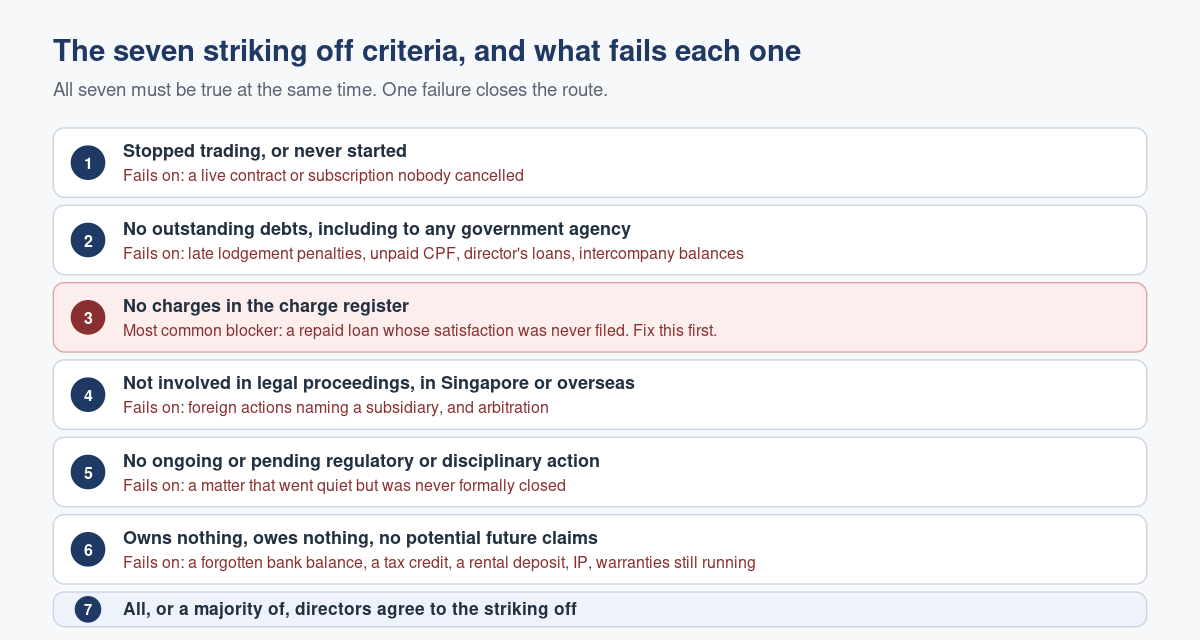
1. The company has stopped trading, or never started
Either it has ceased business, or it has never commenced business since incorporation. Dormant registered companies that were set up and never used are the textbook case.
What trips this up: a company that still has a live commercial contract, a subscription it has not cancelled, or a trading arrangement that has quietly continued while everyone assumed it had ended. Cessation is a matter of fact, not intention.
2. It has no outstanding debts, including to any government agency
Not just trade creditors. This covers every government agency the company deals with, including tax, CPF and any licensing or regulatory body.
What trips this up: an unpaid late lodgement penalty, an unfiled or unpaid tax position, an outstanding CPF contribution for a former employee, an accrued director’s loan that nobody has documented, or an intercompany balance within a group that everybody had mentally written off but never actually released.
3. There are no charges in the charge register
Any registered charge still showing in the company’s charge register disqualifies it, even if the underlying loan was repaid years ago.
What trips this up: this one, more than any other. A facility is repaid, everyone moves on, and nobody files the satisfaction. The charge sits on the public register indefinitely. The fix is to file the satisfaction of charge first, which needs a discharge letter from the lender. Start that early, because reconstructing a discharge letter for an old facility can take weeks.
4. It is not involved in legal proceedings, here or overseas
Any pending or ongoing litigation in Singapore or in another jurisdiction disqualifies the company.
What trips this up: overseas proceedings that the Singapore directors have not been kept informed about, particularly in group structures where a subsidiary is a named party in a foreign action. Also arbitration, which people often do not think of as litigation.
5. It is not subject to regulatory or disciplinary action
Any ongoing or pending regulatory action or disciplinary proceeding rules the company out.
What trips this up: a matter that has gone quiet but has not been formally closed. Quiet is not the same as concluded. If a regulator has opened something and never told you it is finished, assume it is live.
6. It owns nothing, owes nothing, and faces no potential future claims
Zero assets and zero liabilities. Including contingent and potential claims, which is the part people skate over.
What trips this up: a bank balance nobody remembered, a rental or security deposit still lodged with a landlord, an outstanding tax credit, intellectual property registered in the company’s name, a shareholding in a subsidiary, or a warranty or indemnity given in a past sale that has not yet expired. A struck-off company’s assets do not simply pass to its former shareholders, and unwinding that later is far more expensive than dealing with it now.
The tax credit point deserves its own mention: if the company is dissolved while holding a credit, that money is transferred to the Insolvency and Public Trustee’s Office. Former shareholders can go and claim it, but they may have to pay processing fees to do so. Clear it beforehand.
7. The directors agree
All of the directors, or at least a majority of them, must agree to the striking off. Where a corporate service provider files on the company’s behalf, the CSP must be satisfied that a majority of directors have consented before it applies.
What trips this up: a director who is overseas, uncontactable or estranged. Where the company’s foreign owners have gone silent entirely, the position is harder and there is now specific guidance on it, covered in our note on the trapped nominee director’s exit.
The disqualifiers, and what to do about each
| Blocker | What it looks like | The fix before you apply |
|---|---|---|
| Live charge on the register | Repaid bank facility never cleared | Obtain the lender’s discharge letter and file the satisfaction of charge |
| Outstanding tax credit | Refund sitting with IRAS | Claim or apply the credit before dissolution, so it does not pass to the Insolvency Office |
| Unresolved court summons | ACRA summons for a past non-filing | Resolve it fully before applying |
| Stale registered office or company email | Nobody has updated Bizfile since 2019 | Update the company’s information first, so you receive ACRA’s letters |
| Assets still held | Bank balance, deposit, IP, shares in a subsidiary | Distribute or transfer properly, then close the account |
| Directors not aligned | One director uncontactable | Resolve consent, or consider whether winding up is the honest route |
| Pending regulatory matter | Open file with a regulator | Get written confirmation it is closed |
Things to do before you file, not after
Four housekeeping items belong on the pre-application list, because each one causes a failed or delayed strike-off if left until later.
- Update the registered office address and the company email address in Bizfile. ACRA sends striking off letters to the registered office and to the officers’ residential addresses. If those are wrong, you will not see the correspondence, and a strike-off can fail and return the company to “Live” status without anyone noticing for months.
- Check the Bizfile inbox for notices and summonses. A court summons must be resolved before you apply. The notice telling you about it is sitting in the company’s Bizfile notifications.
- Confirm the charge register is empty. Pull it and look, rather than assuming. Our guide to logging in to Bizfile as a business user covers the access side if nobody currently has Corppass rights.
- Prepare the two pieces of information you will need: the company’s unique entity number, and the cessation date of the business if there is one. You do not need to prepare any supporting documents for the application itself.
What goes wrong in practice
The optimistic declaration. The most common failure mode is not fraud. It is a director who genuinely believes the company is clean, because nobody has looked properly. The charge from 2016, the dormant bank account with a few hundred dollars in it, the tax credit. None of that is in anyone’s head, and the declaration gets made anyway. Applying without meeting the criteria can constitute a false declaration and can lead to an investigation.
The company is struck off while still holding an asset. This is the expensive one. The company no longer exists, but the asset is still registered in its name. Recovering it means a Court application to restore the company, which is available within six years of the strike-off but costs real money and takes real time.
The application lapses on endorsement. Where the company has other position holders, all or a majority of the directors must endorse the application within 14 days. Directors who are not watching their Bizfile notifications are the usual cause, and the application simply expires.
An objection lands during the waiting period. Anyone with an interest can object during the process. If an objection is accepted, the company has a limited window to resolve it directly with the objector, and if it is not resolved the application lapses. A forgotten creditor is the classic objector, which is another reason the “owes nothing” criterion has to be tested honestly.
The company stays live and the clock keeps running. If a strike-off fails, the company remains on the register and every compliance obligation resumes as though nothing happened, including annual returns and annual general meetings. Directors who stopped filing on the assumption the company was closing can accumulate late lodgement penalties in the meantime.
Frequently asked questions
Can I strike off a company that has never traded?
Yes. A company that has never commenced business since incorporation meets the first criterion directly. It still has to satisfy all of the others, which is usually straightforward for a genuinely unused shell, provided no bank account was opened and no charge was ever registered.
Do I need to file outstanding annual returns before applying to strike off?
Outstanding annual returns do not by themselves prevent an application, as long as every striking off criterion is met. But if the strike-off fails and the company remains live on the register, all compliance obligations resume and continue to accrue, so this is not a reason to stop filing.
Does a small amount of money in the company bank account matter?
Yes. The criteria require the company to own nothing. Distribute the balance properly, close the account, and then apply. Money left in a dissolved company’s account is not simply available to the former shareholders and recovering it is disproportionately difficult.
What if we cannot reach one of the directors?
The application needs all or a majority of directors to agree and to endorse it. If a majority is achievable without the missing director, you can proceed. If it is not, you need to resolve the director’s position first, or consider whether a different closure route is the honest answer.
How long does the whole thing take once we qualify?
The application itself is approved quickly, immediately in many cases, or within 14 days where endorsements are needed. After approval, the process takes at least three months, running through the striking off letter, the first gazette notification, a 60 day objection window and the final gazette notification.
Can we change our mind after applying?
Yes. A striking off application can be withdrawn through Bizfile at any time before the company is struck off, and there is no fee for withdrawing. ACRA publishes the names of entities that withdraw their applications.
Testing the criteria before you file
The honest eligibility check takes an afternoon. It means pulling the charge register, reading the Bizfile inbox, reconciling the bank account, checking the tax position, and asking every director whether they know of anything outstanding. Almost every failed strike-off we see would have been caught by that afternoon.
Raffles Corporate Services runs that check for companies closing in Singapore, clears the blockers that would otherwise surface at month four, and manages the filing and the endorsement chase through to the final gazette. Where a company does not qualify, we say so at the start.
Continue with part two, making the application, and part three, what happens after you apply. If you are still deciding between routes, start with striking off or winding up. The statutory basis is Section 344A of the Companies Act 1967, and ACRA’s filing channel is set out on its striking off a local company page.
— The Editorial Team, Raffles Corporate Services
Need help with this?
Raffles Corporate Services can handle the ACRA filings, compliance documentation and records for you, and where court proceedings or legal advice are needed, we work with a panel of experienced Singapore law firms who offer cost-effective and efficient legal service and advice.
Email: [email protected]
Call, SMS or WhatsApp: +65 8501 7133