
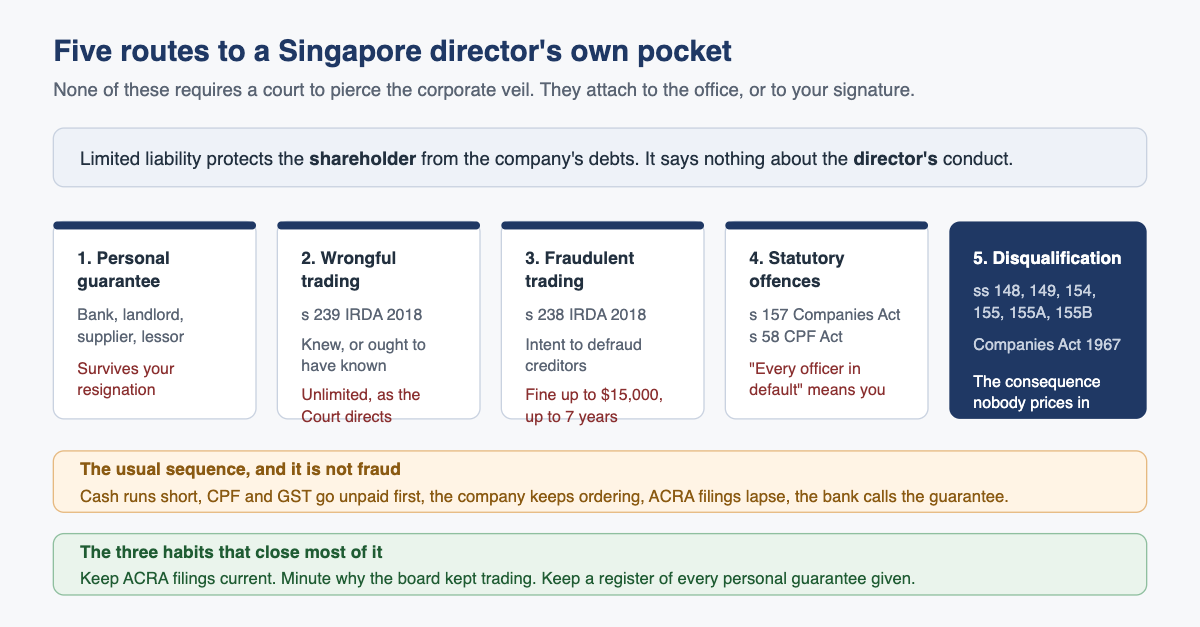
Limited liability protects shareholders from the company’s debts. It does not protect directors from their own conduct. A Singapore director can end up personally liable through five routes: a personal guarantee, a court declaration under the insolvency legislation, a statutory offence, an unpaid statutory contribution, or a disqualification that ends their ability to earn.
Most directors of small Singapore companies believe the opposite. They read “limited” in “Pte Ltd” as a wall between the business and the house. It is a wall, and it holds in the ordinary case, but it has doors in it, and almost every director who walks through one does so without noticing.
This is the last of four parts on directors’ duties. The first three cover your statutory duties, your fiduciary duties, and conflicts of interest and related party transactions. This one covers what happens when you get them wrong.
What the corporate veil actually protects
A company incorporated under the Companies Act 1967 is a separate legal person, and its debts are its own. But the protection belongs to the shareholder, in that capacity. The veil answers the question “whose debt is this?”. It does not answer “who behaved badly?”.
Courts look behind the company only in narrow circumstances, broadly where it is a sham or a façade concealing the true position, or where it is used to evade a legal obligation that already existed. Companies that simply failed are not pierced. So if you are worried about the veil, you are worried about the wrong thing: none of the routes below requires piercing at all.
Personal guarantees: the door most directors walk through
This is the single most common source of personal liability for a Singapore director, and it has nothing to do with company law.
Banks lending to a young private company almost always want the controlling directors to guarantee the facility. So do landlords, equipment lessors, trade suppliers extending credit, and factoring companies. The guarantee is a separate contract between you and the creditor, and the company’s limited liability is irrelevant to it.
Three points that cost people money:
- A guarantee survives your resignation. Only the creditor can release you, in writing, and it will usually want a replacement guarantor first.
- “All monies” wording is not the same as guaranteeing one loan. It covers facilities granted after you signed, including ones you never saw.
- Joint and several means all of it. The bank can pursue the one guarantor with assets for the entire debt and leave that director to chase the others.
Before you sign anything for the company, read it for your own name. If your name appears anywhere other than as signatory for and on behalf of the company, you are giving something personally.
Trading on when the company cannot pay
The Insolvency, Restructuring and Dissolution Act 2018 contains the provisions that most directors of a struggling company should know and almost none do.
Wrongful trading, section 239
Section 239(12) defines it precisely. A company trades wrongfully if, while insolvent, it incurs debts or other liabilities without reasonable prospect of meeting them in full; or if it incurs debts it has no reasonable prospect of meeting in full and which tip it into insolvency.
Where that happened, the Court may declare any person who was a party to it personally responsible, without any limitation of liability, for all or any of the company’s debts. The test in section 239(1) is that you knew the company was trading wrongfully, or, as an officer, ought in all the circumstances to have known. That second limb is the one that bites: “nobody told me” is not an answer for a director. Section 239(6) adds a separate offence carrying a fine of up to $10,000 or up to 3 years’ imprisonment, or both.
Two mercies exist. Under section 239(2) the Court may relieve you wholly or partly if you acted honestly and ought fairly to be excused. And under section 239(10) a company, or a person interested in a proposed transaction, can ask the Court in advance to declare that a course of conduct would not amount to wrongful trading.
Fraudulent trading, section 238
This is the deliberate version: business carried on with intent to defraud creditors, or for any fraudulent purpose. Anyone knowingly a party to it can be declared personally responsible for the company’s debts without limit, and the offence in section 238(4) carries a fine of up to $15,000 or up to 7 years’ imprisonment, or both.
Neither section requires the company to be in liquidation. Nearby, section 237 imposes liability where proper accounting records were not kept, and section 240 lets the Court assess damages against a delinquent officer for misfeasance. Our notes on directors’ duties in the twilight zone, on unfair preference payments and on how a liquidator examines officers go further.
Unpaid CPF and unpaid GST
These two get lumped together in conversation and they work very differently.
CPF. Failing to pay CPF contributions within the prescribed period is an offence under section 58(1)(b) of the Central Provident Fund Act 1953. Where a body corporate commits that offence, a director, manager, secretary or other officer is personally guilty of it if it was committed with their consent or connivance, or is attributable to their neglect. Section 61(2) then sets a fine of not less than $1,000 and not more than $5,000, or up to 6 months’ imprisonment, or both, doubling at both ends for a repeat offender. Note the minimum: this is one of the few places in Singapore corporate compliance where the statute sets a floor rather than a ceiling.
GST. GST arrears are the company’s debt, not yours, and the Comptroller pursues the company. The director’s exposure arises elsewhere. The offence provisions of the Goods and Services Tax Act 1993, including the penalty for an incorrect return and the fraud provisions, catch a person rather than only an entity; and a company funding itself by not remitting collected GST is very likely also trading wrongfully within section 239(12). The GST debt is the symptom; the wrongful trading claim is the liability.
ACRA penalties, composition sums and prosecution
ACRA’s enforcement ladder has three rungs, and directors are named on all three.
Late lodgement penalties. A company filing a required change late pays $50 within three months of the due date and $200 after that, per late transaction. A company that lets four officer changes drift for six months pays four times. See ACRA’s late lodgement penalty schedule.
Composition. Under section 409B the Registrar may compound a prescribed compoundable offence by collecting a sum capped at the lower of half the maximum fine and $20,000. A composition sum is not a fine and not a conviction, but it is paid by whoever is offered it, and where the offence catches “every officer of the company who is in default” that is the director, personally.
Default penalties. Where an offence continues after conviction or composition, section 408 adds a daily default penalty, up to $200 a day where the section states no figure of its own. Small numbers compound quickly across several filings and several companies.
Disqualification: the consequence people forget to price
The fine is rarely the worst outcome. Losing the ability to act as a director is. Six provisions of the Companies Act 1967 do it, and only two of them involve dishonesty.
| Provision, Companies Act 1967 | Trigger | Effect |
|---|---|---|
| Section 148 | Undischarged bankrupt | Cannot act or take part in management without Court permission or the Official Assignee’s written permission |
| Section 149 | Director of an insolvent company whose conduct makes them unfit | Court disqualification order for up to 5 years |
| Section 154 | Conviction of an offence involving fraud or dishonesty punishable with 3 months’ imprisonment or more, among others | Automatic disqualification; the court may also order it on conviction under section 157, or under section 237 or 239 of the IRDA |
| Section 155 | Persistent default in filing, conclusively proved by 3 or more offences or orders within 5 years | 5-year disqualification; acting in breach means a fine up to $10,000 or up to 2 years |
| Section 155A | Director of 3 or more companies struck off within a 5-year period | 3 years from the last striking off, or 5 years if previously disqualified under the section |
| Section 155B | Registrar satisfied the company is in default of a relevant requirement | Debarment of the director or secretary in office at the time, lifted when the default is rectified |
Section 155 is the quiet one. It does not require dishonesty or insolvency. Three filing defaults in five years, and the Act treats persistent default as conclusively proved.
What goes wrong in practice
The pattern is almost always the same, and it is not fraud.
A company runs short. The directors believe a receivable or a funding round will land, so they keep ordering stock, keep taking deposits, and stop paying CPF and GST first because those creditors do not stop supply. Six months later the money has not arrived. By then the company has incurred a further tranche of debts it had no reasonable prospect of meeting, which is the section 239(12) definition almost word for word; the CPF arrears carry an offence with a minimum fine; the ACRA filings have lapsed, starting the section 155 clock; and the bank calls the guarantee. None of that required anybody to pierce the corporate veil.
The other common failure is the dormant directorship. The Act does not recognise a passive director: duties, offences and disqualification attach to the office, not the level of involvement, and someone never formally appointed can still be caught as a shadow director. If you are lending your name to a relative’s company, read our note on nominee director arrangements first.
Frequently asked questions
Can I be made to pay my company’s debts if it goes into liquidation?
Not automatically. Company debts stay with the company. You pay personally only if you guaranteed the debt, or if the Court declares you responsible under section 238 or 239 of the IRDA for fraudulent or wrongful trading, or under section 240 for misfeasance. A liquidator must apply and prove it.
Does resigning as a director stop my liability?
It stops liability for what happens after you go, once the cessation is filed with ACRA. It does nothing about what happened while you were in office, and nothing about a personal guarantee. Section 149 reaches your conduct as a director of a company that went into liquidation within 3 years of your ceasing to be one.
Am I personally liable for my company’s unpaid CPF?
You can be prosecuted personally if the failure to pay was committed with your consent or connivance, or is attributable to your neglect. The penalty under section 61(2) of the CPF Act runs from a minimum of $1,000 to $5,000, or up to 6 months’ imprisonment, or both, and doubles for a repeat offender.
What is the difference between a composition sum and a fine?
A fine follows a conviction in court. A composition sum is paid to the Registrar under section 409B of the Companies Act 1967 to close the matter without proceedings, capped at the lower of half the maximum fine and $20,000. Paying it means no further proceedings for that offence and no conviction recorded.
Can directors be insured or indemnified against this?
Partly. A company cannot validly indemnify a director against every liability, and some indemnities are void. Directors’ and officers’ insurance is useful, but it will not respond to fraud and will never respond to a personal guarantee. See our note on directors’ indemnities and section 172, and our guide to sole director companies.
Keeping the wall intact
Directors do not usually get into trouble by deciding to do something wrong. They get there by not noticing a deadline, not minuting a decision, and not reading the one clause with their own name in it.
Three habits cover most of it. Keep the ACRA filings current, which alone removes sections 155 and 155B and the late lodgement penalties from the board. Minute the reasoning behind every decision to keep trading under pressure. And keep a register of every personal guarantee any director has given, with the creditor, the amount and the release conditions.
Raffles Corporate Services acts as company secretary for several hundred Singapore companies and keeps the filing side of that list closed by default. If you want a clear view of where your personal exposure sits before it matters, that is a short conversation. You can also read more on Singapore corporate secretarial practice at Singapore Secretary Services.
— The Editorial Team, Raffles Corporate Services