
You update a shareholder’s personal particulars through the Update shareholder information eService in Bizfile. It is free and it posts immediately. But it only works for shareholders who hold no position in any live entity, and for Singapore citizens and PRs you should not be filing at all.
That last point catches a lot of companies. A shareholder emails to say she has moved house, someone diligently logs into Bizfile, and either the name is not in the list or the filing duplicates something the Government has already done automatically.
So before you touch the eService, answer one question: who exactly is this shareholder, in ACRA’s eyes?
The routing rule, which is the whole game
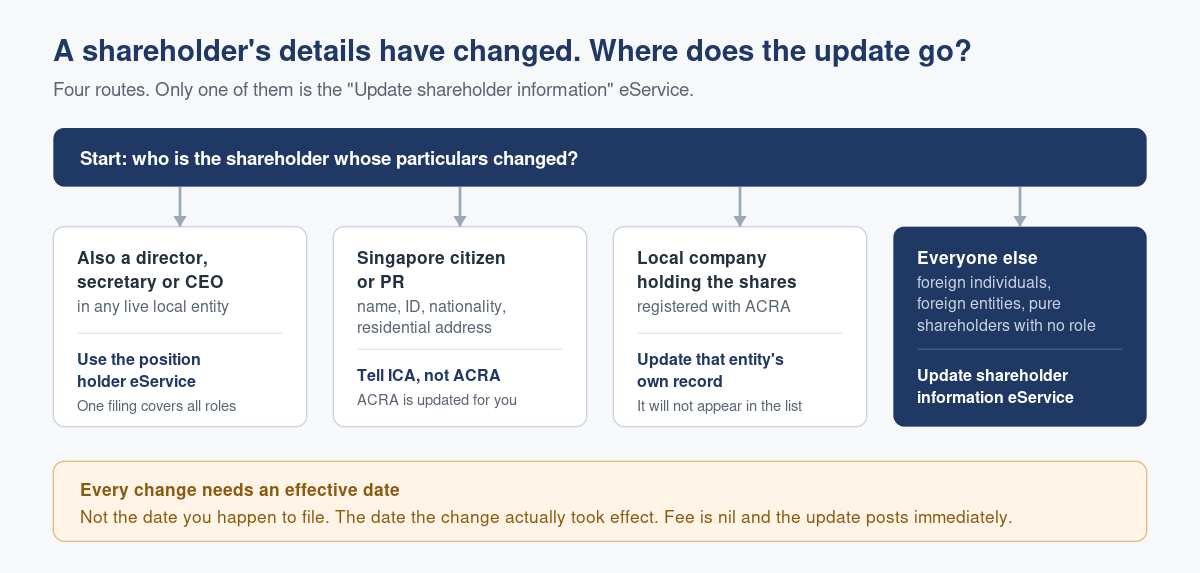
There are four different destinations for a change of shareholder particulars, and only one of them is the eService named after the task.
| If the shareholder is | Where the update belongs | Why |
|---|---|---|
| Also a director, company secretary or CEO of any live local entity | The position holder update eService | Their particulars sit in the officer records, which feed every entity they are attached to |
| A Singapore citizen or permanent resident | The Immigration and Checkpoints Authority, not ACRA | Name, identification type and number, nationality and residential address flow to ACRA automatically once ICA has them |
| A local company registered with ACRA | That company’s own entity record | Corporate shareholders registered locally are not listed in the shareholder update eService at all |
| Anyone else, including foreign individuals and foreign entities | Update shareholder information | This is the residual category the eService is actually built for |
One more boundary worth drawing. This eService changes facts about the person. It does nothing to the shares themselves. If what has actually changed is the shareholding, you are looking at a different filing altogether: see altering share capital under Section 71 or updating paid-up share capital, and note that ACRA groups all of those under shares and updating share information.
The practical test is simple. If the person appears in the dropdown when you open the eService, they belong there. If they do not appear, you are in the wrong place, and the fix is almost never to raise a support ticket. It is to go to the right eService.
The ICA point deserves emphasis
If your shareholder is a Singapore citizen or PR and has changed her name by deed poll, changed her NRIC, changed nationality or moved house, the Immigration and Checkpoints Authority is the only body she needs to tell. ACRA receives the update without anyone filing anything.
That is genuinely useful, and it is also the reason a lot of corporate secretaries have a habit they should drop: chasing local shareholders each year for an address confirmation so they can “update ACRA”. You cannot update it, and you do not need to.
Foreign shareholders are the opposite. Nothing about them updates automatically. If a foreign shareholder moves, renews a passport under a slightly different name, or changes nationality, the only way ACRA learns about it is because you file.
What you can actually change
For a shareholder who does sit in this eService, the fields available depend on what kind of shareholder they are. Broadly, the updatable particulars are:
- Name, supported by evidence such as a deed poll
- Identification type and identification number
- Nationality
- Residential address and contact address
- Contact details, including email and telephone
- Status and date of death, where the shareholder has passed away
Shareholders holding an NRIC who are within scope of the eService typically have a narrower set available, essentially contact address, email address and telephone number, because the identity fields come from the national records rather than from you.
Every change carries its own effective date. This is not the date you happen to file. If a shareholder moved on 3 March 2026 and you file in July, the effective date is 3 March 2026. Getting this wrong is not fatal, but it corrupts the audit trail, and the audit trail is the only reason the register exists.
Who is allowed to file
Three categories of filer can lodge the update: an authorised officer of the company itself, a registered corporate service provider acting for the company, and a group of companies filer where that arrangement is in place.
“Authorised officer” means someone with the right Corppass e-service assignment, not simply someone who is a director. If you have never worked through that mapping, our note on who should have Bizfile access and how to assign Corppass e-service roles covers it, and logging in to Bizfile as a business user covers the mechanics of getting through the door.
If a CSP is filing, they are filing under their own professional obligations as well as yours. Those obligations tightened considerably under the Corporate Service Providers Act 2024, and “the client told me so” is no longer a complete answer to how a CSP verified a particular.
The steps, in order
- Log in to Bizfile as a business user through Corppass. If you are a CSP, switch to your corporate service provider profile and select the right firm before you go further.
- Confirm the entity showing on the top menu bar is the company you mean to file for. This sounds trivial. It is the single most common source of a filing that has to be reversed.
- Open the Update shareholder information eService and choose to start a new transaction, or continue a saved draft if you began one earlier.
- Select the shareholder from the list. If they are not there, stop and re-read the routing table above.
- Edit the particulars that have changed, and enter the effective date for each one. Attach supporting evidence where the change is to a name.
- Check that the shareholder is flagged as pending update before you move on, then proceed to the review page.
- Read the review page properly, tick the declaration and submit.
Fee: nil. Processing: immediate. You will get an acknowledgement on screen and a notification in your Bizfile inbox, and the second one is the copy worth keeping.
When a shareholder dies
You update the shareholder’s status and record the date of death. What you do not do, and cannot do through this eService, is remove them from the company.
The shares are still theirs until they pass to someone. They will continue to show on the company’s profile until the shares are transmitted or transferred out to the executor, administrator or beneficiary. That is a separate filing and usually a separate legal exercise, involving a grant of probate or letters of administration.
This is where families get an unpleasant surprise years later. A founder dies, nobody deals with the estate, the shares sit frozen in a deceased person’s name, and then the company wants to sell, refinance or wind up and discovers it cannot get a clean signature on anything. The death update is five minutes. The transmission is the part that needs attention, and the sooner it starts the cheaper it is.
What goes wrong in practice
The shareholder is missing from the list and someone gives up. Nine times out of ten the shareholder is also an officer, or is a local corporate shareholder. The update still needs doing, just elsewhere. Abandoning it leaves the register wrong.
The wrong company is selected. Filers who act for several entities switch profiles less carefully than they think. Because the update posts immediately, the correction is a second filing, and if the error cannot be fixed by a notice of error you can end up needing a court order to clean it up.
Nobody files for foreign shareholders at all. Local shareholders self-correct through ICA, which quietly trains people to assume updates are automatic. They are not, for anyone else.
The effective date is set to today for convenience. It takes the same ten seconds to enter the correct date, and the register then means something.
The mismatch surfaces at the worst moment. Banks, acquirers, auditors and grant assessors pull the ACRA record, not your internal spreadsheet. A shareholder whose recorded address is three homes out of date, or whose name does not match the passport on the KYC file, stalls a transaction for days. Our note on what to tidy up before restructuring or selling a business covers the wider cleanup, and the Companies Act 1967 deep-dive FAQ covers the statutory background.
A useful habit: after any shareholder update, download the register of members from Bizfile and confirm the change actually landed. It is free. If you have not done that before, start with what Bizfile is and what you can do in it.
Frequently asked questions
Do I need to tell ACRA when a Singapore citizen shareholder moves house?
No. Report the change of residential address to ICA. ACRA is updated automatically from ICA’s records, and the shareholder update eService will not let you change it anyway. The same applies to a change of name, identification type, identification number or nationality for a citizen or PR.
Why is my shareholder not showing in the dropdown?
Because they are either a position holder in the same entity, such as a director or company secretary, or a local corporate shareholder. Position holders are updated through the position holder eService. Local corporate shareholders are updated through their own entity record, and the change flows through to your company.
How much does it cost and how long does it take?
There is no filing fee, and the update takes effect immediately on submission. You will see an acknowledgement on screen and receive a confirmation in your Bizfile inbox. Keep that notification with the supporting document, such as the deed poll, in the company’s records.
What do I file when a shareholder passes away?
Update the shareholder’s status and enter the date of death. The shares remain registered in their name until they are transferred or transmitted out to the estate or beneficiary, which is a separate filing supported by the grant of probate or letters of administration.
Can my corporate secretary do this for me?
Yes. A registered corporate service provider can file on your behalf, as can an authorised officer of the company with the right Corppass e-service assignment. The company remains responsible for the accuracy of what is filed, so supply the supporting documents rather than a verbal instruction.
What if I file the wrong information?
Try a notice of error first. If the error cannot be corrected that way, the remaining route is an application to court for an order to amend the record, which is expensive and slow relative to the two minutes it takes to check the review page before submitting.
Keeping the register true without thinking about it
Shareholder particulars are low-drama until the day they are not. Nobody loses sleep over an out-of-date contact address, right up to the point where a bank’s compliance team asks why the register says one thing and the passport says another.
Raffles Corporate Services maintains statutory registers for several hundred Singapore companies, files particulars changes in the right eService the first time, and reconciles ACRA’s record against the company’s own before every year end. If you are not sure whether your register currently matches reality, that is a short conversation.
You can reach us through Raffles Corporate Services, or read more on Singapore corporate secretarial practice at Singapore Secretary Services.
— The Editorial Team, Raffles Corporate Services