
The central Register of Registrable Controllers is ACRA’s own database of who beneficially owns and controls every Singapore company, registered foreign company and LLP. It is not public, it cannot be bought, and your own shareholders cannot see it. Only officers, corporate service providers and law enforcement agencies can.
That combination surprises people in both directions. Directors worry that filing their controller details makes them searchable by anyone with a credit card, which is wrong. And counterparties sometimes ask a Singapore company to “pull its central RORC entry” as part of due diligence, not realising that no such public product exists.
This piece covers what the central register is, what ends up in it, and precisely who has a route to the data. For the filing cycle and its deadlines, see how to file your RORC and keep it current. For the register you keep yourself, see setting up and keeping your private RORC.
What the central RORC is, in one paragraph
Section 386AN of the Companies Act 1967 empowers the Minister to direct the Registrar to maintain a central register of controllers, and requires entities to lodge with the Registrar every particular contained in their own register of controllers, plus every subsequent update. Central filing has been in place since 30 July 2020. The register consists of the same beneficial ownership information you are already required to keep privately, mirrored into ACRA’s systems so that it exists in one searchable place rather than in several hundred thousand separate offices.
The purpose is investigative. A law enforcement agency looking into money laundering, terrorism financing or tax evasion can establish who is behind a Singapore entity without first having to find and serve the entity itself. That is the entire point of a central register, and it is why Singapore’s position as a financial centre depends on the register being complete.
Who can actually see it
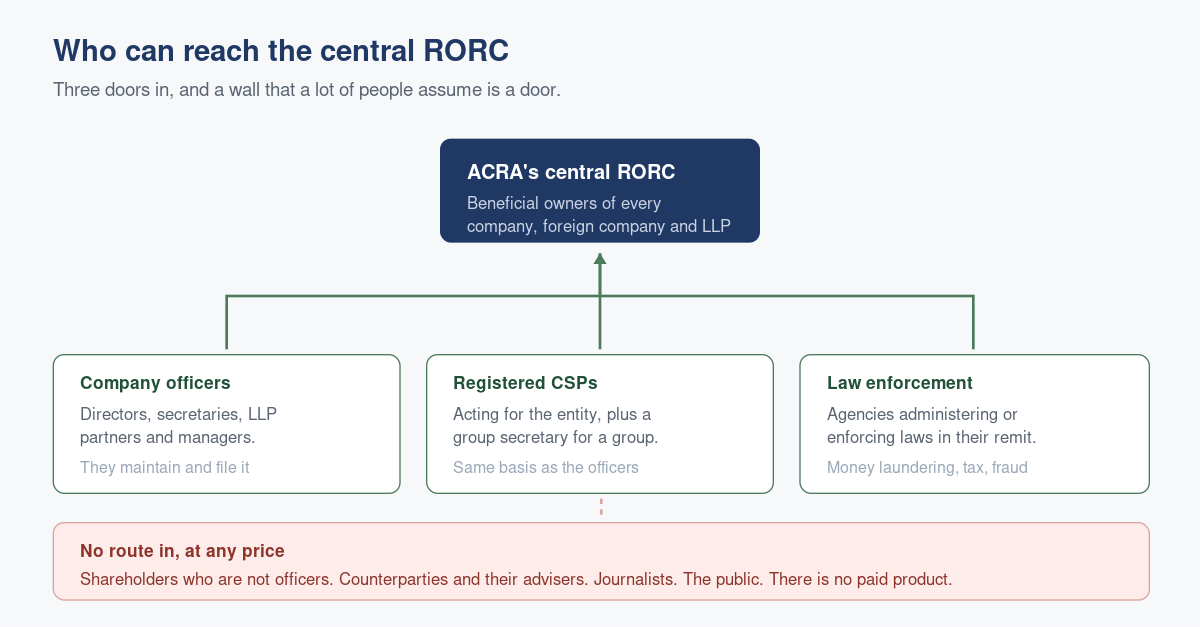
Section 386AN(5) prohibits the Registrar from disclosing the central register, or making it available for inspection, to any member of the public. Subsection (6) allows the Registrar to disclose prescribed information to prescribed persons in prescribed circumstances, which is the statutory hook for controlled law enforcement access.
In practice that produces four tiers.
| Who | Access to the central RORC |
|---|---|
| Company officers, such as directors and secretaries | Yes, for the entity they hold office in, because they are responsible for maintaining and filing it |
| Registered corporate service providers | Yes, for the entities they act for, on the same basis |
| Law enforcement and public agencies | Yes, where needed to administer or enforce laws within their purview |
| Shareholders who are not officers | No |
| Members of the public, journalists, competitors, counterparties | No, and it cannot be purchased |
The fourth row is worth dwelling on. A shareholder with 40% of your company can compel a great deal from you, but they cannot obtain your controller register from ACRA, and you must not hand them your private one either. Section 386AF(11) treats a member acting in that capacity as a member of the public for this purpose.
What has to be lodged
The central filing mirrors the private register. You lodge the particulars of your individual controllers, the particulars of your corporate controllers, and, where you could not identify a controller after taking reasonable steps, the particulars of each director with executive control and the chief executive officer who are treated as controllers in their place.
The individual fields run from full name, aliases, residential address, email and contact number through nationality, identity document number and date of birth, to the dates of becoming and ceasing to be a controller. The corporate fields add legal form, jurisdiction of formation, the registrar concerned and the registration number, where one was ever issued.
You are strongly encouraged to attach the notices or confirmations you received from your controllers. It is not mandatory, but it lets ACRA verify the filing without coming back to you for the underlying documents later. Given how often a request for old notices arrives two years after the person who sent them has left the company, attaching them at the time is cheap insurance.
The filing itself
Filing goes through the RORC update eService in Bizfile. Access is limited to the people responsible for the entity: a director or company secretary, an LLP partner or manager, a registered corporate service provider, or the group secretary of a group of companies. If you have never logged in as a business user, our guide to logging in to Bizfile as a business user is the place to start, and our overview of what Bizfile is covers the surrounding ground.
| What you need to know | Detail |
|---|---|
| Fee | None |
| Processing time | Immediate |
| Extensions of time | Not available |
| Correcting a mistake | Refile the corrected information through the same eService. No notice of error is needed |
| Exempt entities | Declare the exemption through the same eService, and again in the annual return or annual declaration |
Two details catch people out. First, an exempt entity still transacts here: exemption is something you tell ACRA, not something ACRA infers. Second, RORC data sits independently of the rest of your entity record. If a controller is also a director and changes address, that is two filings in two different eServices. Updating the position holder record does not touch the RORC.
What goes wrong in practice
The private register is updated and the central filing never happens. These are separate obligations under separate sections, with separate offences. A company secretary who amends the register and closes the matter has done half the job, and the half that is missing is the half ACRA can see.
The two-business-day window is treated as a guideline. It is not. There is no extension of time for RORC filings, and late filing exposes the entity and every officer in default to prosecution and a fine of up to $25,000 on conviction under section 386AN(4). Because the filing is free and instant, lateness is almost always an attention failure rather than a resourcing one.
Someone assumes the central register is the master copy. It is not. It is a mirror. The obligation to keep the private register at your registered office or your corporate service provider’s office continues regardless of what you have filed, and the Registrar’s inspection power under section 386AM is aimed at the private one.
Due diligence requests get answered with the wrong document. When a bank or an acquirer asks for beneficial ownership confirmation, they are not asking for a central RORC extract, because none exists for them to receive. What they usually want is a director’s confirmation supported by the private register and the shareholding record. Handing over the register itself to a counterparty is a disclosure you are not permitted to make.
A group treats one filing as covering the group. Each entity files for itself. A group secretary can transact for several entities, but there is no group-level RORC and no consolidation. Every subsidiary with its own UEN has its own register and its own filing obligation.
Where nominee structures are involved, the gap between the shareholder on the public record and the controller in the RORC is the whole substance of the exercise. Our pieces on nominee shareholder arrangements and beneficial ownership disclosure and the Corporate Service Providers Act 2024 compliance FAQ deal with that ground directly.
Frequently asked questions
Is the central RORC public in Singapore?
No. The Registrar is prohibited from disclosing the central register of controllers, or making it available for inspection, to any member of the public. It cannot be searched, bought or downloaded as an information product. Access is limited to the entity’s officers and corporate service provider, and to law enforcement agencies acting within their statutory powers.
Can my shareholders see the central RORC?
No. A shareholder who is not also a company officer has no access, either to ACRA’s central register or to the company’s own private register. The statutory position treats a member acting in that capacity as a member of the public for disclosure purposes, so you must not share the register with them on request.
What does it cost to file with the central RORC?
Nothing. Filing through the RORC update eService is free and processes immediately. Because there is no fee and no waiting time, there is no practical reason to delay a filing, and no extension of time is available if you do.
How do I correct a mistake in a central RORC filing?
Open the RORC update eService again, amend the incorrect information and submit. The record updates on submission. You do not need to lodge a separate notice of error, and there is no fee for the correction.
Do I need to file separately if my controller is also a director?
Yes. RORC information is held independently of position holder information. A change of address for someone who is both a controller and a director requires an RORC update and a separate position holder update, filed through two different eServices.
Who in my company is allowed to make the filing?
A director or company secretary, an LLP partner or manager, a registered corporate service provider acting for the entity, or the group secretary of a group of companies. Delegating the filing does not transfer the legal obligation, which remains on the entity and its officers.
Where this usually lands
Most companies never think about the central RORC until something forces them to: a bank refreshing its know-your-customer file, an investor running due diligence, or a compliance review that asks a simple question nobody can answer, namely when the last filing was made.
Raffles Corporate Services files the central RORC for the entities we act for, inside the two-business-day window, and keeps the notices and confirmations with the register so that the answer to “show me the trail” takes minutes rather than weeks. If you are not sure whether your last controller change was ever lodged, we can check the position and put it right.
Further reading: our Companies Act 1967 deep-dive FAQ and our note on restoring statutory registers and records. The statutory provision is section 386AN of the Companies Act 1967 on Singapore Statutes Online, and ACRA’s filing requirements are published on the ACRA website.
— The Editorial Team, Raffles Corporate Services