
Keeping your nominee registers at the office is only half the obligation. Unless your company is exempt, the same information must be lodged with ACRA’s Central Register of Nominee Directors and Central Register of Nominee Shareholders, within two business days of each update to your private registers.
Two business days is the shortest filing window in routine Singapore corporate secretarial practice. It is shorter than the 14 days for officer and shareholder changes, and unlike almost every other ACRA deadline, no extension of time is available. None can be applied for.
This guide covers who files, the deadlines, what happens to the information once it is in, and how to correct a filing that went in wrong.
What the central registers are
Section 386ANA of the Companies Act 1967 requires the Registrar to keep a central register of nominee directors and a central register of nominee shareholders, made up of the particulars held in the registers kept by individual companies. Companies and registered foreign companies must lodge all the particulars in their private ROND and RONS, plus every subsequent update.
These are not public databases. The Registrar is prohibited from disclosing them, or making them available for inspection, to members of the public, subject to the prescribed disclosure powers. Their purpose is to give law enforcement and regulators a single place to look when tracing control and beneficial interest in Singapore entities, rather than writing to companies one at a time.
The obligation to file is co-extensive with the obligation to keep the private registers. If you must keep them, you must file. If your company is exempt, you still have to tell ACRA that it is exempt, through the nominee registers eService, and to declare the exemption when filing your annual return. Our guide to setting up and maintaining your ROND and RONS covers the exemption categories.
The deadlines
Central ROND and RONS filing has been in place since 16 June 2025, introduced by the Companies and Limited Liability Partnerships (Miscellaneous Amendments) Act 2024.
| Situation | Deadline |
|---|---|
| First filing, company incorporated or registered before 16 June 2025 | 31 December 2025 |
| First filing, company incorporated or registered on or after 16 June 2025 | On the day of incorporation or registration, as part of the registration transaction |
| Any later update to the Central ROND or RONS | Within two business days of updating your private register |
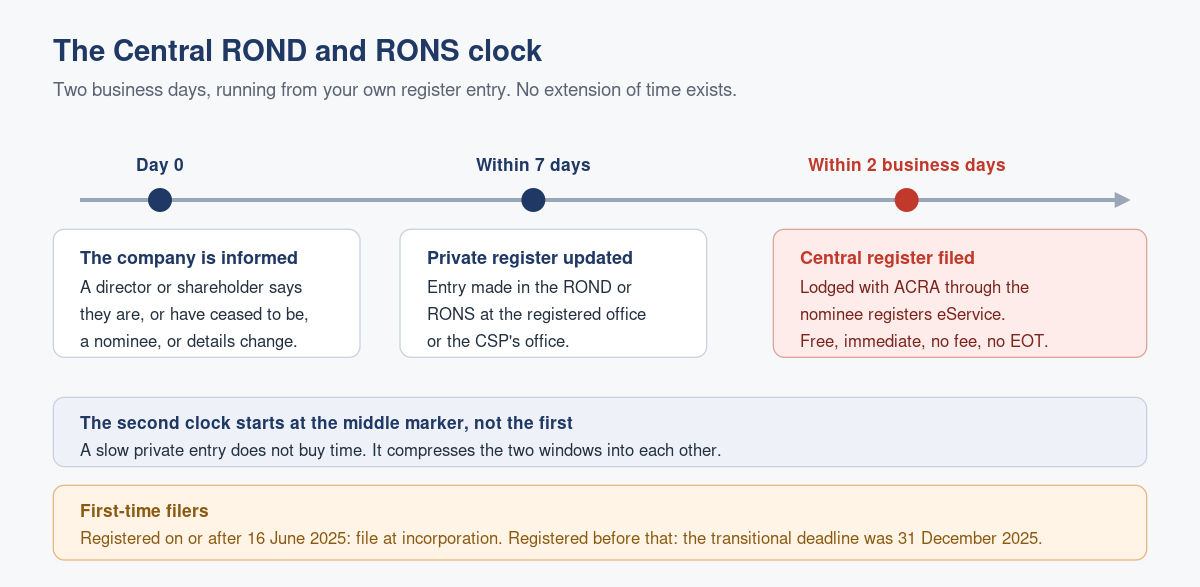
The transitional deadline of 31 December 2025 has passed. A company that was on the register before 16 June 2025 and has never made a central filing is in breach now, not at some future point. The right response is to file immediately rather than to wait for contact from ACRA, because the exposure grows with the delay and the offence is not cured by a later annual return.
The two-business-day clock deserves care. It does not run from the event. It runs from the moment you update the private register, which itself must happen within seven days of the company being informed. Delaying the private entry does not extend the filing deadline in any useful sense: it simply pushes both obligations closer together and increases the chance of missing the second.
There is no extension of time for ROND and RONS filings. Late filing exposes the company, and every officer in default, to prosecution and to a fine not exceeding $25,000 under the relevant provisions of Part 11A.
Who can file, and how
You file through the Update Registers of Nominee Directors and Nominee Shareholders eService in Bizfile, logging in as a Business User through Corppass. Position holders such as directors and company secretaries can file, as can a registered corporate service provider acting for the company.
Before anyone can file, the e-Service must actually be assigned to them in Corppass. This is the step that turns a two-minute filing into a two-week problem, because the assignment is done by the company’s Corppass administrator rather than by ACRA. Our guides to logging in to Bizfile as a business user and to who should have Bizfile access cover that groundwork.
The three transaction types are covered in detail elsewhere in this series:
- Adding a nominator to the Central ROND and RONS, for a new arrangement.
- Editing a nominator in the Central ROND and RONS, when particulars change.
- Ceasing a nominator, when an arrangement ends.
Volume, and how records are structured
You can submit up to 100 nominee arrangements, counting nominee directors and nominee shareholders together, across one or more transactions. A company with more arrangements than that simply runs another transaction through the same eService.
The structure is one record per nomination, not one record per person. If a single nominee acts for three nominators, that is three records, and you select the same nominee three times. If a single nominator stands behind four nominees, that is four records. This is the point at which large group structures take longer than expected, so it is worth counting the records before you begin rather than discovering the shape of the job halfway through.
For a foreign company, ACRA does not hold the member information it holds for a local company, so when you file nominee shareholder details you supply the shareholder’s name yourself rather than selecting it from existing records.
What becomes public, and what does not
This is the question every nominator asks, and the answer is reassuring.
| Information | Public? |
|---|---|
| That a current director is a nominee, shown as “ND” | Yes, in the company’s Business Profile |
| That a current shareholder is a nominee, shown as “NS” | Yes, in the company’s Business Profile |
| The nominator’s name and particulars | No |
| The date of nomination | No |
| Historical or ceased nominee arrangements | No |
| The Central ROND and RONS themselves | No, and members of the public cannot buy them |
Nominee status appears only in the Business Profile, which anyone can purchase. It does not surface through Bizfile’s people search. The marker also disappears in several situations: where the nominee arrangement has ceased, where the director’s appointment has ended, where the shareholder is no longer a member, where the company is exempt, and where the company has no nominees.
The purpose of that narrow disclosure is customer due diligence. A bank or counterparty running checks can see that the person they are dealing with is acting for someone else, without being handed the identity of the person behind them.
Correcting a filing that went in wrong
There is no notice of error procedure for ROND and RONS filings, which is unusual and genuinely helpful. You open the same eService, correct the information and submit. The records update immediately.
One consequence of that design is worth understanding. Because the update is immediate and there is no error-correction paper trail to file, there is also no grace period built into the process. The correction is easy. The deadline it sits behind is not forgiving.
If you see “inactive” beside a nominator’s name in the eService, nothing has gone wrong. It means you previously filed a nomination and have since recorded that the nomination ended. The record stays visible in the system as a historical entry.
What goes wrong in practice
Assuming the company filing covers everything. ROND and RONS information is stored separately from the rest of your company’s records at ACRA. If your nominator is also a director or company secretary, changes to their particulars must be filed through the position holder eService as well. If they are also a shareholder, the shareholder information eService as well. One update does not propagate across the others. Our note on changing a shareholder’s details with ACRA covers that adjacent filing.
Ceasing the appointment but not the nomination. When a nominee director resigns, two separate filings are needed: cease the appointment through the position holder eService, and file the date the nomination ceased through the nominee registers eService. Doing only the first leaves the company’s central register saying the arrangement is live.
Waiting for the annual return. The exemption declaration is made in the annual return, which leads some companies to treat the whole regime as annual. It is not. Every event carries its own seven-day and two-business-day windows. The annual return declaration is a confirmation, not the filing.
Missing the 31 December 2025 transitional deadline and doing nothing. Filing late is better than not filing. The exposure is ongoing.
Discovering the Corppass gap on day two. If nobody at the company has the eService assigned, you will not make a two-business-day deadline. Assign it before you need it.
Frequently asked questions
How long do I have to file an update with the Central ROND or RONS?
Two business days from the date you update your private register, which itself must be updated within seven days of the company being informed of the change. No extension of time is available for ROND and RONS filings, and late filing can lead to prosecution and a fine not exceeding $25,000.
What does it cost to file with the Central ROND and RONS?
Nothing. Adding, editing and ceasing nominator records through the nominee registers eService in Bizfile carries no filing fee, and submissions process immediately. The financial exposure lies entirely in filing late or not at all, rather than in the filing itself.
My company was incorporated before 16 June 2025 and we never filed. What now?
File immediately through the Update Registers of Nominee Directors and Nominee Shareholders eService. The transitional deadline was 31 December 2025, so the company is already in breach, and the position does not improve with time. If the company has no nominees, file the nil declaration rather than assuming nothing is due.
Can members of the public see who my nominator is?
No. The nominator’s identity and particulars, the date of nomination and any ceased arrangements remain private, and the central registers cannot be bought. The only public marker is “ND” or “NS” against a current director’s or shareholder’s name in the company’s Business Profile.
How do I correct a mistake in a ROND or RONS filing?
Open the same eService, log in, amend the incorrect information and submit. Records update immediately, and there is no notice of error to file. That makes correction straightforward, but it does not extend the original deadline you were filing against.
Do I file separately if my nominator is also a director or shareholder?
Yes. ROND and RONS information is held separately from position holder and shareholder information, so a change to a person who wears more than one hat requires a filing in each relevant eService. Updating one does not update the others.
Two days is not long, so build the habit
A two-business-day window only works if the filing is part of the same task as the register update, done by someone who already has the eService assigned and the nominator’s particulars in front of them. Every element of that sentence is a place where companies come unstuck.
Raffles Corporate Services treats the private register entry and the central filing as a single step, keeps the Corppass assignments current so the filing is never blocked at the login screen, and reconciles ROND and RONS positions against the register of members before each year end. If your company has never filed with the central registers, or you are not sure whether it has, that is a quick thing to establish and a quicker thing to fix.
You can reach us through Raffles Corporate Services, or read more on Singapore corporate secretarial practice at Singapore Secretary Services. The statutory basis sits at section 386ANA of the Companies Act 1967, and ACRA sets out the filing requirements on its Central ROND and RONS page.
— The Editorial Team, Raffles Corporate Services