
Every Singapore limited liability partnership must lodge an annual declaration with ACRA stating whether it can pay its debts. One manager makes it, it costs $30, it is filed in Bizfile, and it takes about ten minutes once your entity details are in order.
Raffles Corporate Services works with a panel of experienced Singapore law firms who offer cost-effective and efficient legal service and advice. This article is general information only and is not legal advice.
That is the whole obligation in a sentence. What makes it worth reading further is what happens when an LLP misses it, because the consequence is considerably sharper than the penalty figure suggests.
An LLP has no annual general meeting, no annual return, no audit and no requirement to lodge accounts. The annual declaration is very nearly the only recurring filing the structure has. Precisely because there is so little else in the calendar, it is the one most often forgotten.
What an annual declaration actually is
It is a solvency statement, not a set of accounts.
Section 30(1) of the Limited Liability Partnerships Act 2005 requires every LLP to lodge a declaration by one of its managers that, in that manager’s opinion, the LLP either appears to be able to pay its debts as they become due in the normal course of business, or does not.
Two things follow from the wording, and both matter.
First, it is an opinion, and it belongs to a named individual. Section 30(6) makes it an offence for a manager to declare the LLP solvent without reasonable grounds, punishable in the case of an individual by a fine of up to $5,000 or imprisonment of up to 12 months, or both. What that signature actually commits the manager to is set out in what the manager is really signing.
Second, there is no obligation to declare solvency. The declaration has two honest options. If the LLP cannot pay its debts, you say so. That is uncomfortable, but it is the lawful answer, and it is a great deal safer for the manager than the alternative.
When is an LLP annual declaration due?
The rule is built on fifteen months, not on your financial year end. This trips up accountants who are used to companies.
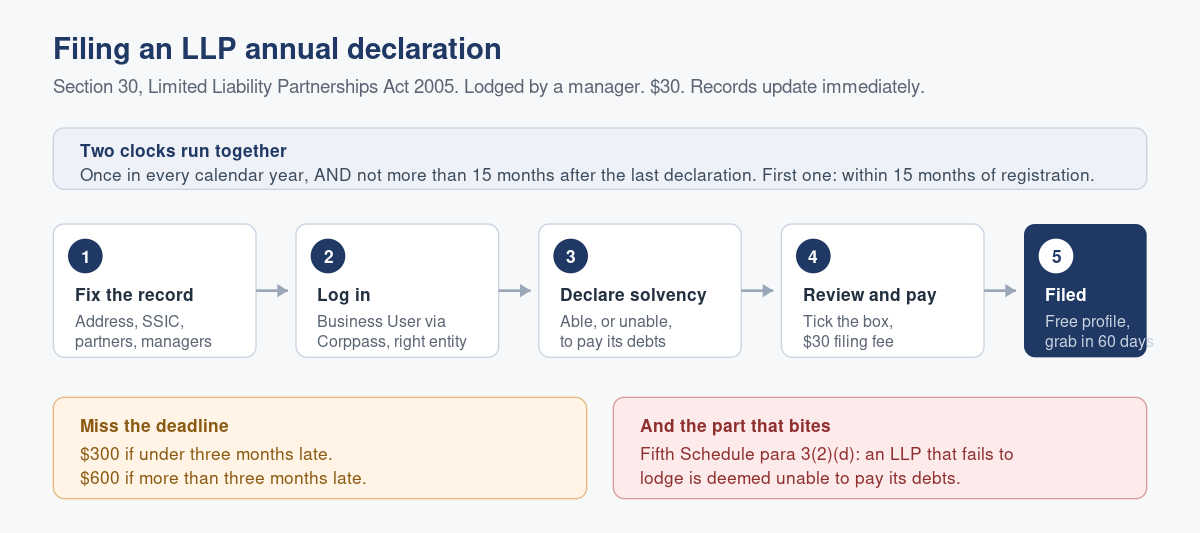
Section 30(3) requires the declaration to be lodged not later than 15 months after the LLP’s registration, and after that once in every calendar year at intervals of not more than 15 months.
| Situation | Deadline |
|---|---|
| First declaration, newly registered LLP | Within 15 months of the registration date |
| Every declaration after that | Once in each calendar year, and no more than 15 months after the previous one |
| Earliest you can file | Up to three months before the deadline |
| Filing fee | $30 |
| Time for ACRA records to update | Immediate on successful payment |
There are two conditions running at once and you have to satisfy both. Filing once in each calendar year is not enough if the gap since your last declaration has crept past fifteen months. A fourteen-month gap is not enough either if it means you skipped a calendar year altogether. We work the arithmetic through properly in the 15-month clock nobody watches.
The safe practice is simple: pick a month, file in that same month every year, and never let the interval drift. You then keep three months of slack for the year something goes wrong.
Who can file it
Two categories of person can lodge the declaration: a manager of the LLP, or a registered corporate service provider acting for it.
Partners who are not managers cannot file. Neither can your bookkeeper, unless they are with a registered CSP and are authorised in Corppass for the entity. If you are relying on an outside firm, check that they are a registered corporate service provider, because the regime tightened considerably under the Corporate Service Providers Act 2024.
Access is through Corppass, as a Business User. If nobody in the LLP has ever set this up, that is the real first step and it is not instantaneous. Our guides on logging in to Bizfile as a business user and on who should hold Bizfile e-service roles cover the setup and the access decisions.
The steps, in order
- Clean up your entity information first. Registered office address, SSIC code, partners and managers. If any of it is wrong, correct it through the update eService before you start the declaration, not during it. Section 34 of the LLP Act 2005 requires changes in partners, managers and other registered particulars to be lodged within 14 days, so any correction you make here may itself be late and may attract its own penalty.
- Log in to Bizfile as a Business User using Corppass, and confirm the entity name showing in the top menu bar is the right one. If you hold positions in several entities, switch profile before you go any further.
- Open the annual filing eService for limited liability partnerships and start a new annual declaration.
- Check the entity information page that Bizfile presents, and proceed to file only when it is accurate.
- Review the declaration dates on screen. For a first filing, the system shows only the deadline, fifteen months from registration, with no previous submission. For an existing LLP it shows the last submission date and the next deadline, both populated automatically.
- Answer the solvency question. Able to pay its debts, or unable. If unable, Bizfile will ask you to select further detail.
- Review, tick the declaration box, and proceed to payment. The fee is $30.
- Pay. Your ACRA record updates immediately on success.
After filing you get a notification in your Bizfile inbox with a link to a free electronic Business Profile. Download it inside 60 days, because the free copy expires after that and you will otherwise have to pay for it. Keep it: it is the cleanest single-page evidence that the filing went through.
What it costs to be late
The late lodgment penalty is a flat charge that steps up once, and it is steeper for annual declarations than for ordinary filings:
| How late | Penalty for a late annual declaration |
|---|---|
| Within three months of the deadline | $300 |
| More than three months after the deadline | $600 |
Bizfile will show you the exact amount payable when you file, and the penalty is collected on top of the $30 fee. ACRA publishes the full schedule on its late lodgment penalties page.
Separately, section 30(5) of the LLP Act 2005 makes failure to lodge within time an offence by the LLP, punishable on conviction by a fine of up to $5,000.
The part nobody tells you: a missed declaration deems your LLP insolvent
This is the genuine risk, and it is buried in a schedule rather than stated on any guidance page.
Section 30(5)(b) of the LLP Act 2005 applies paragraph 3(2)(d) of the Fifth Schedule to an LLP that fails to lodge. That paragraph provides that an LLP which fails to lodge a declaration as required under section 30 is deemed to be unable to pay its debts, and remains so deemed until a solvency declaration under section 30(1)(a) is lodged.
Inability to pay debts is, under paragraph 3(1)(c) of the same Schedule, a ground on which the Court may order the LLP to be wound up. Paragraph 2(1)(b) lets any creditor apply, including a contingent or prospective creditor.
So an LLP that simply forgot to file is not merely carrying a $300 penalty. It is, as a matter of statute, carrying a deemed insolvency that any unpaid creditor can point to. In a dispute with a supplier, a landlord or a former partner, that is a live piece of leverage sitting on the other side of the table.
The cure is the filing itself. Lodge a solvency declaration and the deeming falls away. But it is worth understanding that the exposure is not capped at the penalty, and that it is one of the few compliance failures in Singapore where the statutory consequence is genuinely disproportionate to the effort of avoiding it.
What goes wrong in practice
Nobody owns the date. An LLP typically has two or three working partners and no company secretary. Companies have a secretary whose job includes watching the calendar. LLPs have nobody, unless somebody is appointed to do it.
The manager who signed has left. If your sole manager resigns and the change was never filed, the person with Corppass authority no longer wants to sign and the person who should sign has no access. Fixing the manager record under section 34 first, then filing, is two transactions and possibly two penalties.
Entity details are stale. Address changed three years ago, one partner exited, the SSIC code describes a business you no longer run. Each correction is potentially a late filing in its own right.
The interval quietly slipped. Filed in March one year, June the next, then September. Nothing looks wrong on a calendar-year view, but the fifteen-month interval has been breached and the penalty is already running.
Somebody declared solvency to make the screen go away. The most serious of the four. Section 30(6) puts that on a named individual, with imprisonment available. If the honest answer is that the LLP cannot meet its debts, that is the answer to give, and it should be given with advice.
If you cannot make the deadline
You can apply for an extension of up to 60 days under section 30(4) of the LLP Act 2005, free of charge, but only before the deadline has passed. Once the due date has gone, the extension route is closed and you are into penalty territory. We cover the application, the timing trap and the cost of a further extension in applying for an extension of time for an LLP annual declaration.
Frequently asked questions
Does an LLP have to file accounts or an annual return with ACRA?
No. An LLP does not lodge financial statements or an annual return. The annual declaration of solvency is the recurring ACRA filing. You must still keep accounting records sufficient to explain the LLP’s transactions and financial position, and you still have tax obligations with IRAS.
What is the deadline for a brand new LLP’s first annual declaration?
Fifteen months from the date the LLP was registered, under section 30(3) of the LLP Act 2005. There is no previous declaration to interval from, so Bizfile will show only the deadline. You can begin filing up to three months before that date.
Can a partner who is not a manager file the annual declaration?
No. Only a manager of the LLP, or a registered corporate service provider acting for the LLP, may lodge it. The declaration is an opinion on solvency given by a named manager, so the signing authority cannot be delegated to a partner who does not hold that office.
How much is the penalty for a late LLP annual declaration?
$300 if you file within three months of the deadline, and $600 if you file more than three months late. That is on top of the $30 filing fee. Late lodgment is also an offence by the LLP under section 30(5), carrying a fine of up to $5,000 on conviction.
What if the LLP genuinely cannot pay its debts?
Declare that. Section 30(1)(b) provides for exactly this answer and Bizfile will accept it. Declaring solvency without reasonable grounds is an offence under section 30(6) with imprisonment available. If you are at this point, take advice on the LLP’s position before you file, not after.
Can I file early?
Yes, up to three months before the deadline. Filing early does not shorten your next interval in a way that hurts you, but it does reset the fifteen-month clock from the date you file, so keep a consistent month year to year.
Keeping this off your desk entirely
The annual declaration is a ten-minute job that carries a disproportionate downside if it is missed. That combination is exactly what a compliance calendar is for.
Raffles Corporate Services maintains the ACRA filing calendar for LLPs, companies and registered businesses across Singapore, files inside the deadline rather than at the edge of it, and keeps entity particulars current so that the annual filing is never held up by a three-year-old address change. If you are not certain when your LLP last declared, that is a thirty-second check we are happy to run for you.
You can reach us through Raffles Corporate Services, or read more on Singapore corporate secretarial practice at Singapore Secretary Services.
— The Editorial Team, Raffles Corporate Services
Need help with this?
Raffles Corporate Services can handle the ACRA filings, compliance documentation and records for you, and where court proceedings or legal advice are needed, we work with a panel of experienced Singapore law firms who offer cost-effective and efficient legal service and advice.
Email: [email protected]
Call, SMS or WhatsApp: +65 8501 7133