
The strike off application is free, takes about ten minutes in Bizfile, and needs no supporting documents. It is filed by the directors or by a corporate service provider acting for them, and it lapses automatically if the other directors do not endorse it within 14 days.
Raffles Corporate Services works with a panel of experienced Singapore law firms who offer cost-effective and efficient legal service and advice. This article is general information only and is not legal advice.
That last sentence is where most first attempts die. Not at ACRA’s desk, but quietly, in an inbox, because a co-director never opened the Bizfile notification and the clock ran out.
Part 1 of this series covers whether your company is eligible to be struck off at all. This part assumes you have cleared that hurdle and deals only with the filing: who may sign it, what has to be true on the day you press submit, what the transaction actually asks you, and what causes it to fail. Part 3 covers the three months that follow.
Who is allowed to file the application?
The statutory authority sits with the board. Section 344A(2) of the Companies Act 1967 says the application is made on the company’s behalf by its directors or by a majority of them. Not by a shareholder, not by a creditor, not by the company secretary acting alone.
In practice that translates into two filing routes.
Route one: a company officer files directly
A director or the company secretary logs in to Bizfile as a Business User through Corppass and submits the transaction. If the company has more than one director, the remaining directors then receive a Bizfile notification asking them to endorse.
Endorsement is not a courtesy. Without it, within 14 days, the application lapses and you start again from nothing.
Route two: a corporate service provider files on your behalf
A registered corporate service provider files through its CSP profile in Bizfile. The endorsement step inside Bizfile is not triggered, because the CSP is required to have obtained the consent of the majority of directors before filing, and holds that consent on its own file.
This is the faster route and it is the one we use, but it shifts the evidential burden. The CSP must be able to produce, later, the written consent it relied on. A verbal “yes, go ahead” on a call is not enough if the strike off is later challenged. Obligations of this kind on service providers are set out more fully in our Corporate Service Providers Act 2024 compliance FAQ.
What must be true on the day you submit
You are not filing documents. You are making a declaration. The application asks you to confirm that the company meets every striking off criterion, and a declaration that is not true exposes the person who made it to investigation and prosecution.
Before you submit, walk the following list and confirm each item is true today, not true last quarter.
| Item to confirm | Where to check it | Common failure |
|---|---|---|
| Company has ceased trading or never began | Management accounts, bank statements | A dormant bank account still receiving interest or a rebate |
| No outstanding liabilities to any government agency | IRAS, CPF Board, other regulators | An unfiled tax return or an unpaid CPF contribution for a departed employee |
| No charges registered against the company | Register of charges on Bizfile | A bank facility repaid years ago but never discharged on the register |
| No legal proceedings, in Singapore or abroad | Board knowledge, counsel | A dispute the operating team settled but never formally discontinued |
| No regulatory or disciplinary proceedings, ongoing or pending | Correspondence, licensing bodies | A licence suspension that is still live |
| No assets and no liabilities, including contingent claims | Balance sheet | A property interest, a shareholding in a subsidiary, a warranty that has not expired |
| No unresolved court summons | Bizfile inbox | A summons issued to the company that nobody opened |
| Directors have agreed | Board minutes or written consent | One director who was never actually asked |
Two of these are worth expanding.
Charges are the single most common blocker
A company with a live charge on the register cannot be struck off. Charges do not fall away because the loan was repaid. Somebody has to lodge the satisfaction of the charge with ACRA, and in a company that has wound down its operations, nobody usually does.
Pull the register of charges before you apply. If a discharged facility is still showing, that filing has to be cleared first, and it will need the lender’s cooperation, which takes longer than you think once the relationship manager has moved on.
Outstanding tax credits do not stop you, but they should slow you down
If the company is sitting on a tax credit, deal with it before dissolution rather than after. Once the company no longer exists, an unclaimed credit is no longer the company’s to collect, and recovering it becomes a claim through the Insolvency and Public Trustee’s Office, with processing fees and delay attached. It is a small amount of money that costs a disproportionate amount of effort to get back.
The Bizfile transaction, step by step
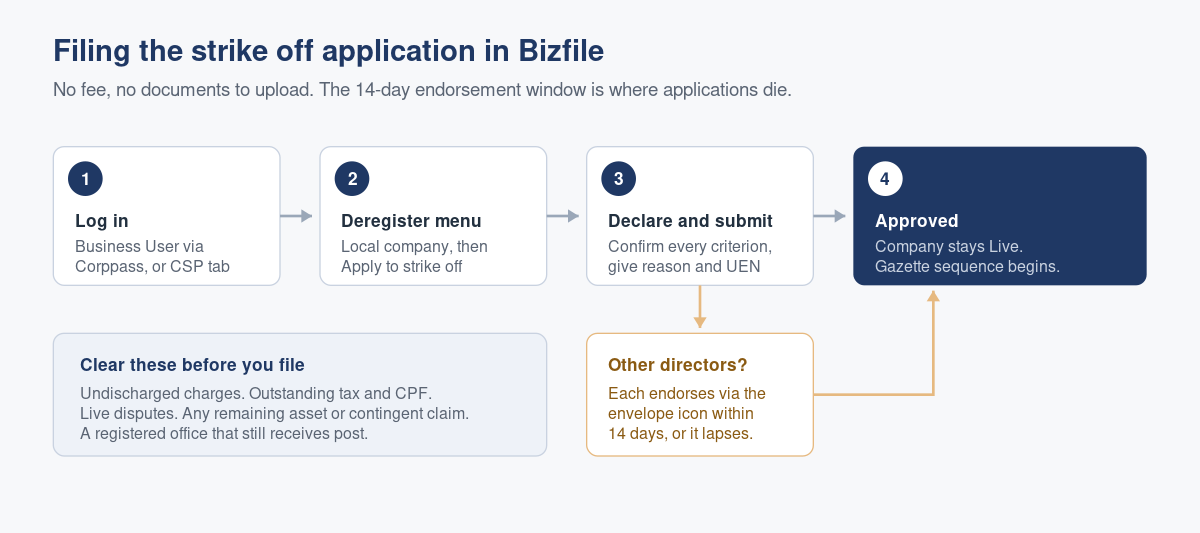
You will need Corppass access to the company with the right e-service assigned. If you have never set that up, that comes first, and our guide to Corppass e-service roles explains which role a filer needs.
- Log in to Bizfile and select Business User. You will be routed through Corppass. If you are filing as a CSP, select the Corporate Service Provider tab on the profile selection page and pick the right firm.
- Check the entity shown in the top menu bar. If you hold positions in several companies, confirm you are in the right dashboard before you go any further. Striking off the wrong entity is not a theoretical risk.
- Open Deregister in the top menu, choose Local company, then Apply to strike off business entity.
- Click Start and verify the company details shown against the company you actually intend to close.
- Confirm that the company meets every striking off criterion. Read this screen properly. It is the declaration.
- Enter the reason for striking off, and the cessation date if the company traded and then stopped.
- Submit. There is no fee.
- If the company has other position holders, each of them opens the envelope icon in their own Bizfile menu and endorses. Watch the 14-day window.
Before you begin, have the company’s UEN and the cessation date to hand, and make sure the registered office address and the company’s registered email address are current. ACRA writes to the registered office and to officers’ residential addresses during the process, and if those letters do not arrive, the strike off can fail on service alone.
What goes wrong, and what it costs
The endorsement window closes. Fourteen days from the application date, and the application lapses if the required directors have not endorsed. There is no penalty, but you lose the elapsed time and you restart the whole three-month sequence. The fix is unglamorous: tell your co-directors the notification is coming, and chase on day three rather than day thirteen.
The registered office is a dead address. Companies that have wound down often let the office lapse or stop collecting post from a former service provider. ACRA’s striking off letters go to that address. Undelivered letters are one of the reasons a strike off fails and the company returns to Live status, still carrying its annual filing obligations. Update the address before you apply, not after.
A director cannot be reached at all. If a co-director is overseas, unresponsive or has effectively abandoned the company, the majority requirement in section 344A(2) becomes a practical problem rather than a legal one. Where a nominee director is the one left holding the company, there is a specific route through this, which we cover in the trapped nominee director’s exit.
The declaration was not accurate. This is the expensive one. Applying while the company still has a contingent liability, an unresolved dispute or an undischarged charge is a false declaration, and the exposure sits with the individuals who made it, not with a company that will shortly cease to exist. If you are unsure whether a claim is really closed, it is not closed.
You picked the wrong exit route entirely. A company with debts it cannot pay should not be applying for strike off at all. That is a winding up, and the directors’ duties shift the moment the company’s solvency is in doubt, as the Park Hotel ruling on duties to creditors makes plain.
Changed your mind?
You can withdraw the application at any time before the name is actually struck off. Section 344B of the Companies Act 1967 gives the applicant that right, the withdrawal is filed through Bizfile, and there is no fee.
ACRA then publishes the fact of the withdrawal, so the company’s name appears on the published list of entities that withdrew their applications. That is public, and anyone doing diligence on the company will find it. It is not a black mark, but be ready to explain it.
Frequently asked questions
Can a shareholder apply to strike off the company?
No. Under section 344A(2) of the Companies Act 1967 the application is made by the directors or a majority of them. A shareholder who wants the company closed has to persuade the board, or appoint directors who will act, or use the winding up route instead.
How much does it cost to apply for striking off?
Nothing. The Bizfile strike off application carries no filing fee, and withdrawing it is also free. Your real costs are elsewhere: clearing outstanding tax filings, discharging registered charges, and the professional time to confirm the company genuinely has no assets and no liabilities.
Do I need to attach accounts or a resolution to the application?
No supporting documents are uploaded. You do still need the board’s agreement, and you should keep the directors’ resolution or written consent on file. If the strike off is ever questioned, that resolution is the evidence that the majority of directors authorised the application.
What happens if one of three directors refuses to endorse?
A majority is enough. With three directors, two endorsements carry the application. If the split is even, or if the objecting director has a substantive reason, resolve that first. Pushing an application through against a director who says the company still has liabilities is how false declaration problems begin.
Can I apply if the company has not filed its annual returns?
Outstanding annual returns do not, by themselves, bar the application, provided the striking off criteria are met. But if the strike off then fails and the company stays Live, those filing obligations are still running and the late lodgement exposure keeps accumulating. Monitor the application through to completion rather than assuming it went through.
How long before the company is actually gone?
At least three months from ACRA’s approval, and longer if anyone objects. The application itself is approved immediately where no endorsement is needed. Everything after that is the gazette sequence, which is covered in part 3.
Closing a company properly is mostly preparation
The filing is ten minutes. The work is the fortnight before it: confirming the charge register is clean, the tax position is settled, the directors have actually consented in writing, and the registered office will still receive post in three months’ time.
Raffles Corporate Services files strike off applications for Singapore companies as a matter of routine, and just as often tells a client that their company is not ready yet and explains what has to happen first. If you are not sure which of those two you are, that is a short conversation.
You can reach us through Raffles Corporate Services, or read more on Singapore corporate secretarial practice at Singapore Secretary Services. The statutory provisions referred to above are on Singapore Statutes Online, and ACRA’s own filing guidance sits on acra.gov.sg.
— The Editorial Team, Raffles Corporate Services
Need help with this?
Raffles Corporate Services can handle the ACRA filings, compliance documentation and records for you, and where court proceedings or legal advice are needed, we work with a panel of experienced Singapore law firms who offer cost-effective and efficient legal service and advice.
Email: [email protected]
Call, SMS or WhatsApp: +65 8501 7133